

In his first season as head coach at his alma mater, Fran McCaffery is taking Penn to the NCAA Tournament as a No. 14 seed...
After a three-game losing streak towards the end of January, Penn was under-.500 both overall (9-10) and in Ivy League games (2-4). From that point forward, though, the Quakers rattled off seven wins in its last eight games to close the regular season with a 16-11 (9-5 Ivy) record that earned the No. 3 seed in a conference tournament that only invites four teams. Its automatic bid hopes took a hit when second-leading-scorer Ethan Roberts was ruled out for the tournament, but Penn persevered.
First, an AJ Levine bucket propelled Penn to an overtime win over Harvard in the semifinals despite trailing by five with under four minutes to play in regulation. It was just Penn's first overtime game of the season, but wouldn't be its last. The very next day, Penn found itself down four with 12 seconds left.
Then, TJ Power put on his cape. Twice.
The first 3-pointer gave him 37. The second gave him 40. Tack on four more in an overtime period that Penn outscored Harvard, 13-9, and Power's 44 points lifted Penn to its first NCAA Tournament appearance since 2018.
Now in the Big Dance, though, let's dive deeper into the Quakers.
What has changed for Penn?
With the Ivy League Tournament included, Penn has now won nine of its last 10 games heading into the NCAA Tournament — with the only loss coming by just four points on the road to Yale. The 9-1 record down the stretch is a stark contract from starting 9-10 (2-4 Ivy), and they have risen all the way from No. 188 on KenPom to begin the stretch to No. 150 upon pushing open the doors to the Big Dance.
Analytically, the Quakers went from playing equivalent to the No. 185 overall team on Hoop Explorer over their first 19 games to playing equivalent to the No. 100 team over the last 10. So what's changed?
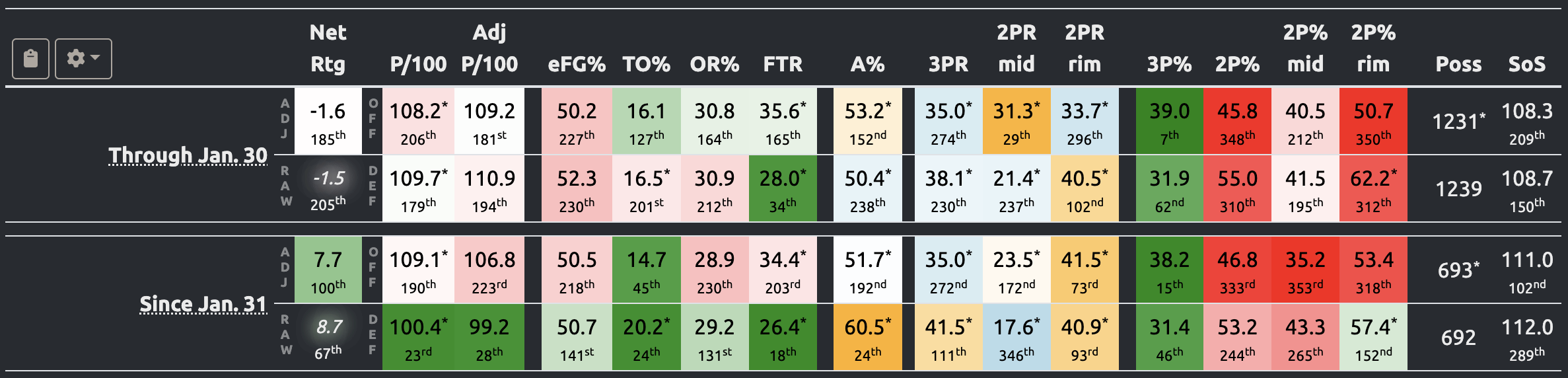
Most notably, Penn has improved on a +0.4% turnover rate margin over its first 19 games margin to a +5.5% margin over its last 10. AJ Levine is a tone-setter with a 4.4% individual steal rate that ranks 16th nationally; he has 10 steals over his last three games and is averaging 2.8 per over the 9-1 stretch. Penn is forcing far more giveaways and thus creating more better opportunities for its offense in tandem.
Penn's adjusted offense is down over the closing stretch due to strength of schedule changes, but its raw efficiency is improved. The defensive numbers are way better with the turnovers sniffing out potential points as well as improved interior defense. The Quakers have gone from averaging 1.5 fewer shots than its opposition through 19 games to 1.4 more over its last 10; they average 5.2 more FTAs per game than their opponents for the season.
Given a first-round matchup with an Illinois team that ranks 10th in turnover rate and top 40 in both rebounding rates poses a lot of problems to keep it up, though.
TJ Power is an explosive scorer.
A former five-star recruit who spent a year each at Duke and Virginia before finding his way to Penn, TJ Power showed out in the Ivy League Tournament final with a career-high 44 points. He stepped up with huge shots with the team down Ethan Roberts, but the performance wasn't an enormous outlier for the season. The 6-9 forward averages a strong yet modest 15.8 points per contest, but had already crossed the 27-point barrier in three other games before the championship against Yale.
Power netted 29 in an early-season win over La Salle, 27 in a road win at Dartmouth, and 38 in a home win over Dartmouth. His combination of shooting ability (77-for-173, 44.5%) and size (6-9) make him a potentially-dangerous scorer in the NCAA Tournament if he catches fire — and he has been on fire. Power has shot 28-for-51 (54.9%) from deep over his last six games, an average of 4.7 makes per contest on ridiculous efficiency.
Power is also a plus rebounder, notching 7.9 per game and securing 8+ in seven straight, but it is his scoring that Penn will need in heavy doses to pull off an upset. If Roberts remains out during the NCAA Tournament, which is expected, the Quakers will need an elite Power outing, plus a lot of help from others. Levine has been strong of late, and four-year Quaker Cam Thrower made big plays in the championship game in Roberts' starting spot.
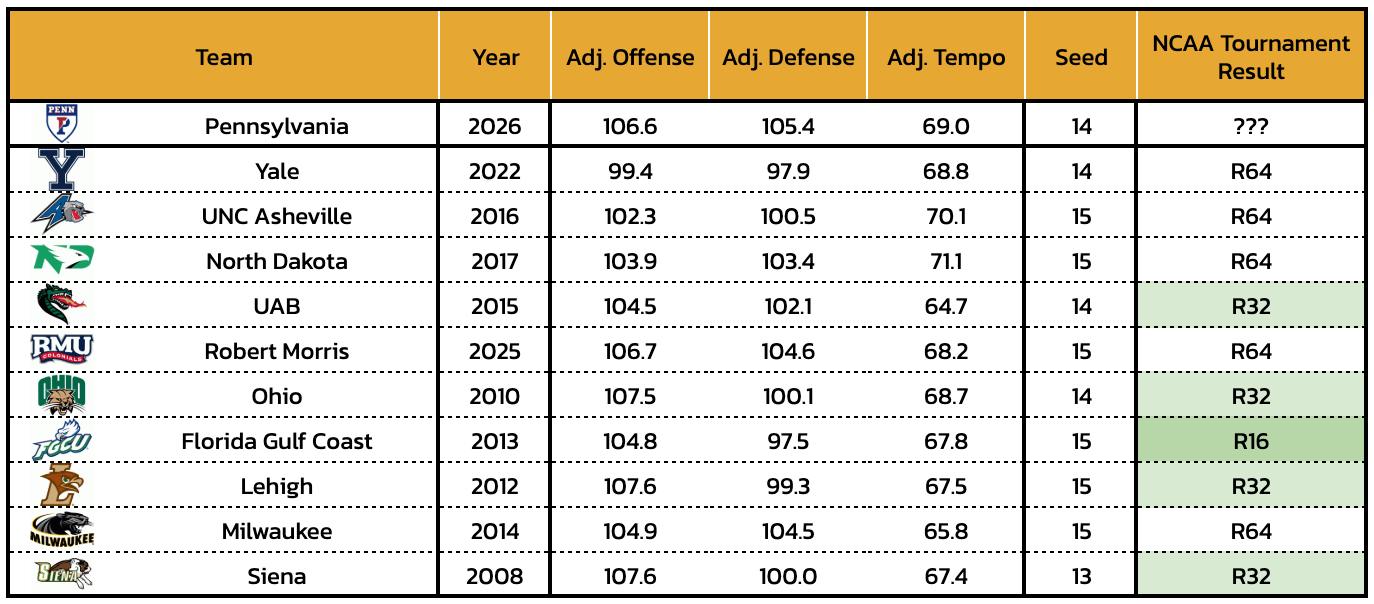
Similar NCAA Tournament efficiency profiles
Tournament Index evaluation
Penn earned a No. 14 seed at the NCAA Tournament. In terms of seed strength, the Tournament Index grades the Quakers as the third-weakest No. 14 seed compared to the last 12 tournament fields. Two others in the bottom eight for No. 14 seed strength still pulled off upsets, though. For Penn, The TI projects an average of 0.12 wins given its seed and team strength.
