


Idaho was only the 7-seed in the Big Sky Tournament following a 9-9 campaign in league play, yet it managed its run to the conference's automatic bid with relative ease. The Vandals won four games in four days with three wins coming by double digits, including their 77-66 victory over Montana in the title game.
Idaho is now heading to the NCAA Tournament for the first time since 1990. It will be the fifth appearance in program history. The Vandals had not posted a winning season since the 2017-18 campaign, which is also the last time they won 21 or more games in a season.
Head coach Alex Pribble's group had shown flashes of this potential during non-conference play. The Vandals opened the season with a win at Washington State, pushed UC San Diego on the road, and were tied with Notre Dame at halftime.
Inconsistencies plagued Idaho in late January and early February, however, as a 2-6 stretch ruined any chance of competing for the regular-season title. While just about all of those games were tight, Idaho was not as good as they had been both on the glass and on the defensive end.
Those things have been trending in the right direction in the eight games since, which is why the run through Starch Madness did not feel fluky.
Idaho's game plan starts on the glass
The Vandals are at their best when they are able to control the rebounding battle. They rank in the top five nationally in defensive rebounding rate, grabbing nearly 76 percent of opponent misses. They simply do not give up many second-chance points or extra possessions.
6-foot-11 center Brody Rowbury is at the center of that, but it's a collective group effort. Seven different players average between 3.3 and 5.2 rebounds per game.
This carries extra importance because Idaho does not force turnovers. It ranks 291st in steal rate and 335th in block rate, opting for structure over pressure. This works as long as they're able to grab those defensive rebounds at the rate they normally do.
Three-point dependency
On the offensive end, Idaho's lack of size outside of Rowbury makes them a much more perimeter-oriented team, and the Vandals play to that. They rank 35th nationally in three-point attempt rate and led the Big Sky in that category.
How often they make those attempts is the biggest indicator of Idaho's chances to win. In their 14 losses this season, the Vandals are just 29.2 percent from long range. In their 21 wins, they are shooting 38.6 percent.
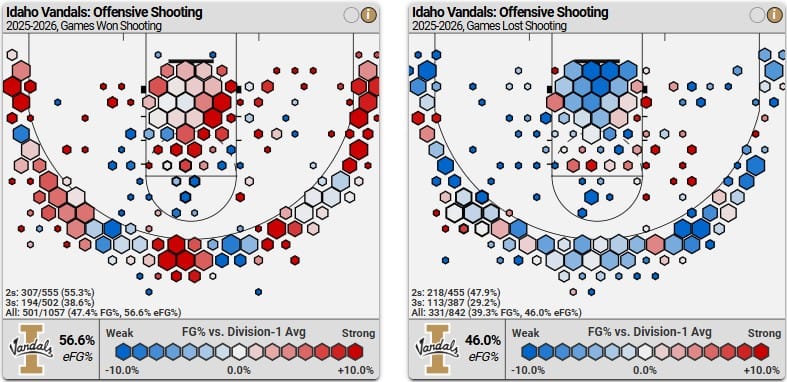
As much as plays into the equation, there is no stronger correlation between Idaho's wins and losses than three-point shooting.
And, much like rebounding is a collective effort for Pribble's squad, so is three-point shooting. Six different players shoot at least 36 percent from long range, led by Isaiah Brickner.
The 6-foot-4 guard is shooting 42.2 percent from deep, and his play in Idaho's title game victory over Montana was a perfect encapsulation of how anyone can step up for the Vandals on any given night. The senior finished with 23 points and 10 rebounds against the Grizzlies, marking his first career double-double in the biggest game of his career.
Balance is key
Along with the plethora of three-point shooting and balance in the rebounding department, Idaho also thrives with a balanced offensive attack. Brickner is one of four players who average over 12 points per game. Jackson Rasmussen leads the way with 13.9, while Kolton Mitchell is right there with him (13.7).
Those three, along with Biko Johnson, have recorded multiple 20-point games this season, showing how any of the four can carry the Vandals on a given night.
Brickner was the star of the title game but, in the semifinal win over Eastern Washington, Mitchell was the one with a monster game (26 points, seven rebounds, three assists). Johnson led the charge with 19 points in a quarterfinal win over Montana State, while Rasmussen had 19 in the first round game against Sacramento State.
That versatility of attack makes it very hard for opponents to gameplan for Idaho, and we just saw how the Vandals can use that to their advantage.
Similar NCAA Tournament efficiency profiles
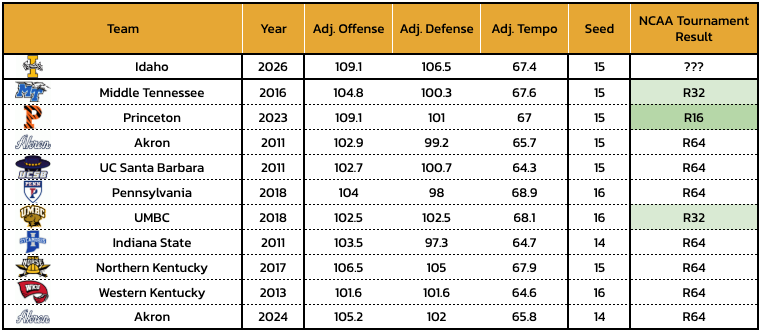
Tournament Index evaluation
As it stands, Idaho is a projected No. 15 seed by our bracketology at Basket Under Review and the Bracket Matrix.
If that comes to fruition, the Tournament Index grades the Vandals are the 11th-weakest No. 15 seed (38th in power rating out of 49 teams) compared to the last 12 NCAA Tournament fields. Should they end up a seed lower, the TI views them as the 13th-strongest No. 16 seed over the same time frame. The TI projects an average of 0.10 wins given its projected seed (No. 15) and strength.