


The Bison are back dancing after missing the tournament last season, winning the MEAC for the third time in four seasons. Howard won both the MEAC Tournament and the league’s regular season, leading the league on both ends of the court on their way to punching their ticket for the dance.
Business Finished 💼
— Howard Men’s Basketball (@HUMensBB) March 15, 2026
On to the field of 6️⃣8️⃣#dreamfactory🦬🔵🔴 #howarduniversity #meacchampions pic.twitter.com/ZkZZiJ5ZvM
This season’s team is the best defensive unit for head coach Kenny Blakeney, who has been in DC with the team for 7 seasons. It’s a remarkable transformation of the program over his tenure. Blakeney joined the university amidst an 18-year streak without a winning season. The 2025-26 team is the fifth straight Bison group with a winning record, going 23-10, the best in Blakeney’s tenure.
Havoc on defense
The Bison have a 100 Defensive Rating this season, good for the 96th percentile in Division I. Their opponents in the MEAC shot 43.9% from the field, the lowest in the conference. On the season, opponents are shooting 42.5% from the field against Howard. Their perimeter defense is also stellar, holding opponents to 30.4% from behind the arc, which ranks 18th-lowest in the country.
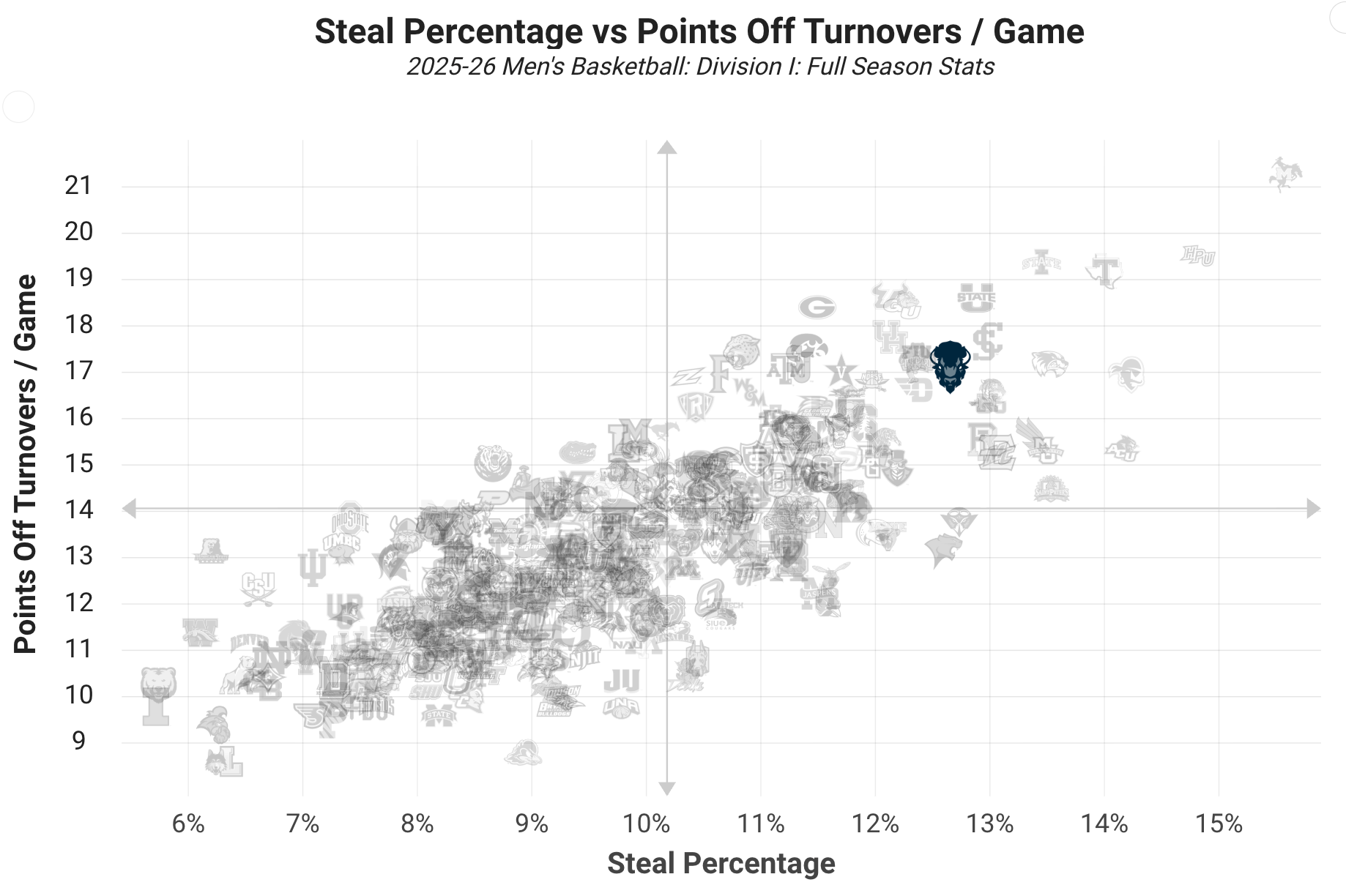
But it’s not just the Bison’s sound shot contesting, they also force plenty of turnovers and havoc guarding on ball and jumping passing lanes. Their 8.7 steals per game rank 27th in Division I, with five players averaging at least 1 steal per game. The turnover creation leads Howard to average 17.1 points off turnovers per game, putting them in the 95th percentile in that category.
Dangerous trio
While the Bison have ups and downs in scoring efficiency, they have three guys who can step up and score at different levels if there are matchups to exploit. The biggest threat to do this is senior MEAC Player of the Year Bryce Harris, who has been with the program for five seasons.
Harris largely operates in the pace but can knock down shots from the midrange or while posted in the corner. He’s averaging 17.1 points to go with 6.9 rebounds and 2.5 assists this season, scoring 20 points or more 11 times this season.
Cam Gillus came to Howard by way of Lehigh in the offseason. He’s a 5-foot-11 point guard shooting 37.4% from deep on 3.7 attempts per game. Gillus is averaging 10.5 points and 4.6 assists per game, with an ability to get downhill and draw fouls. He held an absurd 90.2% free throw rate in Howard’s last five games, averaging 7.4 free throw attempts.
After missing the first 11 games of the season, Cedric Taylor has taken the scoring burden off of Harris and made them a dynamic one-two punch on the offensive end. Taylor averaged 17.1 points and 6.7 rebounds this season, and largely creates spacing for Harris by expanding his shot selection to the midrange and paint jumpers with above-the-break threes. He’s scored 20 points or more in 8 of his 21 games this season.
Weakness: Lack of a real interior
This will be an issue for any low-major team playing in the NCAA tournament, but the Bison play incredibly small because of who they can recruit. They rank 337th in the country for average height on the roster and they play Harris and Taylor in the frontcourt when their height and frame would normally suggest they’d be wings.
This small-ball style helps their steal rate, but it also explains many of the issues they face when playing high-major talent. Northwestern’s Nick Martinelli and Cameron Boozer dropped 32 and 26 points on them in December matchups. In Quad 1 games, Howard’s opponents' two-point shooting balloons from 48.3% to 67.1% while giving up 47 paint points per game. On offense in Quad 1 games, their two-point shooting is 35.3% and they average just 18 points inside.
Similar NCAA Tournament efficiency profiles
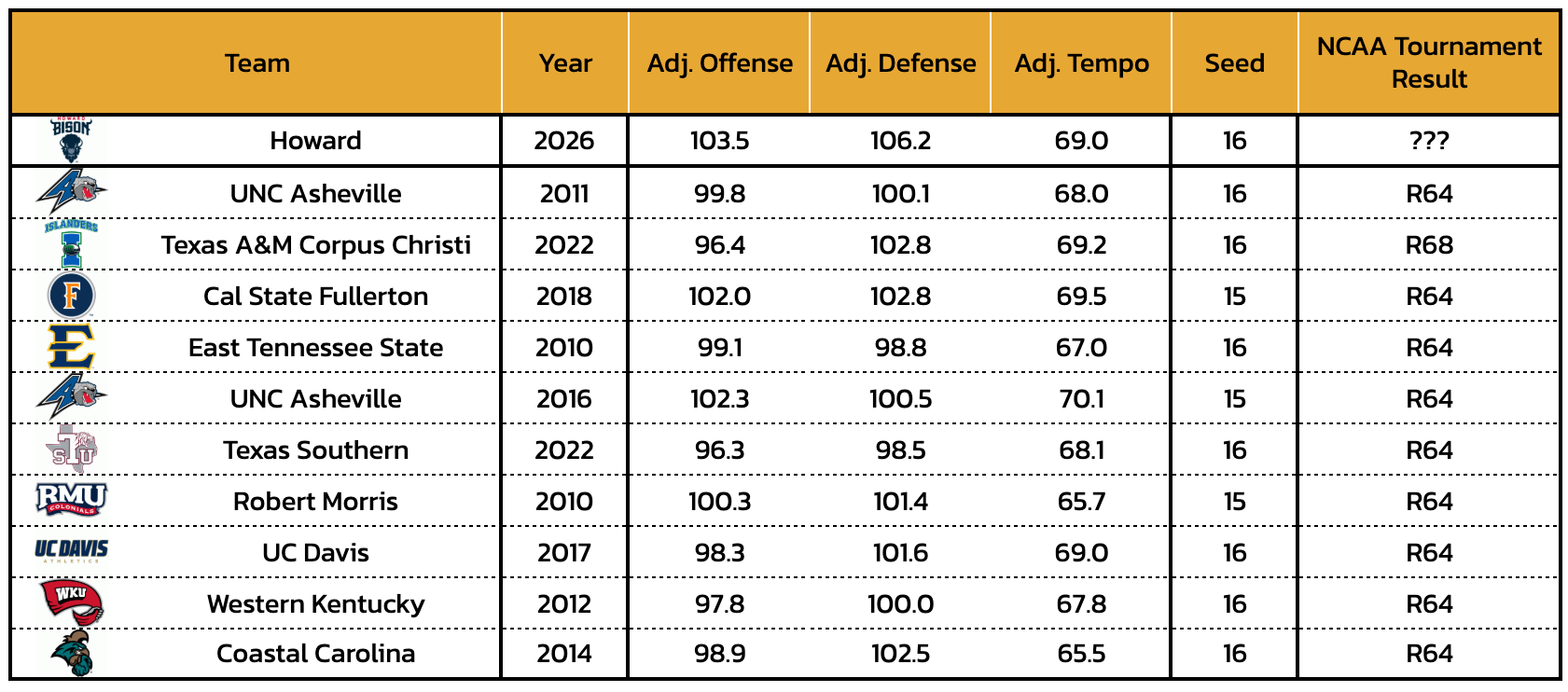
The limited size and interior options make it a tough task for the Bison to upset as a Cinderella. They have a solid chance to get out of the First Four with a win, but arguably the best frontcourt in the nation in Michigan will be as unideal of a matchup as Blakeney's team could ask for.
Tournament Index evaluation
Howard earned a No. 16 seed at the NCAA Tournament. In terms of seed strength, the Tournament Index grades the Bison as the 14th-strongest No. 16 seed of the last 13 tournaments (out of 52 R64 teams), and the strongest of this year's field. For Howard, the TI projects an average of 0.07 wins if it gets out of Dayton.
