


Could it have really ended any other way? Gonzaga takes home the WCC tournament championship for the 23rd time and the 21st under Mark Few in his 27 seasons as head coach. Gonzaga becomes the automatic bid for the WCC in their final postseason before heading to the Pac-12 in the fall. Their 79-68 win on Tuesday night against Santa Clara clinched their 27th straight NCAA tournament appearance, the third-longest active streak in Division I.
The Bulldogs head to the NCAA tournament 30-3, Few’s ninth 30-win team in his career, but their record may not indicate just how challenging a year it’s been in Spokane. While the Zags quickly rose up rankings at the start of the season, leading to a proclamation of “the best regular season game ever” prior to their loss to Michigan in the Players Era Festival, the team’s season was derailed in January when their leading scorer Braden Huff was sidelined with a knee injury that has held him out for the remainder of the team’s season.
Huff and potential All-American Graham Ike were the most dominant front court in the country on offense, leading the Zags to the most paint points per game in the country and the best field goal shooting percentage before Huff’s injury. It maintained Few’s offensive identity as the team leaned further into its defense with the addition of Jalen Warley and Tyon Grant-Foster, who have turned this Gonzaga team into a top-10 defense nationally.
And since the junior forward’s injury, Gonzaga has only leaned further into their defensive identity. In the 15 games that Huff has been out for, they’ve gone from an offensive rating of 125.9 to 118.2, but they’ve maintained one of the best defensive units in the country in terms of opponent shooting and turnover creation.
That defensive strength was tested in the final weeks of the season as their Huff replacement in the starting lineup, Warley, was sidelined with an ongoing thigh contusion that has hindered his play since February 4th. With his limited availability and inefficiency from the stand-and-shoot specialist Steele Venters, what was once a 10-man rotation became a 7-man rotation with sophomore reserve big man Ismaila Diagne playing a couple of minutes to let Ike catch his breath. Again, Gonzaga had to recontextualize their identity to what was available to them.
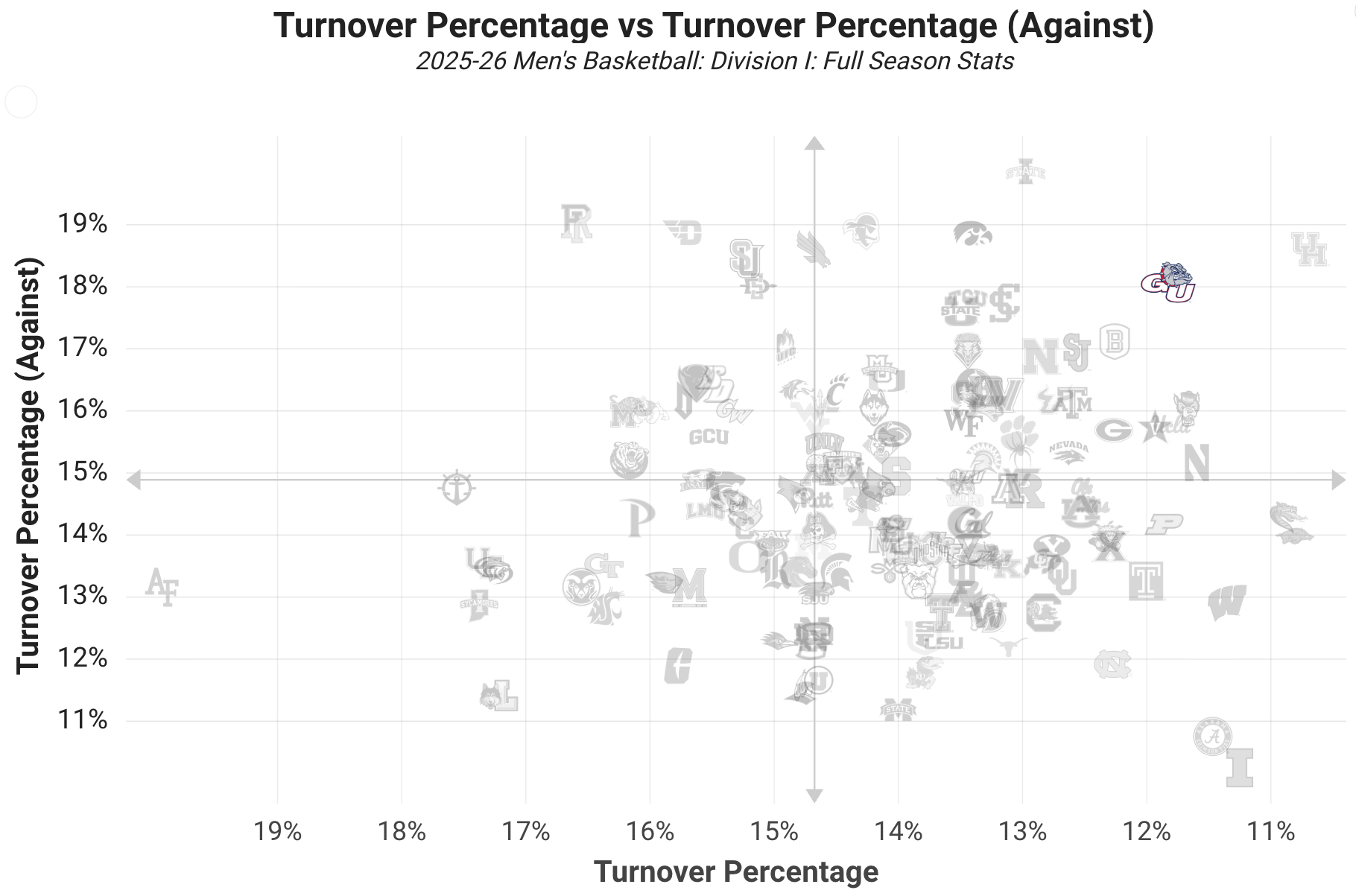
Warley returned to the rotation for the Las Vegas tournament this past week, allowing for Grant-Foster and freshman Davis Fogle to remain focused on wing duties rather than overly aiding the post and returned the Zags to one of the most suffocating two-point defenses in the country, coupled with an offense that takes care of the basketball and maximizes their possession differential. They rank fifth in the country for both assist-to-turnover ratio and turnover margin this season.
Can Graham Ike be the next Drew Timme?
The role that Ike has taken on in Huff’s absence cannot be overstated. He’s remained the high usage monster while expanding his minutes per game from 30 minutes to nearly 35 for the final 15 games of the season. Most impressively, he’s actually held a higher shooting efficiency while putting up more attempts, going from 57.3% field goal shooting on the season to 60.7% this extended final stretch.
As Huff still looks considerably far away from being able to practice with the team, let alone play meaningful minutes, Gonzaga’s offense rests dramatically on the 6-foot-9 senior’s shoulders in a win-or-go-home format. It’s a responsibility that shouldn’t be all too unfamiliar to Gonzaga’s coaches, as it resembles the role of the big that Ike replaced: Drew Timme.
Shooting through 7 career NCAA Tournament games:
— Jared Berson (@JaredBerson) March 18, 2022
Drew Timme: 61-95 (64%)
Kareem Abdul-Jabbar: 61-95 (64%)
Those are the last 2 players to average 20 points per game on that high of a shooting % in their first 7 NCAA Tournament games.
How close Ike gets to Timme’s efficiency and output will decide the length that Gonzaga stays in this tournament. In his 13 NCAA tournament appearances, Timme averaged 23.1 points per game with an effective field goal percentage of 61.3%. In Ike’s 6 tournament games, he’s averaged 17.7 points and an effective field goal percentage of 64.7%.
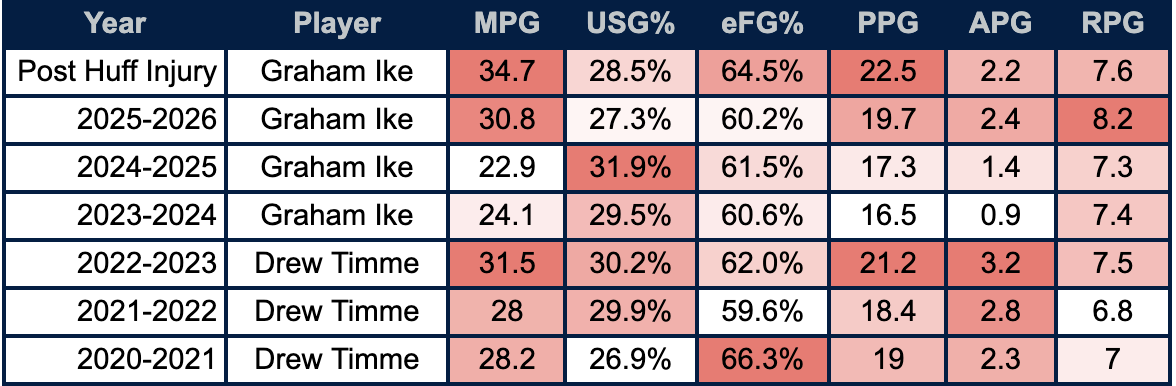
If Gonzaga makes the second weekend for the 10th time in the last 11 tournaments, it will be because their defense remained elite and Ike provided enough offense to circumvent the limitations of no solidified second option or reliable three-point shooting.
Freshmen stepping up
The loss of Huff has become a way to explain away Gonzaga's atypical, non-elite offensive efficiency in the second half of this season. And that’s not to diminish how hard it’s been to replace him as one of just three players in the country who are averaging 17 points and an effective field goal percentage of 65% or higher.
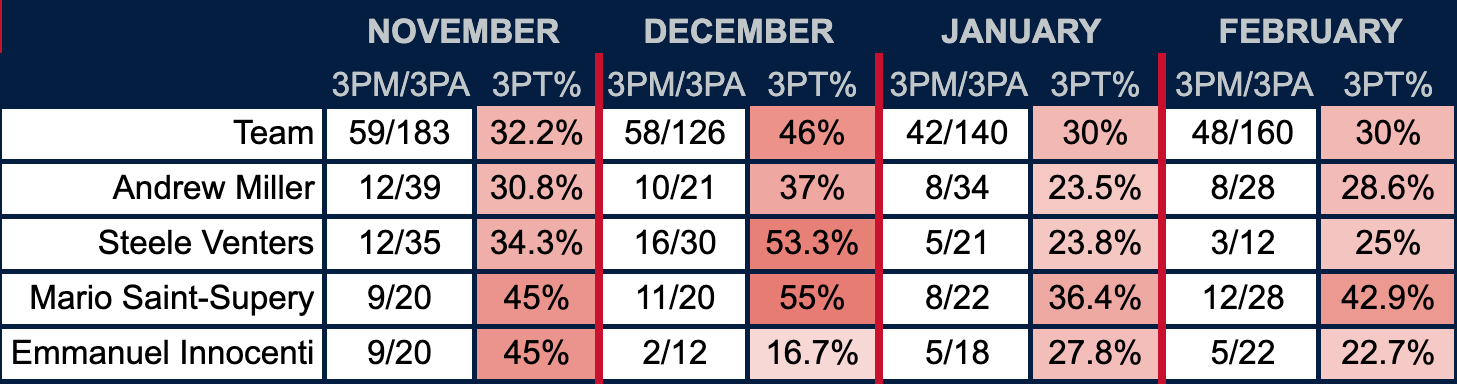
But that masks a major three-point fall-off that, as previously mentioned, took Venters out of the rotation and allowed teams to pack the paint further to try to prevent Ike and the effectiveness of Grant-Foster and Warley’s downhill rim-attacking. The Zags finished 2025 shooting 37.9% from deep. They’re shooting 30.4% from three in 2026.
Few and his staff decided to pun on three-point shooting even beyond their 21st percentile three-point rate at the point of Huff’s injury. They swapped Venters out for freshman Davis Fogle and decided to go fully invested in length and athleticism that harkens to last season’s St. John’s team. Fogle, prior to the Huff injury, saw some limited first-half opportunities because of guys ahead of him being inefficient with their minutes, but he was largely a reserve that shone in garbage time. Since the Huff injury, he’s playing 23.3 minutes per game and averaging 10.5 points, 4.4 rebounds and 2.1 assists.
Fogle is now third on the team in shot attempts and has helped create a hyper-switchable rotation with at least two players on the floor at all times that can competently defend guards, wings and forwards. It’s a meteoric climb and the more surprising jump of the two freshmen Gonzaga plays extensively, headed into the national tourney. The other ascent is by starting point guard and former ACB player Mario Saint-Supery, who is back in the starting lineup after losing the spot for 14 games in the middle of the season.
Saint-Supery was streaky as one of the youngest players in ACB, and his freshman season has not been all too different. It’s been a season of the staff waiting for the 19-year-old to take control of the role and make it a tough ask to pull him off the floor. But instead, each opening of the game has almost felt like an audition for him and backup redshirt junior Braeden Smith to see who would close out the game and play closer to 30 minutes.
Perhaps it’s been a tough ask for both Saint-Supery and the staff. The Bulldogs are coming off four of their last five seasons with one of the Nembhard brothers in their backcourt, steadying the offense and posting absurd assist percentages. Going from that to a flashy teenager who sometimes presses too much, throws risky jump and skip passes could make you quickly press the eject button for a less peak-and-valley ballhandler. And going from a free-flowing style of play and a team with no expectations to a nationally ranked team with established post players and poor spacing isn’t necessarily an easy transition.
But as the season has gone on, as shown in the graphic above, Saint-Supery has developed into the clear perimeter scorer on this team, shooting 43.4% on 106 attempts. Tasked with running the offense and being on-ball has limited how much Gonzaga can exactly exploit him and give him the volume of catch-and-shoot opportunities they’d ideally get as a team, whose other shooters were 70 for 250 (28%) in January and February.
That was until the WCC championship game against Santa Clara. In the second half, the Zags tried to counter the Broncos’ aggressive paint packing and Ike doubles and triple-teaming by getting Saint-Supery more off-ball and away from play gravity on the opposite wing. That resulted in the guard making 4 out of 9 attempts in the second half and making 6 threes in the game. His 12 attempts from three were a season high for him and could allude to further actions for him as a shooter in the next tournament.
Similar NCAA Tournament efficiency profiles
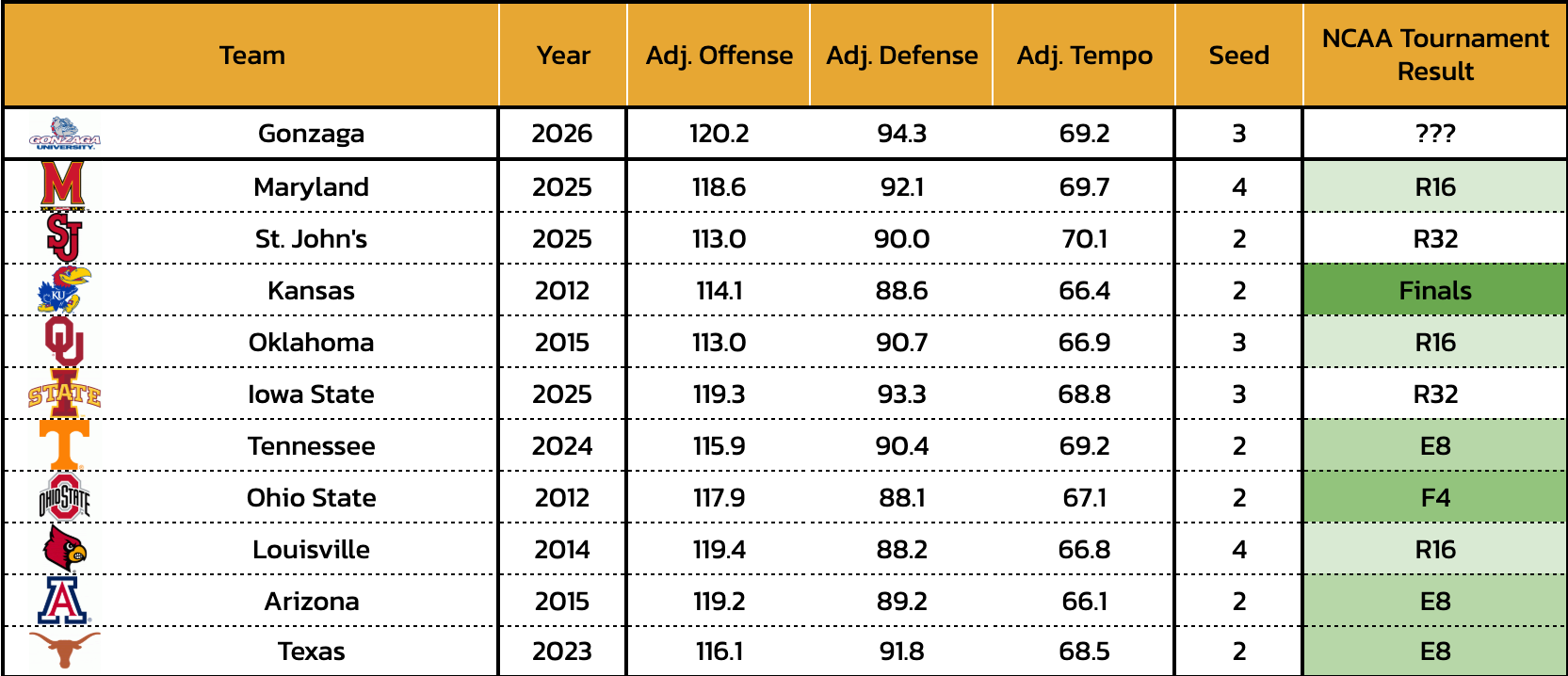
The Bulldogs look the part of a second-weekend team, with both their floor and ceiling dependent on their matchups in the round of 32 and beyond. With this tournament being the last games of their collegiate careers for four of their seven rotational players, it's hard to envision defensive lapses. Now, if they can avoid going 2-for-22 from deep, as St. John's did in their round of 32 game, they have a chance to make a run in March.
Tournament index evaluation
As it stands, Gonzaga is a projected No. 3 seed by our bracketology at Basket Under Review and a projected No. 4 seed by the Bracket Matrix.
In the former scenario, the Tournament Index would grade the Bulldogs as the sixth-strongest No. 3 seed (out of 49 teams) compared to the last 12 NCAA Tournament fields. As a No. 4 seed, they would grade as the eighth-strongest over the same time frame. The TI projects an average of 2.00 wins for Gonzaga if a No. 3 seed, and 1.85 wins if a No. 4 seed.
