
High Point, Northern Iowa, now Furman…it’s a purple takeover at the bottom of the NCAA Tournament bracket! The Paladins became the latest purple ticket punched on Monday night, handling SoCon No. 1 seed ETSU en route to a 76-61 victory.
This marks Bob Richey’s second NCAA Tournament appearance in nine years as Furman’s head coach; you might recall the first appearance (and Kevin Harlan’s virtuoso performance calling it). Richey’s run at Furman has been wildly impressive: he has won 20+ games in seven of eight non-COVID years, and the Paladins have hit 10+ SoCon wins in every season of his tenure.
Richey prefers to build internally, only using the portal to accentuate his homegrown core and fill in spots around them. This year’s squad is built around star freshman point guard Alex Wilkins, the Most Outstanding Player in the SoCon Tournament, and big men Charles Johnston and Cooper Bowser, all of whom were initially Furman recruits. Key wings Ben Vander Wal (29 starts) and Eddrin Bronson (six starts, including the entire SoCon Tourney) are also Paladins through and through.
The only transfers in the rotation are complementary forwards Tom House (Florida St.) and Asa Thomas (Clemson), two former ACC players who bring nearly identical games. Both are listed at 6-7, 200 pounds, and are on the floor almost exclusively to light it up from beyond the arc.
Full Strength Furman
That starting lineup adjustment – slotting in Bronson with Vander Wal sliding to a high-effort sixth man role – seemed to unlock a different gear for the Paladins. It has been a season of lineup shuffling for Richey, particularly in January, when Bowser and Thomas both missed extended time.
No one wants injuries, but Furman got a sneaky benefit from those injuries piling on top of each other. The Paladins elected to pull a redshirt off athletic freshman Cole Bowser, Cooper’s brother, and the younger Bowser instantly made an impact in the rotation. He helped keep Furman afloat while his brother dealt with turf toe, and he made some crucial winning plays during the Paladins’ postseason run.
Other players also missed time with nagging injuries: Bronson, Vander Wal and House all had to sit at least one contest while dealing with minor ailments. Richey also shuffled back and forth between two freshmen, Abijah Franklin and Collin O’Neal, as the last rotation piece before locking in on Franklin later in the season.
All of this roster strife indicates that Furman could be underrated analytically. The Paladins were rarely the best version of themselves, but they got healthy at the right time and pulled off the upset win in the conference tournament as the No. 6 seed.
Offensive Approach
Richey has a recruiting mantra: “can’t shoot, won’t recruit.” While he clearly loosened that tenet to bring in Vander Wal and Bowser, the policy still reflects the Paladins’ approach to offense. They want to play four- or even five-out at times, opening up the paint for drives or post ups while putting immense pressure on help defenders with a lethal collection of shooters. Johnston has slumped as a three-point gunner this year (29%, down from 39% last year), but his stroke is smooth and he can pull opposing bigs away from the basket.
Wilkins is the biggest beneficiary of this space. He is a vicious downhill slasher, using his length to get into the paint. He shot 64.6% at the rim on the season, per CBB Analytics, a strong number for freshman guard, and he also has a lethal midrange game (46.4%, 81st percentile).
Richey has long been a proponent of using dribble handoffs to get his guards into gaps, and Wilkins excels there:
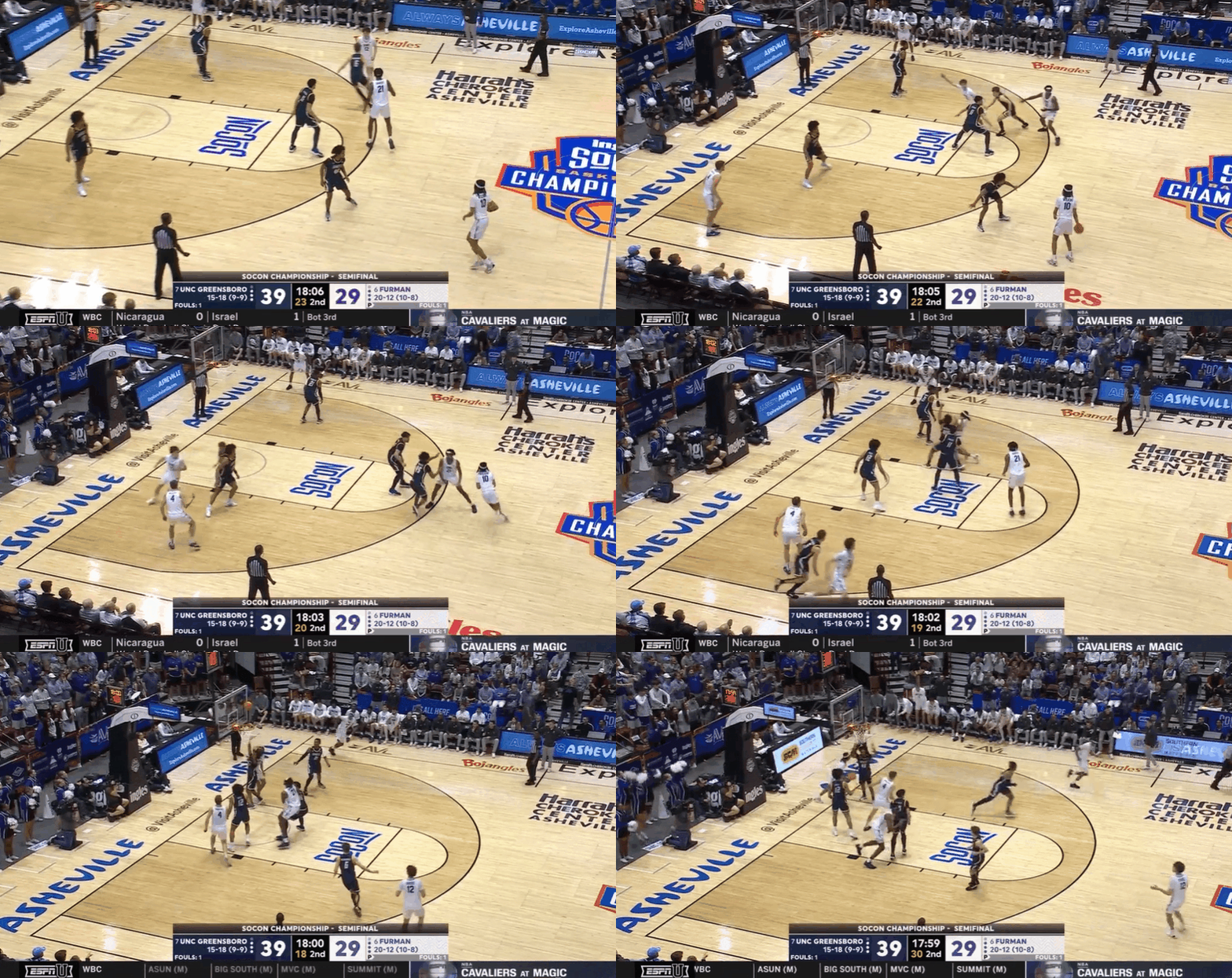
Teams have to choose between digging into his drives or staying home on shooters, and Wilkins’ vision (34.7% assist rate, 32nd nationally) consistently punishes the foes who opt to help.
The Paladins will also gladly feed Cooper Bowser on the block, where the big junior’s righty hook is all but unstoppable. His counters to that move are still a work in progress, but he has enough footwork to get to that move consistently. That fueled his outstanding efficiency in the post; per Synergy, he tallied 1.205 points per possession there on high volume, good for the 95th percentile nationally.
Other Strengths and Weaknesses
One critical difference between past Furman squads is the size featured across the board on this roster. The skill level is still omnipresent, but with two true 6-11 big men and a rangy 6-5 point guard, Furman ranks 5th nationally in average height. The team that beat Virginia in 2023 ranked 256th; 2024 Furman ranked 306th. That additional size has helped boost the Paladins around the bucket, and they led the SoCon in both 2P% offense and 2P% defense.
Furman’s biggest weakness is a complete inability to handle pressure. The Paladins benefited greatly from playing in the SoCon, the league with the lowest turnover rate in the country – the conference’s defenses simply do not prioritize that.
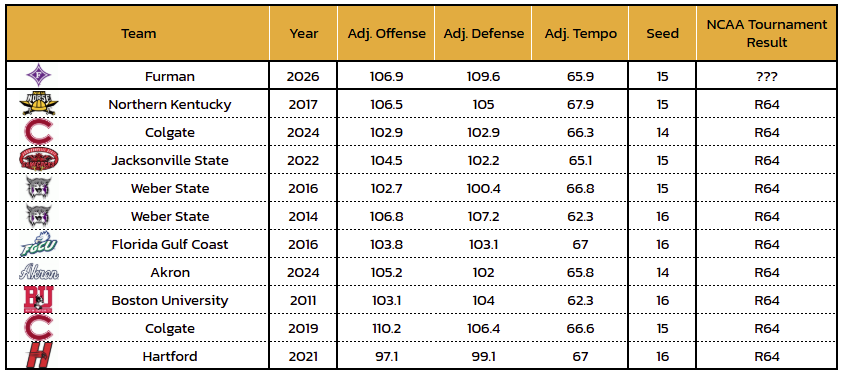
Similar NCAA Tournament efficiency profiles
Tournament Index evaluation
As it stands, Furman is a projected No. 15 seed both by our bracketology at Basket Under Review as well as on the Bracket Matrix.
In that scenario, the Tournament Index would rate the Paladins as the sixth-weakest No. 15 seed (out of 49 teams) compared to the last 12 NCAA Tournament fields. Should they end up lower, they would grade as the 16th-strongest No. 16 seed over the same time frame. The TI projects an average of 0.09 wins for Furman if it lands a No. 15 seed.