


No Caleb Foster, no Pat Ngongba, no problem for the Duke Blue Devils.
Jon Scheyer's squad knocked off Virginia on Saturday night to win the program's second consecutive ACC Tournament title and its third in four years since Scheyer took over for Mike Krzyzewski.
Even while shorthanded, Duke controlled the game in the way it has so often this season — by turning defensive stops into long, grinding possessions and consistently winning the battle on the glass. The ACC Tournament run reinforced what the underlying metrics have suggested all season: the Blue Devils enter the NCAA Tournament with one of the most complete profiles in the country.
No one has as many Quad 1 wins as Duke, who is 16-2 in such games going into Selection Sunday. Its victory over Michigan back on Feb. 21 might be the best win anyone has on its resume. A win over Florida in December also means the Blue Devils have beaten two of the other three projected 1-seeds in the NCAA Tournament — and that doesn't even include convincing wins over Kansas, Arkansas, Michigan State, Louisville, and the Virginia team it beat for a second time on Saturday.
For a program accustomed to playing deep into March, the expectation in Durham is never simply to make the field. With an elite defense, dominant rebounding numbers, and a backcourt that appears to be finding its rhythm at the right time, Duke now turns its attention toward a run that could extend well beyond the tournament’s opening weekend.
Elite Defense, Elite Rebounding
The foundation of Duke’s success this season has been its ability to control games defensively.
When healthy, the Blue Devils have arguably the nation's best defense, using their size and length across the lineup to disrupt opposing offenses. Duke consistently forces teams into difficult half-court possessions, closing out on shooters while protecting the rim and limiting clean looks in the paint.
Just as important is what happens after those initial stops. Duke has been one of the country’s best rebounding teams on both ends of the court. By finishing possessions and limiting second-chance opportunities while creating their own, the Blue Devils have consistently tilted the possession battle in their favor.
That combination — forcing tough shots and securing rebounds — has made Duke one of the most difficult teams in the country to score against over the course of 40 minutes.
No individual player embodies this work on the glass more than Cameron Boozer. The favorite to win National Player of the Year, Boozer led the ACC in rebounding by nearly a board per game and is 13th nationally in this category.
He had several key rebounds to push Duke past Virginia, but none were bigger than this one.
CAM 💪💪💪 pic.twitter.com/fdWflKMxVw
— Duke Men’s Basketball (@DukeMBB) March 15, 2026
Improved Play from Cayden Boozer
Another encouraging development during Duke’s ACC Tournament run was the play of freshman guard Cayden Boozer.
Boozer’s season has been marked by inconsistency, but his performance in the conference tournament stood out. He was thrown into a larger role with Foster's injury but, as the tournament progressed, he looked more and more comfortable running the offense, pushing the pace in transition, and making quicker reads in half-court sets.
After averaging 6.5 points in 20.6 minutes per game during the regular season, Boozer upped his scoring to 13.7 points in 33.0 minutes per game throughout the ACC Tournament. When he is playing with that level of confidence, Duke’s offense becomes far more dynamic.
If the ACC Tournament version of Boozer continues into March, it adds another layer to a Duke team that already wins games through defense and rebounding.
Duke's Health Questions
The one variable that could shape Duke’s ceiling in the NCAA Tournament is health.
While the Blue Devils were able to win the ACC Tournament without Foster and Ngongba, their availability moving forward will be worth monitoring. Depth is often one of Duke’s strengths, and the Blue Devils have managed to navigate injuries throughout the season. Still, the margin for error in the NCAA Tournament is slim, and having as many contributors available as possible becomes increasingly important as the competition level rises.
The bottom line is that Duke can't get to where it wants to go without Foster and Ngongba. The latter has served as a defensive anchor for the Blue Devils as his size, strength, and rim protection allow everyone else to pressure the perimeter even more. The former is a veteran point guard who has done veteran point guard things all season long — like consistently hit shots in clutch moments — while organizing the offense and giving Duke another floor spacer.
It can win games without them, sure, but whoever wins the national title is going to need to beat at least two or three other elite teams to accomplish that feat. Assuming Duke enters the tournament with Ngongba back in the fold (Foster may be able to return for the Final Four), the Blue Devils will arrive with the type of profile that historically translates well in March — elite defense, dominant rebounding, and a superstar capable to winning a game by himself.
Similar NCAA Tournament efficiency profiles
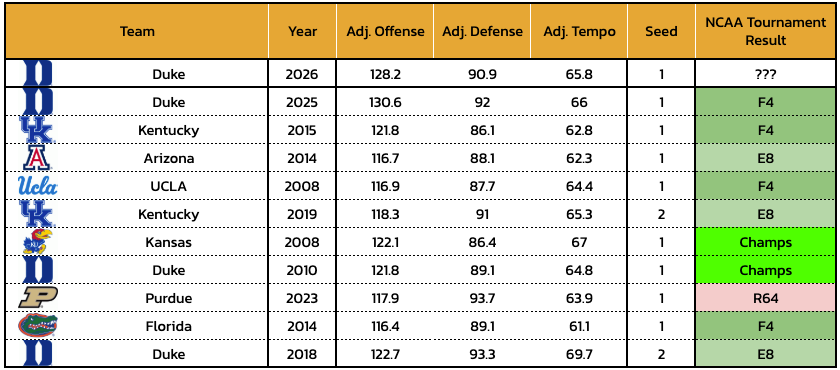
Tournament Index evaluation
As it stands, Duke is the projected top overall seed by our bracketology at Basket Under Review and the Bracket Matrix.
Should that be the case, the Tournament Index rates the Blue Devils as the...single strongest No. 1 seed (first in power rating out of 49 teams) compared to the last 12 NCAA Tournament fields, narrowly edging out 2015 Kentucky. The TI projects an average of 3.25 wins for Duke given its projected seed (No. 1) and strength.
