

Hi. I'm the guy who writes about all the college basketball conference tournaments here. I need you to understand something: I am very passionate about the Sun Belt’s conference tournament format. I am issuing a missive to the Sun Belt, right here, right now: do not bow down. Do not give in. You are right, and you will be proven right in the years to come.
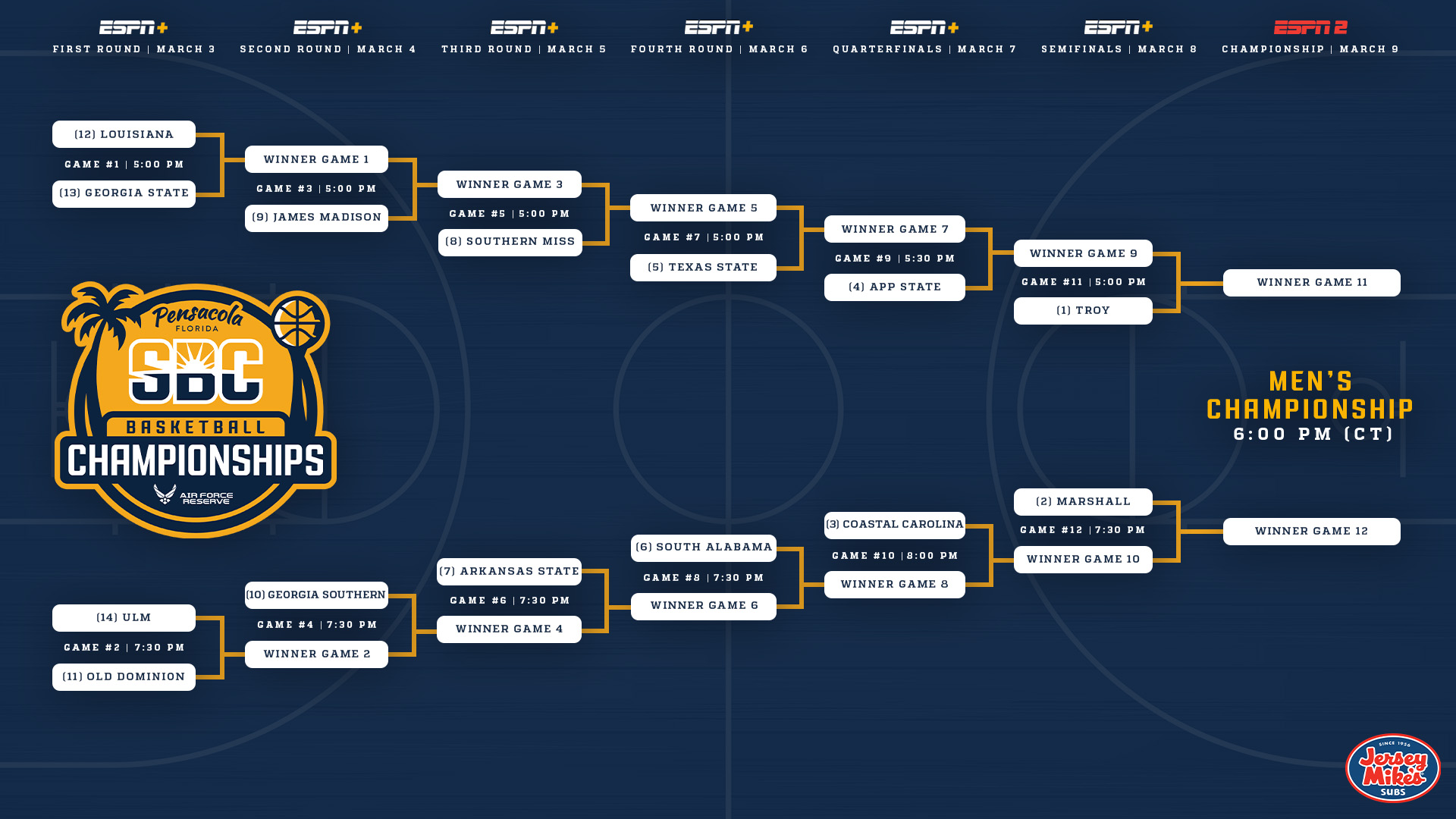
This is Year Two of the Sun Belt’s conference tournament bracket, a ladder format that invites everyone in the league but forces the 14 seed to win seven games in seven days while a 1 seed only has to win twice. You'll be shocked to hear opinions have been plentiful. Some, like me, believe it is the platonic ideal of protecting a conference’s best teams. Others believe, and I quote, that this format is “loser [stuff] for losers who lose.”
In a year like the Sun Belt had, the ladder format is going to look a little silly. The league’s champion, Troy, went 12-6, a record that normally might get you third place. There was a six-way tie for second place, which resulted in the analytical best team (Arkansas State) being saddled with the 7 seed and a task to win five games in five days. Admittedly, this is not the greatest year for the format to exist, especially when the champion is the champion largely because of a one-point win over the league's worst team, Louisiana-Monroe.
Still, this should exist. Every single mid-major conference that wants to win games in March should adopt it. I've seen too many mid-major greats sidelined by the theory that conference tournaments are, for some reason, supposed to outweigh the 30-game bodies of work these greats built up beforehand. I fundamentally disagree with this premise. To me, the NCAA Tournament should be the place for chaos, and perhaps the Power Five conference tournaments. I do not want excellence waylaid by one terrible, horrible, no good, very bad day.
Remember Mike Daum and the 2018-19 South Dakota State team that went 14-2 in conference play with a top-40 offense? Of course you don't, because that team lost in the Summit League Quarterfinals thanks to their worst offensive performance of the season at the worst time possible. 2017-18 MTSU, who put up a legendary in-season run that got them ranked in the AP Poll for a week? Left out because of an opening round loss to Southern Miss. 2018-19 Toledo, 2016-17 Monmouth, 2015-16 UAB, 2014-15 Louisiana Tech, 2012-13 Denver...all potential March heroes, all sidelined to NIT or nothing by way of one truly horrific day at the office.
So: why not go to this format?
Well, people have their opinions. I figure it's only fair that I share rebuttals.
- The Sun Belt's format is unfair to the league's middle class.
This one comes from, of all places, Bro Bible. This is a site I last touched in 2015 when my friend Matt would send me stuff from it, but apparently they're still kickin'. Good for them! Their argument centers around, predictably, the conference standings, their lack of clarity, and...
Arkansas State and Marshall both finished the regular season at 11-7. The Thundering Herd has to win only two games to make the NCAA Tournament. The Red Wolves must win five. . . . This unusual Sun Belt bracket format also puts South Alabama and Texas State at a major disadvantage, having to win four games.
This is hard to refute. Objectively, it is unfortunate that Arkansas State, by way of convoluted tiebreakers, must win five games while the objectively lesser Marshall must only win two. However, I would offer Arkansas State a foolproof way out of this: they could have beaten Marshall on January 31 instead of losing 70-61 at home in a game they were favored to win.
Arkansas State also could have won any of the following: a 91-87 overtime loss to South Alabama, a 92-88 overtime loss at home to South Alabama, and an 82-81 loss to an awful Georgia State team. In fact, just by flipping that 92-88 South Alabama game - one where Arkansas State blew an 18-point lead in the final six minutes - Arkansas State would've been the 1 seed in the conference tournament, by nature of defeating Troy.
Of course, Arkansas State isn't alone. I assume that Appalachian State, the team with the highest efficiency margin in conference play, is perturbed that they are the four seed and have to win three games, not two. App State lost to Marshall and Texas State by a combined four points in their season's final eight days. South Alabama, who led the conference in overall wins with 21, has to win four times. South Alabama was arguably super lucky to even be here, going 12-5 in close games, but had they gone 13-4 and not lost to Texas State in a game they led by 15, they could've been a top-2 seed.
Perhaps I am being rude or a cad, but do you know how you avoid ending up in tiebreaker land? Winning more games. I would simply win an additional game or two to feel safe.
- The format overcorrects for regular season events, killing the 'anybody can win' spirit of March.
God forbid a man have hobbies, but I'm going to expose an embarrassing one: I do use Reddit from time to time. Mostly, this is to read up on what people think of Bill Simmons, and one of my blow-off-steam habits is to read threads about celebrity gossip. Sue me, it's the slop I love. I used to see when my newsletter posts would end up on the College Basketball sub-Reddit, but I made an executive decision a couple years back to not read reaction to a post of mine anymore. Protecting yourself is a nice thing.
Anyway, here's what some fine Reddit posters think of the whole shebang.
"I’m all for rewarding regular season success and protecting your top teams in a one bid league. But this seems excessive."
"IMO no league should have this bracket. This is a crime against humanity."
"It's absurd that people continue to defend brackets like this. The 7-seed here is one game behind the 1-seed in the standings and also is the best team in the conference according to KenPom and this nonsense means that they have to win five games in five days. Just an utter affront to the goodness that is weekday basketball."
Now, far be it from me to be the arbiter of judgment, but I believe this ladder format incentivizes the regular season the correct amount. In order:
- Everyone has a chance.
- BUT: the teams that were the best in the regular season have the best chance to make the final.
- The teams that were good, but not great in the regular season still have a chance to make the final, just a less-good one.
- There is no law stating the 7 seed can't simply win five games in five days.
- Also, rust versus rest and things of that nature.
Having an "anybody can and should be allowed to win" mentality with a conference tournament is perfectly fine if you are, say, the Big 12. It's fine that all 16 teams are invited to their conference tournament. The top four teams get double-byes, and 5-8 all get an extra day off. You know why this is fine? Because all of those teams, on average, are going to make the NCAA Tournament regardless of what happens in the conference tournament.
The Sun Belt, and ~90% of mid-major leagues, don't have this luxury. Whoever wins the conference tournament is the representative. To me, it makes the most sense to give the teams who accomplished the most during the regular season the best chance at being that lone representative.
You guys like money, right? I would wager you do if you're spending some of your disposable dollars on this. You wanna know what gives you the best chance at more money for a league that's a firm have-not? Sending the best team possible.
- Upsets are reduced, which is just as bad for the Sun Belt as not having them at all.
For the Sun Belt alone, we have all of one Tournament of a sample size to work with. That one produced a semifinal of all 1-4 seeds and the two objectively best teams from the regular season in the final. This was the first time this has happened since 2019, which seems notable to me.
Now, you may think this is a good thing, as I would, but incredibly, I have run into many a person who actually likes conference tournament upsets, even for one-bid leagues. Paul Mills, a guy who needs upsets to win games, hates the American's new format because "you don't give teams the opportunity for March." A guy that I'm pretty sure is on our Basket Under Review Discord wrote up a whole missive defending conference tournaments in 2023, including this little nugget:
Some of the biggest Cinderella teams did not win their regular season titles. St. Peter's was 2nd in the MAAC. UMBC was 2nd in the AEast. Oral Roberts was 4th in the Summit. Florida Gulf Coast was 2nd in the ASUN. Norfolk State and Lehigh were both 2nd when they pulled the double 15 seed deal. I could go on and on.
On and on he could go, and I do find some defenses to his claims. However, I would like to point out a critical flaw in the analysis here: nearly all of these teams were at least top-two seeds. They would've gotten the quintuple-bye. Even Oral Roberts, under the Sun Belt's format, would've only had to win three games in three days, which is exactly what they did anyway.
Frankly, I think the artist known as The Bear before The Bear was on television perhaps said it best.
Fans love upsets in these smaller conference tourney games, but the leagues privately have to hate not getting one of their best teams over the course of the entire season in the NCAA Tourney.
— Chris Fallica (@chrisfallica) March 8, 2024
You like money, right? I know you do.
- It's a gimmick, and I hate gimmicks.
Would you have cared about the Sun Belt Tournament if, say, it were a 14-team field where the top-four seeds got a direct bye to the quarterfinals? No. You would probably be unaware it exists at all, barring a huge upset or some sort of officiating controversy. This was functionally how the Sun Belt operated up through 2024, and the league has had at least 12 members since 2017. For your safety, I am going to list all of the times from 2017-2024 that the 1 seed in the Sun Belt won the conference tournament.
- uh
- well,
It never happened. Not once. Exactly one time during this span, the league managed to send its best team to the field of 68, and it was a 30-win James Madison team in 2023-24 that only failed to win the league title because they went 15-3 while App State went 16-2. Several excellent teams - top-70 Louisiana Lafayette in 2017-18, top-75 UT Arlington in 2016-17, even dating back to #66 Georgia State in 2013-14 - all failed to make the conference title game. They had to play three games, not two.
Here's the thing: when those teams failed to win their leagues, no one really cared. It was a shame for about 15 minutes, then media members moved onto the next thing. Now that there's a protective item here, people are annoyed and mad. Read the replies to the Sun Belt's own tweet here and you'll see many heated people either directly calling this a gimmick or inferring it as one.
You know what an actual gimmick is? Conference tournaments, which have only existed in a widespread fashion for about 50 years. The Big Ten didn't see the need for one until 1998. Arch Madness, everyone's beloved Missouri Valley tourney, didn't exist until 1977 and wasn't played in St. Louis until 1991. The Ivy League made it just fine without a conference tournament until 2017. Why were these started up in the first place? Well, you heard it here first.

- If this has to exist, the lowest seeds shouldn't be invited at all.
This is the lone argument I find myself somewhat sensitive to. If the goal you're after is to avoid an embarrassing, shocking upset for your 1 or 2 seed in the conference tournament, not making the 11-14 seeds (or at least 13 & 14) perform a humiliation ritual for a day or two might be a good start. This would not look dissimilar whatsoever to the West Coast Conference's format, which more or less deletes a step from the Sun Belt.
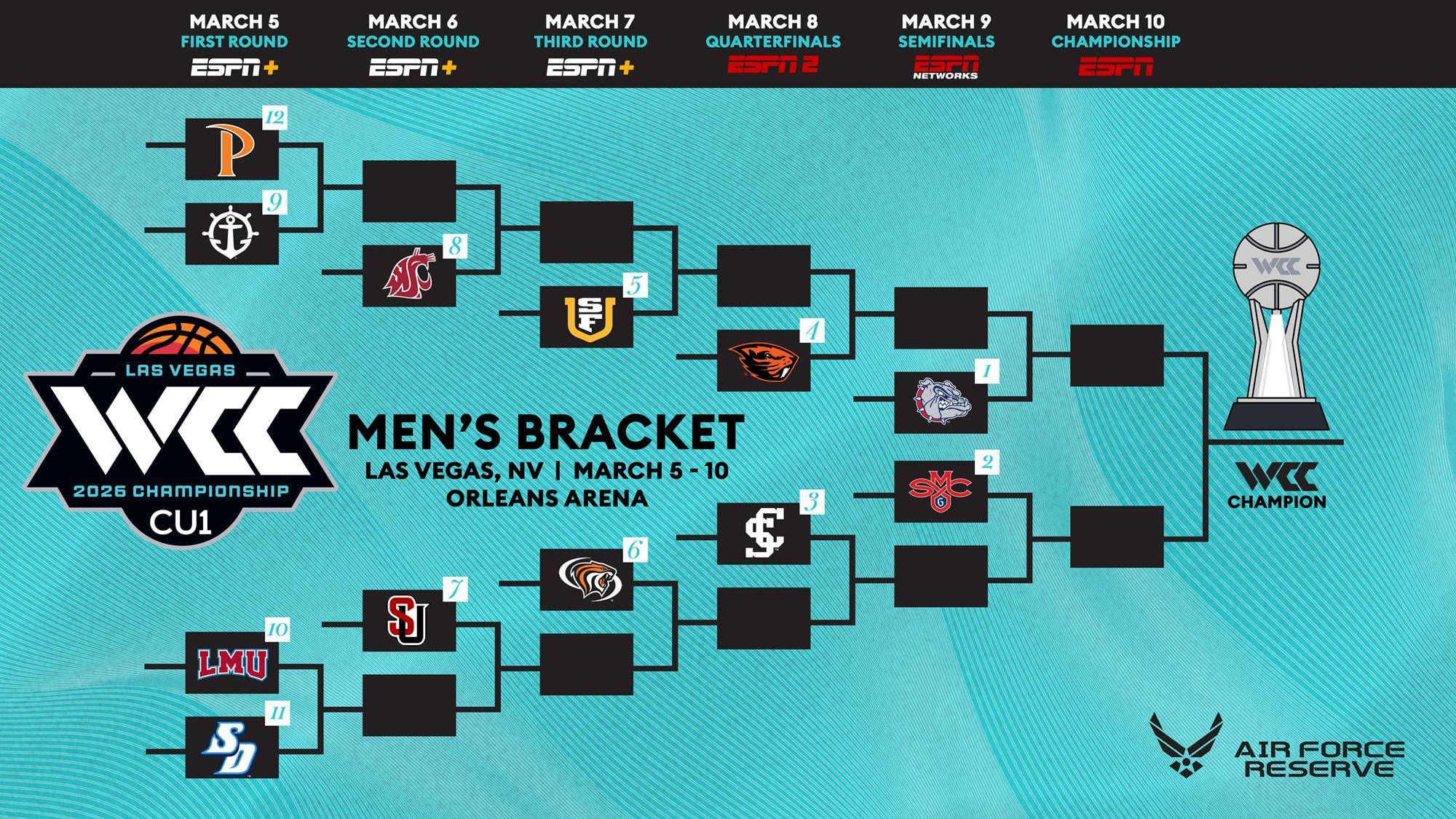
This would reduce some number of scheduling/logistics items and you'd save on a day of rent in Pensacola. It makes it more manageable and doesn't necessarily provide false hope to, like, a UL-Monroe. You can live with that and live with your overall emphasis on rewarding regular-season performance without running irregular risk.
But! I do not think they should banish anyone from this tournament. For one, this is the perfect year to allow all 14 teams to play. As chaotic as it was up top, no one has seemed to realize that the chaos also touched the bottom. Seeds 11-13 were decided by a round robin tiebreaker, as all three teams finished 7-11. 10 seed Georgia Southern is only the 10 seed because of multiple overtime victories in December.
Now, let's play the Normie Game. Say we want a 12-team bracket, just like it used to be, and 13 and 14 stay home. Mr. Fairness here wants Georgia State, who went 0-3 against the other 7-11 teams, to not play in the conference tournament. Kind of a bummer if you ask me, considering Georgia State defeated four of the 11-7 teams (Marshall, Arkansas State, Coastal Carolina, App State) and was one coin-flip overtime loss to James Madison from being safely a 10 or 11 seed.
Or hey, let's do this guy's format. Everyone loves This Guy, the Bracket Respecter.
Fixed it for you pic.twitter.com/fyTHh8Ms4G
— Squilliam (@Will_jasper24) February 28, 2026
This is the Sun Belt's previous 14-team format. Georgia State is a meaningless addition to a meaningless round. Would you be aware whatsoever that Georgia State is in this, unless you read Mid-Major Madness daily and/or were a betting obsessive? I doubt it.
In the ladder format, Georgia State has a chance and is known. (Or had. They lost to Louisiana-Lafayette on Tuesday.) This draws eyeballs and interest, and suddenly, the four teams who have to go 7-for-7 are adopted by numerous superfans of the sport. The entry of Georgia State and their 7-11 friends increases drama and gives smaller schools a glimpse at glory without automatically undermining top seeds, since the structure heavily favors them. I think that's more democratic than less.
- I miss how things were when I was exactly 21 years old and I am imprinting this philosophy upon you because my bloodline is weak and I love nostalgia.
Correct.
Anyway, happy Ladder Week.