


The Tennessee Volunteers remain true to the philosophy of Rick Barnes when it comes to shot selection and value, a philosophy he’s held for the majority of his 39 years as a head coach, during which he's reached 860 career wins. You’re going to play through the post, get looks at the rim and wear down your opponent.
“Deep down inside,” Barnes said after Tennessee’s 79-72 win over Virginia on Sunday, “I wish there was no 3-point line and everything was played at 15 feet from the net. I would be a football coach. We would run the single wing or whatever. We would be running three yards in a cloud of dust.”
Barnes’ team ranks fifth among high majors in paint points per 100 possessions and subsequently led the country in offensive rebounding percentage, thanks in large part to how and where they generate their looks. Counter to their identity, so far in the NCAA Tournament, it’s been Tennessee’s guards that have the Volunteers in their eighth straight Sweet 16.
Gillespie finds another gear
“Thank God Ja’Kobie Gillespie is a Vol. He’s had our prayers answered every day.” - Assistant coach Gregg Polinsky
Throughout the year, the Vols’ offense has continued to prioritize pick-and-roll actions with their platoon of bigs and getting downhill and spot-up looks. Freshman star Nate Ament and senior guard and transfer portal prize Gillespie have been the space-creating scorers in the midrange and perimeter, taking the majority of the team’s shots. However Ament has been battling injuries, missing the last two regular season games and gutting through postseason play.
Ament finished the team’s Round of 64 game without a made field goal in 18 minutes. The Volunteers and Ament needed output from their backcourt to buoy themselves in March, and Gillespie answered by scoring 50 points and racking up 15 assists over two games.
The 6-foot guard controlled the games on both ends of the floor, recording 4 steals and helping hold Virginia’s starting backcourt to 35% shooting. On offense, he manipulated defenses by exploiting how he was covered, thanks in large part to his ability to run Tennessee’s vaunted pick-and-roll actions and drill pull-up jumpers against defenders trying to prevent his downhill abilities.
In their first two tournament games, four of Gillespie’s nine 3-pointers came off the dribble. 11 of his 17 makes in the tournament have come unassisted. He’s risen to the moment of March, increasing his effective field goal percentage from 50.4% on the season to 61.4%.
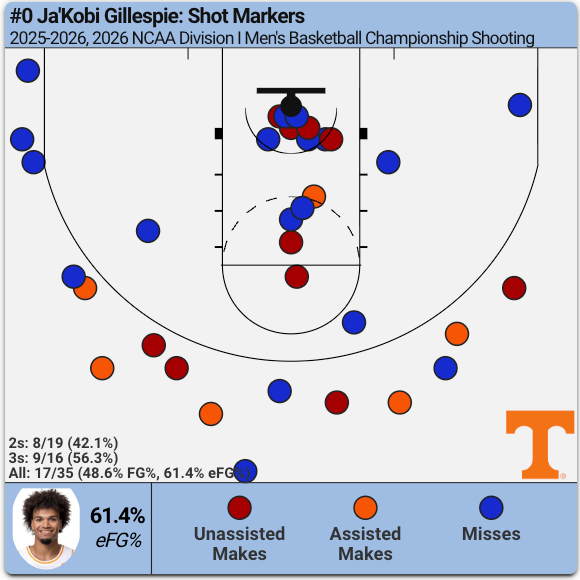
Gillespie increased his scoring production and efficiency and maintained the Volunteers’ offensive identity of facilitating guards, a role Zakai Zeigler maintained for four seasons prior. His scoring and ball-handling savviness minimizes obstacles brought on by varying defensive looks and ball pressure. Against zone coverage, he’s averaging 1.28 points per possession (85th percentile). Want to try and pressure him upcourt in a press? He’s scoring 1.17 points per possession (84th percentile).
“One thing they have in common is they are high-level competitors and think they can win the game by themselves,” Barnes said, “which is a good thing and sometimes not such a good thing. They both have a great way of letting it go when they don't play well. They move on to the next play. That's a God-given talent. I wish more guys had that, but they're good at that.”
The workload for the Tennessee native is significant. Gillespie has accrued the second-most points of all remaining players just behind Darius Acuff of Arkansas. He has the sixth-highest usage percentage among remaining players at 30.6% (20 minutes per game as a qualifier) while playing over 37 minutes per game.
“Getting into the tournament,” Barnes said, “I go into the games honestly thinking we'll play [Gillespie] 40 minutes if we have to and he's able to do it. [Gillespie and Zeigler are] similar in the fact that they're not going to back down regardless of what's in front of them.”
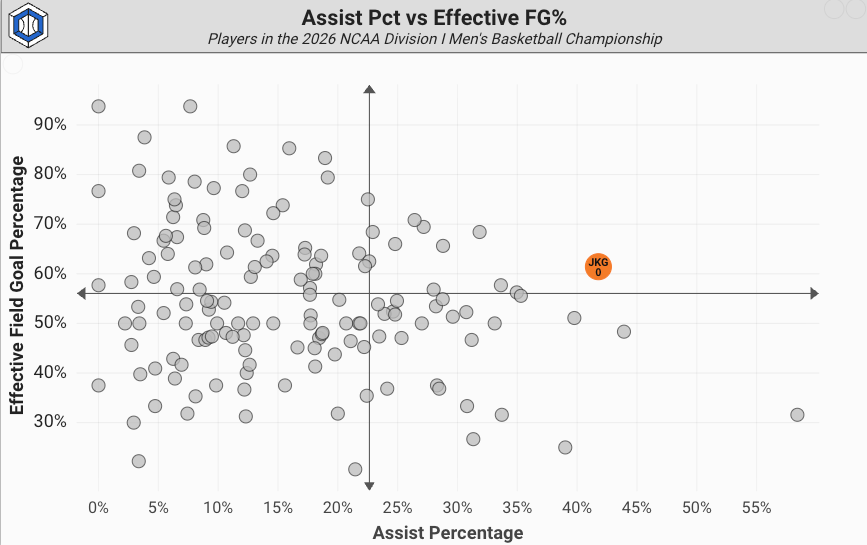
The gravity Gillespie demands can tilt opponents when the Vols’ second guard and wing position pose a threat on the perimeter. Needing to guard the perimeter above the break is essential when guarding a guy making 35.8% on 243 attempts. Add the screen-and-roll actions Tennessee runs in the key, coupled with the weakside spot-up shooters and you have your defense in something that could be best described, ideally in a Tennesseean accent, as cattywompus.
Gillespie is about as good as you could ask for when it comes to drawing defenders and making reads. Here, the guard gets into the paint off of a screen from Okpara in Spain Exit, and his gather at the free throw line brings all five Cavaliers towards him, creating enough space and time for Okpara’s roll to meet an easy lob dunk.
The Volunteers loved the result so much that they ran Spain Exit again two possessions later. This time, Dalin Hall aggressively looks for Okpara’s screen and fights over it while Thijs De Ridder high-hedges on Gillespie. It stops him from getting to the paint, but forces Bishop Boswell’s man to help front Okpara as a roller, leaving a scramble to find Boswell hitting the corner. Gillespie navigates the double seamlessly, plays the numbers, and feeds the corner for a wide-open three.
“The guy moves like he’s on ice skates out there,” Polinsky said. “So easy, so graceful. Makes big play after big play.”
This Boswell raises the Vols’ ceiling
“When Bishop puts up these kind of numbers, it does give us a whole different look as a team” - Rick Barnes
What changed the complexion of this Tennessee team heading into the Sweet 16 and helped them keep the higher-seeded Virginia at arm’s length throughout the game was the arrival of Bishop Boswell as a tandem playmaker alongside Gillespie. The sophomore finished with 13 points and 9 assists, career highs in both categories, while not committing a single turnover.
“If [Boswell is] playing like that, that makes us a whole 'nother team,” Gillespie said. “I think we're going to be really hard to beat with him doing that.”
The chemistry between the two starting guards is undeniable. Throughout the game, Boswell and Gillespie were talking to each other, breaking down where looks were going to come and what Virginia was trying to create on the other end. The bond between the two led to wide-open kick-outs as the Cavaliers tried to prevent Tennessee’s frontcourt from gaining ground at the rim.
“I think we just trust each other and really like playing with each other,” Gillespie said. “We're also roommates on the road, so we can't get enough of each other. I feel like we're just really locked in together.”
Boswell has stepped into a larger role as Ament continues to deal with injuries, and has used his perimeter scoring to create opportunities inside and to create gravity away from Gillespie on the perimeter.
“Bishop took all good threes, had his feet set, he’s been a solid shooter, Polinsky said. “His decisions on basketball, it changes our basketball team.”
The Vols’ style of playing two post bigs at all times forces defenses to adjust and keep as much size or as many bodies close to the paint to help protect the rim and minimize second-chance opportunities. Boswell knocking down looks and Ament and Gillespie sitting on the perimeter, makes that an impossibility. The second-year guard plays Tennessee’s system to a T.
It’s a breakout performance from a guard who was playing just 3.5 minutes per game a year ago. In his second season, Boswell is a 39.5% 3-point shooter and averaging the second-highest assists per game on the team at 3.1. Despite an inefficient stretch of six games shooting below 40% from the field, his perimeter scoring on Sunday makes this already underseeded Tennessee team far more dangerous than the #6 next to their name.
“I think it’s what this program is about,” Polinsky said. “Guys that stay in this program, they end up being like Bishop Boswell.”
Boswell credits the camaraderie between him and his backcourt partner to the intentionalility of the program’s offseason workouts. Building rapport in the portal era isn’t easy. Especially with 11 new guys on a roster.
“The staff does a great job of just giving us team events, but I think the biggest thing was just us wanting to spend time with each other just in general,” Boswell said. “And we spent a lot of time with each other just hanging out and getting close. When you work as hard as we do and go through the stuff that we do on the court, it’s hard not to become close.”
The closeness is palpable, especially from the distance between a Boswell baseline drive to a kickout to Gillespie sliding on the perimeter. Boswell playing within himself is an ideal counterbalance to the high-volume, high-usage Gillespie, who finds the right moment to score and to facilitate. It makes Barnes’ intentional inside-out approach unpredictable when the guards are feeling it.
“I like to see us sharing the ball and I love teams that are balanced,” Barnes said. “When we have a guy that can go, you have seen us do it through the years with a bunch of guys. We play to their strengths, but we love balance.”
