

Welcome to another edition of the Tournament Watchlist! Some games will features two opinions from our staff writers to give you some extra analysis and perspective.
Enjoy the hoops!
South Regional
(4) Nebraska (-1.5) vs. (9) Iowa, 7:30 PM ET, TBS.
This game should be so fun, but not in a "these are two of the best teams in the country" way like Houston/Illinois, or in a "we get to watch the best passer of all-time attack a soft drop coverage" way like Purdue/Texas, or a "there are going to be so many points" way like Arizona/Arkansas.
Instead, I think this game should be so fun in the "these teams play two distinctly different styles with two awesome coaches and perhaps the least raw talent amongst all teams remaining in the field and have already played two games against each other that were polar opposites so who even knows what to expect" way. If Arizona/Arkansas is a 100-mile per hour fastball pitcher, this contest is the knuckleball guy. I mean that in the best way possible.
A part of me wonders if the start of this game produces culture shock for Iowa, given Nebraska and Florida could not possibly be more different opponents. That said, Iowa's general concept of slowing the game down and playing through Bennett Stirtz-led pick-and-roll should largely be the same.
Interestingly, Nebraska is just 2-4 against power conference teams in games under 64 possessions, including three of the four times it has failed to top 1 point per possession this year. Iowa's home win in this series was 60 possessions, and Nebraska's home win was 66 possessions before overtime hit.
Nebraska's shot profile was nearly identical in its two games against Iowa. 3-point rate between 50 and 55%, rim rate between 35 and 41%, and assist rate between 56 and 67%, 12 turnovers in each game.
But Iowa's was drastically different. Bennett Stirtz took 12 more field goals and five more free throws in the first meeting. Iowa had 12 more assists and seven more turnovers in the second meeting. Iowa had 14 isolation points and zero off cuts in the first meeting, and then two isolation points and 12 off cuts in the second matchup. It was a completely different offensive profile. Here's what that looked like in action.
Bennett Stirtz Iso, Game 1
Bennett Stirtz drive and dish, Game 2
Iowa's shot profile in the second meeting was way more akin to what Nebraska's defense usually forces, and though it technically did produce a higher offensive output for the Hawkeyes, one could argue that the additional ball movement forced by the Cornhuskers led to the additional turnovers, more possessions, and a pace more to Nebraska's liking.
Most people will look at Nebraska and tell you the team's defining feature is how many threes they shoot and allow. But to me, their defining feature is how few rim points they allow, ranking second nationally. For an Iowa team that ranks fifth in the Big Ten in rim points per game despite playing at the slowest pace, it puts the onus on its long distance shooting.
Inevitably, by Nebraska playing a distinct style, it sort of forces opponents to play their way to a certain extent. That is exactly what Iowa did to Florida, and I think the Hawkeyes will get a taste of their own medicine. I would be very surprised if Fred Hoiberg and his defensive scheme allow Iowa to play a 60-possession, Bennett Stirtz isolation game. It's not traditionally what this team does, and that issue was fixed in game two.
Instead, if the game involves a 50%+ 3-point rate across the board with 20 total live-ball turnovers like the second meeting, that heavily favors the Huskers. My guess is that's closer to the way this one plays out, and Nebraska pulls out a fun, but aesthetically un-pleasing tilt. - Matthew Winick
I'll make a few points in Iowa's favor, but agree with my colleague that this one is likely nip and tuck for all 40.
There simply aren't enough superlatives to describe the coaching job Ben McCollum did against Florida. On one day of prep, he had Iowa limiting Florida to 61 possessions, the slowest game of the Todd Golden era since another 61 possession game against Miss State in year 1 in Gainesville. Iowa held Florida to a total of 39 rim and transition points, their third lowest combined total in that regard all season. Iowa meanwhile shot 70% on 2PT attempts, scoring 31 points in PNR offense (19 on the roll), the most Florida allowed all season in pure raw totals, and that was in their lowest possession game of the year!Duke was the only other offense this season to even hit the 60% mark on 2PTAs against the Gators until the Hawkeyes. My mere words cannot fully express what McCollum did Florida, and will go down as one of the alltime great coaching performances in NCAA history. So what's the follow up for a rubber match with Nebraska, with both he and Hoiberg having prep time?
Both games were unsurprisingly coin flips, but Iowa did struggle with the extreme no middle from the Huskers in both meetings, sporting 20% and 26% turnover rates, 7 from Stirtz in the series. They also had a 6th percentile 2PT proximity distance and 36th percentile in the 2 games (no surprise given Nebraska owns the lowest rim rate allowed in the country), but did shoot the ball much better from the field in the regular season finale, but lost that game in OT at PBA.
Nebraska hedge, double teams, and general overshift defensively makes ball screen offense difficult (8th percentile rate allowed, 99th percentile efficiency rating), and Iowa scored just 9 total points via ball screen in the 2 game season series, with most of Stirtz' points in the Iowa win coming in isolation. However, Nebraska has been vulnerable against the short roll, and the Huskers were getting so scrambled by Vandy's spread PNRs and the corner kick out they had to zone down the stretch, which ultimately won them the game.
Iowa can exploit this, especially if Fulgueiras' mother continues to be in the stands and he and Koch keep spreading out against the Husker ball overloads.
Nebraska will spread out 5 wide offensively, with Mast spraying out of DHOs to nonstop cutters and screeners (90th+ percentile rates in both areas, with high 90th percentile finishing efficiencies), and Iowa's hedge is particularly vulnerable to elite cutting teams, defending in just the 9th percentile nationally in that regard, per Synergy data. To wit, in Nebraska's win they scored 17 points via cut at 1.7 PPP, the most Iowa allowed all season.
Honestly with prep time and scheme familiarity, I think both coaches have everything figured out here, and Hoiberg isn't afraid to trade halfcourt schematic volleys with McCollum, as the Huskers are an elite halfcourt offense. Iowa has the best player on the floor, but Nebraska has the more skilled overall cast. Iowa's elite short roll usage is the key offensively, Nebraska's player and ball movement the key on the other end. If Folgueiras and Koch are still making shots in Houston out of these short roll kick outs, I think Iowa can win. - Jordan Majewski
(2) Houston (-3.5) vs. (3) Illinois, 10:05 PM ET, TBS.
The analytics and play styles suggest that we could have a wire-to-wire classic in this one, a battle of contrasting styles and strengths found at almost every angle of this game for both teams. Houston’s identity as a defense-first team, 15th in the country in opponent turnover rate, goes up against Illinois, which is 10th in the country for lowest turnover rate on offense.
Illinois is KenPom’s second-ranked offense, while Houston is the site’s fourth-ranked defense. The line suggests we’re looking at a basic pick ‘em, especially given Houston playing in a semi-home environment (shoutout to Rice University for helping a neighbor out by hosting the region). Finding threads on the angle to take here requires a deeper probe into matchups and team identity, something that can get lost when looking at statistical rankings.
I wrote about this back in February, but Houston’s defense, especially its interior, is operating from a bit of hand-waving that they’re a carbon copy of previous Cougar defenses. Kelvin Sampson’s blitzing point of attack defense is still a major component to this game, and how freshman Keaton Wagler and Kylan Boswell respond to Houston’s ball pressure will be a major factor in this one.
But Houston’s rim protection is not what it was when J’wan Roberts was on this team. Their 7.4% block rate is the lowest the team has had in eight seasons. Opponents are shooting 60.6% at the rim this season, the highest average Houston has given up since joining the Big 12. Their opponent's free throw attempt rate of 38.6% dwarfs their own of 27%, putting them in the 25th and fourth percentiles of both categories.
That previously mentioned ball pressure defense also has the potential to be neutralized because of the competent passing found up and down this Illini roster, especially with David Mirkovic, who has what I view as the biggest mismatch in this game. One of Jojo Tugler and Chris Cenac will need to go out and defend the 6-foot-9 forward with the handles and court vision of a guard. If it’s Tugler, you bring their best rim protector out to the perimeter. If it’s Cenac, you put a freshman center on a crafty scorer able to exploit how he’s being covered.
We’ve seen Illinois fade in tough moments throughout this season. And the Illini haven’t really faced a defense as aggressive and physical as the Coogs. But we’re also seemingly ignoring that Houston is 4-6 against top-20 NET teams this season, with its best wins coming against Arkansas in a “third game in three days” scenario and Texas Tech, who was still up-and-down when it had JT Toppin. We’ll see if the grind of Big 12 play or experiencing four overtime losses will make the winner ready for a battle. - Tuck Clarry
The location of this game is a major story (it’s in Houston!), but I am far more fascinated by what will take place on the court. Weaknesses and strengths collide here, and both Houston’s Kelvin Sampson and Illinois’ Brad Underwood will have quite a task in outfoxing the other on the chess board all night.
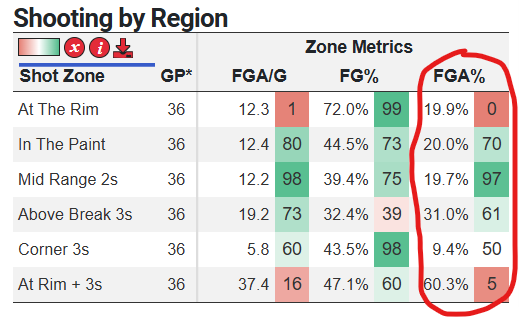
The Cougars’ massively midrange-depending offense will get the shots it wants against Illinois’ extreme drop coverage. The Cougars rank 364th nationally in average 2-point attempt distance, per KenPom, with their troika of guards plus Chris Cenac all comfortable with firing in the floater/long 2 range (frequency chart via CBB Analytics):
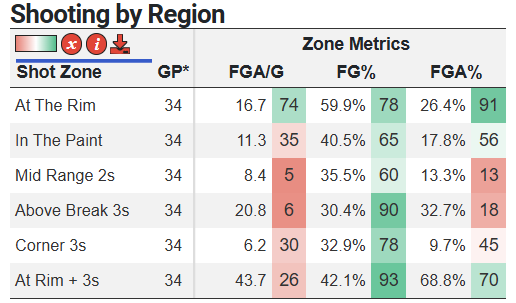
Meanwhile, Illinois takes away the rim and forces midrange jumpers at an extremely high rate:
Houston survives that approach by winning the shot volume battle: attacking the offense glass and never turning it over. This is not quite the normal elite Cougars on the boards (“only” 26th nationally in O-Reb Rate), but they just punished Texas A&M in that category and do have three highly active, athletic bigs in their primary rotation.
Because of the Illini’s conservative approach, they rarely force turnovers (365th nationally in steal rate, dead last). Does that make Houston’s elite ball control (5th-ranked turnover rate on offense) irrelevant? Perhaps, but any Houston miscue will be a surprise.
The bigger worry for the Cougars is the offensive glass, where Illinois’ towering size can compete and negate Houston’s onslaught. Illinois is the tallest team in the country by average height, per KenPom, and they rank 32nd in defensive rebound rate. Their drop coverage keeps the bigs in beneficial rebounding position.
On the other end, Illinois’ offense will not get the switches it loves to attack (Wagler off the bounce against bigs, Mirkovic posting up guards, etc.). Houston’s base coverage is to hedge hard and even blitz ball screens, forcing the ball to a short roll man or, ideally, long skip passes to the opposite side of the court. Those allow their ferocious defenders to scramble and recover while the ball is in the air.
Illinois has highly capable short roll playmakers. Mirkovic and Tomi Ivisic are excellent passers, and they can both score in the middle of the floor of the defense lets them get in too deep. The Illini rank in the 99th percentile in frequency of PnR Roll Man possessions, per Synergy, and that could be a real weapon against the Cougars’ aggressive style. That duo plus Zvonimir Ivisic can all be lethal pick-and-pop threats, as well.
The location of the game does not matter all that much to me at this stage. Illinois has some edges here that should make this game a coin flip. If Illinois can handle Houston's roving athleticism, they can win this "road" game. - Jim Root
West Regional
(2) Purdue (-7.5) vs. (11) Texas, 7:10 PM ET, CBS.
As it stands at the time of writing, Texas is the second-most popular underdog in the entire Sweet Sixteen behind Arkansas, which I guess does make sense. People love underdogs, big spreads, and certainly the fact that 11 seeds have a ton of success in March compared to their surrounding seed lines. Plus, 11 seeds are 2-1 in the last three 2/11 games. Just...maybe forget the part where they were 2-15 in the 17 before that!
The appeal for Texas would be that Purdue probably got a little lucky in opening weekend - they shot an astonishing 58% from 3 while opponents shot 27% - and that Texas just toppled a Gonzaga team I thought would eventually topple Purdue. (That's on me for overestimating Gonzaga without Braden Huff.) The appeal for Purdue, conversely, is that they are straight-up better and that Texas also was pretty fortunate (opponents shot 21% from 3). In a matchup of two excellent half-court offenses and two bad (relatively speaking) half-court defenses, I would take the team with the better offense and defense, which is Purdue. Also, I kinda think this is a bad matchup for the Longhorns.
On offense, Texas should be able to get a good chunk of points in P&R, and their roster sets up well to have a bevy of guards (Dailyn Swain, Jordan Pope, and Tramon Mark) to cook any sort of drop coverage Purdue attempts to run out. Purdue isn't running drop nearly as much as they did in the Edey era, but they'll still make it a decent chunk of their defensive look depending on their opponent. All three of Swain/Pope/Mark are legitimately very tough shot-makers who take and make a lot of tough shots:
It's also a Sean Miller offense, so it's going to be ISO-heavy, and if Texas can target the right guys I think they'll have some advantages there too. None of Purdue's starters are truly awful defenders, but none are great, either. I could see both C.J. Cox (if available) and Fletcher Loyer being in bad positions against Tramon Mark when he starts doing his thing, and certainly Miller's going to realize that and run a lot through Mark (and Swain) offensively.
But...well, here's the thing. Generally speaking, the Longhorn backcourt has fared worst against hard-hedge coverages, which makes sense because said backcourt is superior to the frontcourt and none of these guards are particularly GREAT passers. Swain is the best of them, but against the three best hedge-y defenses they played (Duke, UConn, Tennessee) he put up a horrific 13 turnovers and was held to 30 total points. As mentioned, this Purdue team hedges harder and better than any Purdue team in a bit. The Longhorns barely faced any hedge coverage at all, instead facing a ton of drop, which would be nice if Purdue was 2023 Purdue and not 2026 Purdue.
The other end of the court could be a 40-minute roasting unless I'm missing something about the Texas defense. The Longhorns are in the ninth-percentile in pick-and-roll defense at Synergy. They're going to primarily play drop coverage, which, uh, really a choice against Braden Smith and against a Purdue offense at its best this year versus drop coverages. (Even against Michigan, a drop-first offense, Purdue dumped 1.2 PPP across two games. ON MICHIGAN.) Even when Texas has tried to hedge this year it generally hasn't gone well, because their frontcourt recovery speed is poor:
Also can't say I love the Texas defense having to face TKR and Cluff post-up after post-up. The Horns actually have been pretty good as a post defense this year and generally don't have to double, and against the couple of offenses Texas played this year that go to the post as frequently/as effectively as Purdue, Texas actually did a pretty great job of post denial. Or at least the part where you deny a post player going through with the post-up. Now, when they forced a pass? Well, not great, because they gave up 36 points on cuts to the basket, much of those from post passes.
Again, if you're about to play possibly the pre-eminent high-low and big-to-big team in the field, this is not a good thing. Tennessee, maybe the only team in the field I would definitely say is more prolific with big-to-big stuff, popped off a 1.27 PPP day, and outscored the Horns 44-18 in the paint. 44-18!
There's a couple other aspects I can't say I love here, such as Texas being average at defending off-ball motion and DHOs, but it feels like beating the point in too hard. I basically think Purdue's going to be able to get almost anything they want for a full 40 minutes. If Texas holds up on true post-ups and limits TKR's impact, I could see Purdue becoming almost too reliant on P&R and turning this into a shooting variance game. If that's the case, these are two great rebounding teams, but one of them (Texas) fouls way more than the other. Would pick Purdue here, probably by a little more than the listed spread, barring a serious shooting variance game against Purdue and/or for Texas. - Will Warren
The counter to Will's many excellent points is a question about shot value. While yes, Texas is a horrific pick-and-roll defense, and even worse defending dribble jumpers in just the 4th%, what the Longhorns are very good at is limiting catch-and-shoot looks (98th%), gaudy assist totals (No. 34), and short 2-point field goals (No. 21 in average 2-point distance).
In other words: does it really matter if Texas is horrible at defending the PNR when those sets will largely result in Braden Smith pull-up twos and Trey Kaufman-Renn flip shots instead of straight-line rim drives and swing threes? Let's take a look at Purdue's Synergy shot types chart.
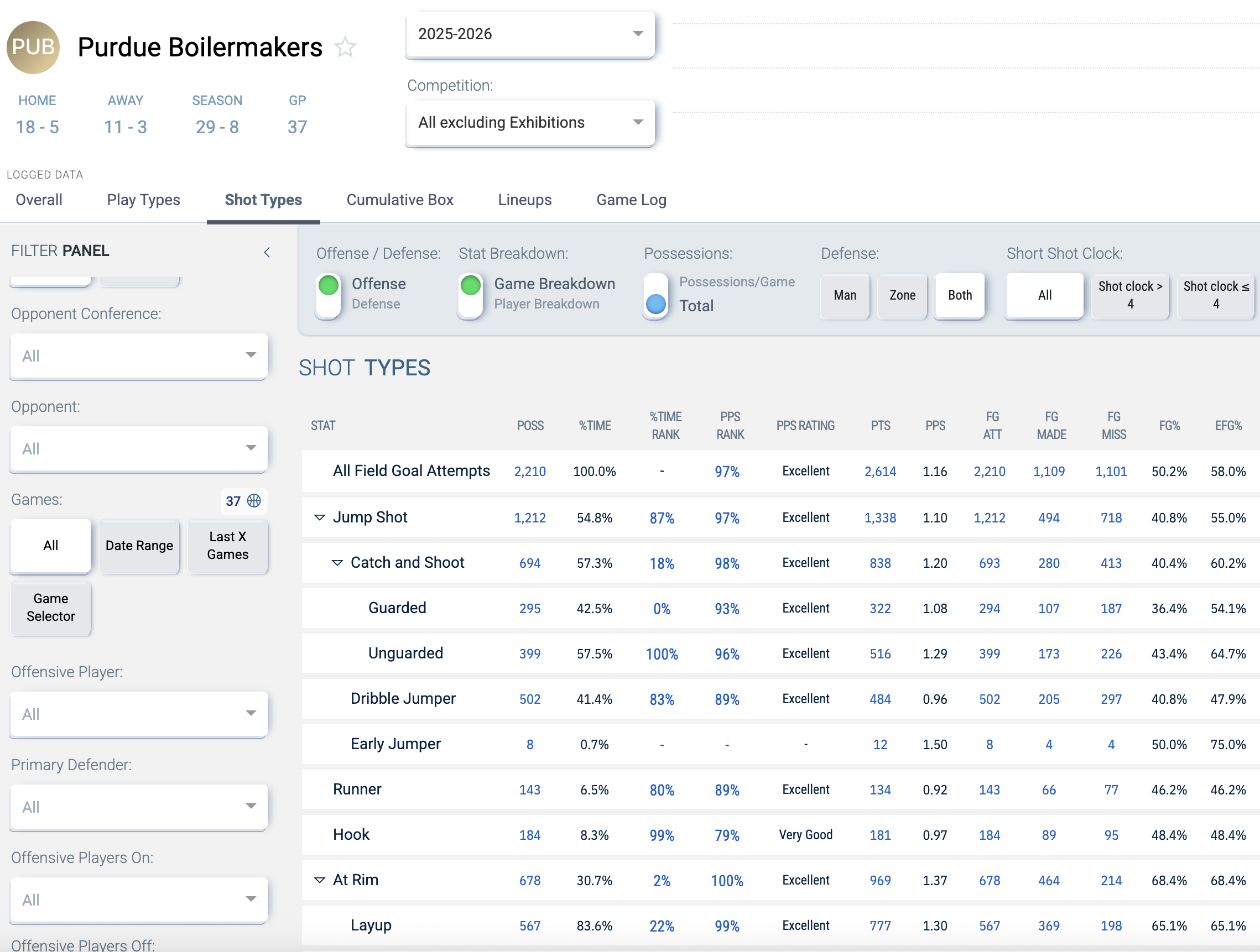
First of all, wow. I can see how Purdue leads the country in offensive efficiency. But the key category here is points per shot. The Boilermakers are amazing at everything, but their catch-and-shoot and rim attempts both net them over 1.2 points per shot, while their dribble jumpers, runners, and hook shots (largely Smith and Kaufman-Renn terrain) set them around 0.92 to 0.97 points per shot.
The concept of a drop defense would be, even though there's no defensive pressure and you allow high percentages on dribble jumpers, you will take those shots, even against an elite team at hitting them, rather than the more efficient point-per-shot looks a different defense would give up. And by forcing those shots in isolation settings, you are dictating which defenders are involved in the play and avoiding mismatches and poor rebounding position.
Purdue's rebounding edge should be mitigated, and its assist total should be relatively low. The Boilermakers are 0-3 with an assist rate of 50% or lower, and Texas averaged a 46% rate on the year defensively.
Now this concept doesn't always hold true. Purdue's highest dribble jumper rate of the entire year was an ultra-impressive 30-point win over Texas Tech where the Boilermakers went 12-of-23 off the bounce. Tip of the cap to them.
Of course, all of this may mean absolutely nothing, because Purdue is the best offense in the sport. Braden Smith and Co. can score on any team in the country.
Defensively, Purdue is wildly 28-0 when holding its opponent under 1.17 points per possession, and 1-8 when teams clear that number, with the one win coming against 139th-ranked Penn State. Texas is the No. 15 adjusted points per possession offense in the country and are more than capable on exploiting advantageous 1-on-1 matchups when they have the speed or size advantage on a Purdue switch.
This game should also be wildly slow. I think KenPom's pace projection of 64 winds up being too high. Fewer possessions, fewer margin of error.
Do I think Texas is going to win this game? Probably not. But let us not forget the sky was falling for the Boilermakers less than three weeks ago. These are two flawed teams. The Longhorns are more flawed, but I can see a world in which they get this done. - Matthew Winick
(1) Arizona (-7.5) vs. (4) Arkansas, 9:45 PM ET, CBS.
The battle of Nice Hooper versus cohesive team identity reaches its apex on Thursday night. The Arizona Wildcats are a balanced team with just one player, Tobe Awaka, with a usage of 25% or more, while Darius Acuff has the highest usage of players in the Sweet 16 at 35.2%.
Acuff is fairly considered a Kemba candidate, guards win in March and it’s hard to argue mega-usage guard averaging 30 points and 6.5 assists per game in the NCAA Tournament, but picking him to lead a six-man rotation to take down arguably the most well-balanced teams in the country (and considerably more dominant than any team that Kemba’s Huskies played) is a tall ask.
The math just doesn’t make an Arkansas upset seem viable. The Razorbacks aren’t really great at exploiting the minuscule vulnerabilities of a #1 seed with a 34-2 record. John Calipari’s team doesn’t really pour it in from the perimeter; their 3-point attempt ranks 316th in the nation and they’ve capped out at 15 made threes in a single game.
The Razorbacks also are not a particularly great rebounding team, either, sitting 123rd in offensive rebounding percentage and, more concerningly, 229th in defensive rebounding percentage. Those numbers won’t cut it against the fourth-best offensive rebounding and 25th-best defensive rebounding team in the country.
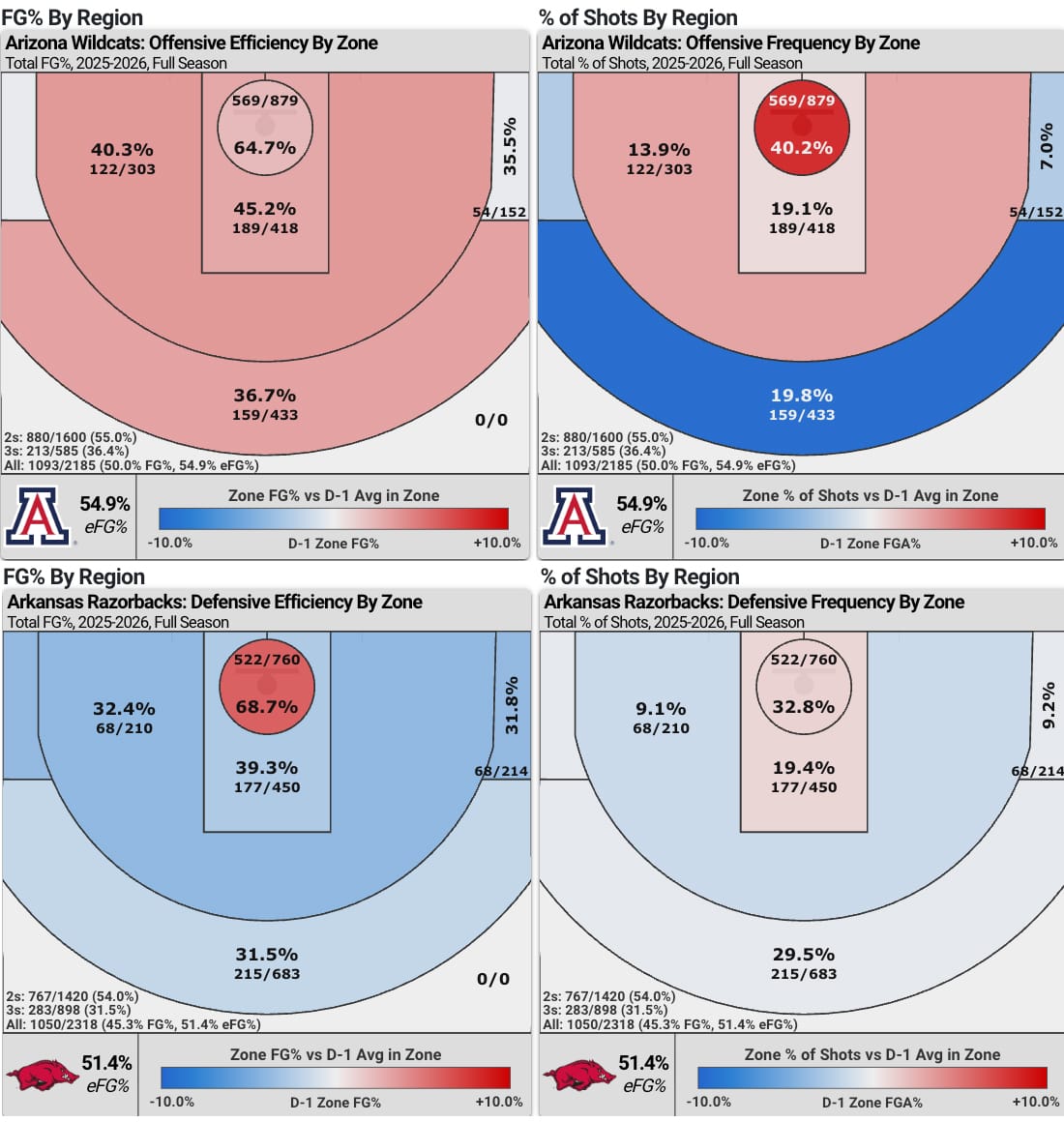
The real sticking point is that Calipari’s team is particularly poor at defending the spots that Arizona looks to score. 48.3% of Arkansas’ opponents’ points come in the paint this season. The Wildcats are in the 98th percentile for attempt rate at the rim, the Razorbacks’ biggest defensive weakness all season. Opponents are shooting 68.7% at the rim against Arkansas this season, 6.1% above the national average.
And the reason you lay the points with Arizona is that Arkansas has been particularly vulnerable to opponent runs so far in the tournament. Despite their gaudy 19-point win over Hawaii, they gave up four runs of seven points or more to the Rainbow Warriors. High Point was able to get off a kill shot early in the second half. When the Wildcats go on a run, it’s back-breaking. They’re able to generate high-efficiency looks while their defense holds opponents to an effective field goal percentage of 44.8%, the lowest in the country.
The margin could get wide because of the foul drawing that Arizona is able to generate. Arizona has made 89 more free throws than their opponents have attempted (700 made free throws to 611 opponent free throw attempts). Nick Pringle is supposed to be available for Arkansas, but that’s still three interior defenders to throw at one of the best group of bigs in the country. - Tuck Clarry
Adding a few statistics that back up Tuck's points (he was too nice about the Hogs' defense), of which I'm in agreement with:
78th percentile rim rate allowed with a 15th percentile efficiency rating. 45th percentile transition rate allowed with a 26th percentile efficiency rating. 203rd in defensive rebounding rate. 46th percentile efficiency rating in overall PNR defense (at a 92nd percentile rate). These are absolutely frightening numbers against Arizona's rim, transition, and OREB rate numbers. Factor in Acuff plays the most ole defense on the perimeter in the entire country (seriously, it's the worst defense I've ever seen at an elite college basketball level), and this looks pretty rough for the Hogs' defense. The easy comp to what Arizona does in transition, on the glass, and in the paint is Florida, and the Gators scored 56 points at the rim and grabbed their few misses at a nearly 50% rate. I keep thinking "well, maybe now that the games REALLY matter, Acuff will show some interest in defending", but he's actually gotten visibly worse this tournament, with Rob Martin literally running right by him in ball screen after ball screen (the help defense is just as bad).
Acuff is a transcendent scorer and the Hogs' athleticism and talent has clearly "played up" against Duke, Michigan State, and Houston, and they'll have midrange opportunities against Arizona's two bigs and Big Mo Drop, but unless there's a sudden and dramatic buy-in defensively, and I don't see how the Hogs get stops with that defensive effort- Jordan Majewski