
East Region
(1) Duke (-6.5) vs. (5) St. John's, 7:10 PM ET, CBS.
In some ways, Duke played a junior version of St. John’s last round: TCU is also highly mobile from 3-5, using that size and versatility to play aggressively on defense and disrupt via hard hedging and switching. The Blue Devils struggled with that approach for about 25 minutes, getting a ton of passes deflected and turning it over 13 times in that first portion of the game. They cleaned it up, though, and their defense suffocated TCU down the stretch en route to an easy victory.
They now have to level up against Rick Pitino and the Red Storm’s top 10 defensive unit. The major differences from TCU are that St. John’s has longer guards (when Dylan Darling is not on the floor), and the Johnnies have a much better rim defense: 90th percentile in FG% allowed, per CBB Analytics, compared to 47th percentile for the Horned Frogs.
Theoretically, the Red Storm have the bodies up front to compete with Cam Boozer inside. No team can truly guard the inimitable Boozer one-on-one, but Zuby Ejiofor and Dillon Mitchell have the size, length and instincts to give him some issues. Bryce Hopkins can probably hold up on a possession here and there, as well.
Perhaps the biggest key against Duke’s offense is being able to handle the plethora of Boozer/Isaiah Evans ball screen actions that Jon Scheyer throws at you. That either forces a switch with a guard taking Boozer, or it gets Evans open against a scrambling closeout:
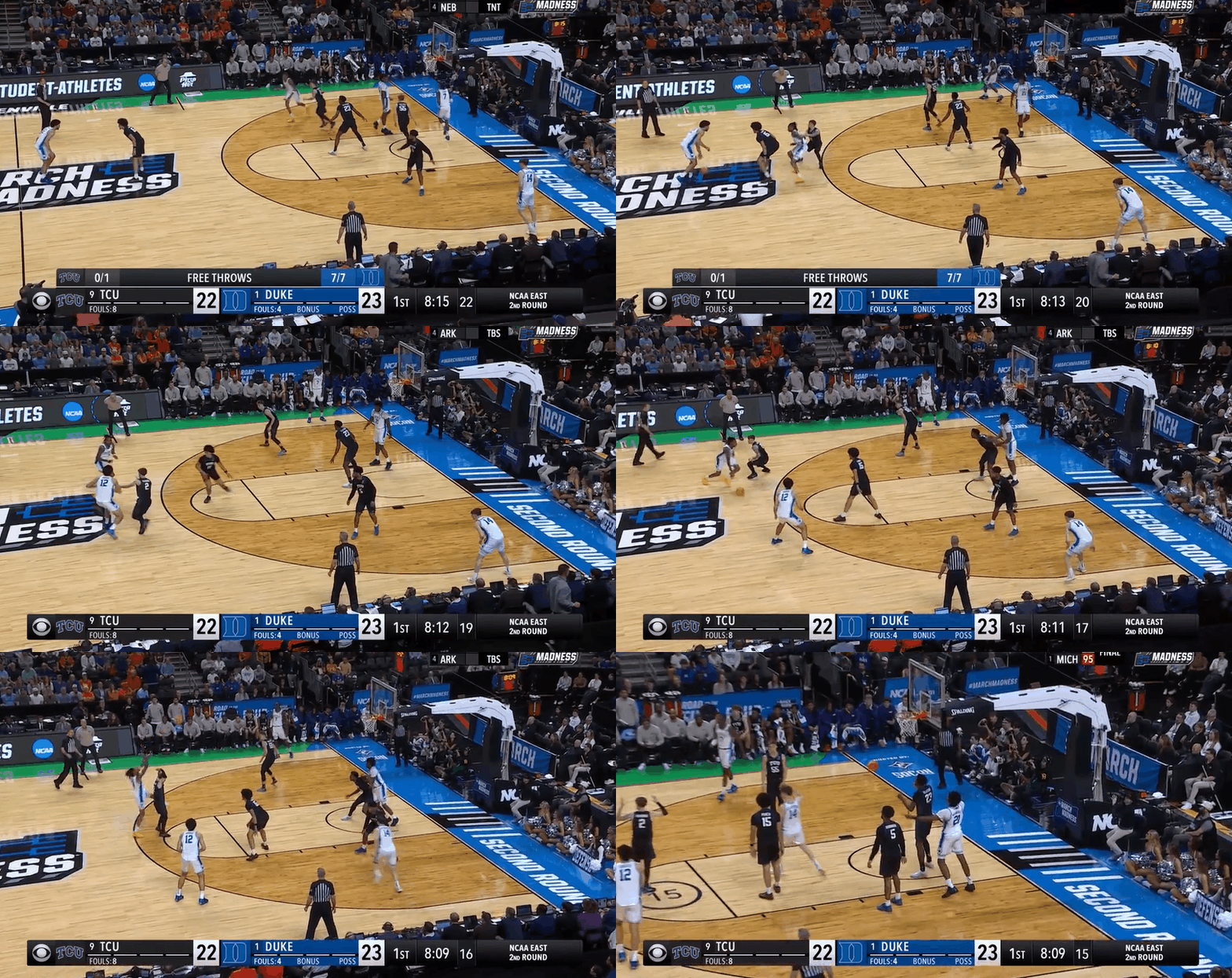
It is a go-to crunch-time action for the Blue Devils, but they can deploy it any time to get their two best offensive players in advantageous situations.
Having a week to prepare should help Pitino and the Red Storm be ready for such actions (and the bevy of other great stuff that Scheyer and his staff deploy). The Red Storm probably have the best defensive personnel Duke has seen all season aside from Michigan and arguably Florida; Duke won both of those games, but narrowly, and mostly with its defense.
That brings us to the greater concern for St. John’s: the offensive end, where it could be a labor to score against the Blue Devils’ set defense. Duke is enormous at every position, particularly with big Pat Ngongba back in the fold (he did not look 100% on Saturday, but he will have had five full days off between games). With Ngongba on the floor, Duke is a deadly drop coverage defense, forcing opposing guards to hit jumpers and locking down the defensive glass.
That could spell trouble for an offense that can be streaky when it has to rely on Darling, Ian Jackson, Oziyah Sellers and Joson Sanon to generate looks. One of those players could emerge as an unlikely hero, but if SJU’s game plan relies on that, they’re grasping at straws somewhat.
The Red Storm will invert the floor some and initiate through Ejiofor, who has blossomed as a passer this year. Duke can “dork” both Zuby (5/19 from 3 in his last seven games) and the non-shooting Mitchell, though, and if the Blue Devils’ length can stay packed inside the arc, the path to scoring becomes even more challenging.
Thus, St. John’s needs – needs – offensive rebounds. The Red Storm need to be much closer to Florida’s production on the boards against Duke (20 offensive rebounds, 47.6% rate) than Michigan (eight, 22.2%) to have a chance. Expect Ejiofor, Mitchell, Hopkins and Ruben Prey to attack the glass with abandon.
Added note: apparently Caleb Foster is probably going to play, which I’m having difficulty comprehending (four weeks from foot surgery??). I’m also struggling to decide how much that will matter in his first game back from that absence; my guess is not much. Take it was you will. - Jim Root
The one major concern I have for Duke that Jim did not mention in his writeup is how Duke, and namely Cayden Boozer, handle the St. John's press. The Red Storm use pressure on 24% of all defensive possessions, the No. 17 mark in the country and the second-highest amongst Duke opponents this season, just behind Virginia. The difference is St. John's is looking to turn you over far more than the Cavaliers, who have a turnover rate nearly 3% lower in those sets.
Kansas turned it over a whopping five times against the St. John's pressure, just constantly being in poor communication between the inbounder and the receiver. Duke has been fine its the small sample size against press this year, but haven't faced one with only one true ball handler in Cayden Boozer.
If Foster is out or extremely limited, no other Blue Devils guard sports even a 10% assist rate. That's before mentioning Boozer's turnover rate is 6% higher in Tier A games. I would imagine Cameron Boozer is the inbounder or the secondary ball handler that is required against Pitino's pressure. But that not only puts a third player in that action who does not want the ball in his hands, but puts a lot more strain on the bigger Boozer to do more than he already does, which is pretty much everything for Duke.
One has to imagine Duke is prepared for this, and that St. John's will pick up maybe a couple of extra possessions from it. But between the actual turnovers forced and the strain it will take on Duke's short rotation, I wonder if that press ends up being the difference in the game.
That said, it's worth mentioning St. John's' five turnovers forced against Kansas in press were all dead-ball, meaning the Johnnies didn't get a transition attempt out of the play. As Jim mentioned, the Red Storm could struggle mightily against Duke's halfcourt defense, and this area of the game is not likely to change that much - Matthew Winick
(2) UConn (-1.5) vs. (3) Michigan State, 9:45 PM ET, CBS.
I don't have much to add from East Region reset, where I broke this game down.
Against UConn, I always immediately look at how opposing defenses defend off the ball, and the returns ain't great for Sparty: 2nd percentile efficiency rating on a 55th percentile rate, per Synergy data. This reared its ugly head in what was Sparty's worst loss of the season at Minnesota. The Gophers scored 1.21 PPP overall and an astounding 1.4 PPP off the ball.
MSU's hedge and general ethos defensively is elite at cutting off the dribble and denying ball handlers at point of attack- that's not really a "thing" in UConn's offensive system, and the Huskies usually redirect offense away from hedge/help defenses, but struggle against strong drop coverages that camp out on the perimeter and switch the off ball stuff. UConn's sets are also elite at detouring defensive traffic away from Tarris Reed and letting him go to work 1v1 in the post. Izzo is generally going to defend 1v1 there with Carson Cooper, who allows just .68 PPP defending mano y mano in the post (the flip side of this is Jaxon Kohler chasing Alex Karaban around screens on the perimeter). The two way post battle is definitely one to watch, especially if Solo Ball (who might have shot his way out of the rotation anyway) and Braylon Mullins continue to struggle to shoot the ball, as 3-25 from 3 against this Sparty defensive scheme is simply not going to cut it, especially if Reed is being neutralized.
While UConn has struggled to shoot the ball this tournament, Sparty has ironically thrived, as noted above. UConn however deploys the opposite ethos defensively as their counterpart, as they generally want to defend with as little help as possible (although Reed will be in hedge and recover on the Fears ball screen). As noted, these are opposing defensive philosophies, and where MSU denies the rim at all costs with their gap help, UConn is funneling you off the 3PT line via ball screens and isos and into Reed's enormous wingspan at the rim. This makes UConn an elite rim 2PT% defense, but also can expose Reed to foul trouble. But generally speaking, forcing Fears and the Sparty offense into isolation and keeping them in front is the way to go, as you don't want to be lobbed to death behind your defense by Coen Carr and the third highest dunk rate overall in the country.
Finally there's the all important transition battle against Sparty. Tom Izzo is the undisputed champion of hunting early offense, and this year's MSU offense is typically elite in that regard, sporting an 82nd percentile transition rate with a 91st percentile efficiency rating (per Synergy data). UConn however allows transition at just a 29th percentile rate with a 91st percentile efficiency rating. If we're considering this to be a halfcourt contest, which I think it will, I like the alignment of UConn's halfcourt offense (assuming someone actually hits jump shots) vs Sparty's halfcourt defensive scheme more than vice versa. - Jordan Majewski
Midwest Region
(1) Michigan (-9.5) vs. (4) Alabama, 7:35 PM ET, TBS.
Splitting this one with Jim, so I won't be too verbose. I have a hard time seeing an upset path here that doesn't involve at least one of the following two items:
- Michigan shooting worse than 28% from three;
- Alabama shooting 40% or better from three.
And even if both happen, there may not be severe enough of a gap to overcome the gigantic frontcourt advantage Michigan should have in this game. Against high-major defenses outside of the top-40 nationally, Michigan is +15% from two, shooting 65% at the rim, and is +8.5 per 100 on the boards. Alabama, against top-40 offenses: 51% 2PT% allowed, 57% at the rim, and 1.19 PPP.
Still: can it happen? Yeah, sure, why not. Alabama is routinely elite against drop coverage that allows them to get threes off, and while Michigan will be at the level at the very least, we don't have to look much further than Bama's win over St. John's back in November for the path to a really nice day at the office. There, Labaron Philon dumped 25 points on St. John's as Alabama scored 48 points in the pick-and-roll, much of which came when the Johnnies couldn't guard Philon or a certain backcourt partner whether they were headed downhill or shot over the top of the drop.
The absence of that backcourt partner looms large over this game for me. Alabama survived opening weekend without Aden Holloway just fine, and there's a school of thought from smart people that no Holloway = no problem for the Tide. I can't quite get there myself for the following reason: against top-50 teams this year, there wasn't a huge difference when Holloway was off the court, as he's a bad perimeter defender. In fact, Alabama's defense is better without him. However: without Holloway, Alabama's eFG% dropped by 2% and their overall offensive efficiency dropped by seven points per 100 possessions.
This shows up most for me in how Alabama operates in terms of attacking the paint. Sans Holloway, Bama's rim attempt rate drops from 34% to 31%, and while it's not obvious, you can make an argument Bama misses Holloway's ability to create for himself off the dribble as their best all-around shooter. Post play (not Alabama's thing) and off-ball motion (also not Alabama's thing) won't be much of an issue here; it's all P&R, all the time when in half-court. Some all-P&R offenses have had great days against Michigan, and certainly some may point to the Wisconsin game as the best-case scenario. The downside would be the Illinois game, who Alabama is most similar to. In that game, Michigan went to Champaign and held Illinois to 1.054 PPP (their second-worst game of the year).
The other side of the court is less exciting for upset purposes. Basically, I have no idea who or what on Alabama's roster is going to slow down Michigan's three-pronged frontcourt for any length of time. Aiden Sherrell is the best shot, which would be more exciting if Sherrell wasn't averaging 4.5 fouls per 40 against top-50 competition. When Sherrell is on the court against top-50 competition, Alabama holds their competition to 48% from two and 53% at the rim. When he leaves the court: 52% twos, 59% at the rim. If he can't play at least 30 minutes here I don't like Alabama's odds.
The Tide's P&R defense is better than you think so I actually think they can hold up okay there, but teams with quality off-ball motion (hi, Tennessee) have been able to rip them up, great news for a Michigan team who has an NBA playbook full of those actions. I feel that this could be a big Trey McKenney game, for example, as he's been great running off of these off-ball screens for a few months.
I strongly lean Michigan here, as against top-25 offenses the Tide have given up a brutal 1.21 PPP, meaning in an expected 75-possession game at KenPom you're betting on a Michigan defense that allowed more than 80 in regulation once all season to give up 90+. (In four games against top-10 offenses, M is averaging 74.5 PPG allowed.) Holloway's absence will be felt more here than against TTU, if I had to guess. - Will Warren
Second perspective: Leave it to Will to say he won’t be verbose and then churn out a 700-word masterpiece of a game preview. Alright then, let’s see what else I can add here!
When trying to topple a top seed with considerably more size and talent than you, I vastly prefer the Ben McCollum “park the bus” school of thought than the Nate Oats “attach rockets to the bus and put a cinder block on the gas pedal” approach. Oats is going to go down guns blazing, though (insert joke about Brandon Miller delivering the guns here), so this should be a high-tempo affair between two teams who love to run, run, run.
To wit: Alabama has played six other teams who rank in the top 40 of average possession length on offense (Michigan is 14th). Those six games had 75, 79, 78, 88 (2OT), 77 and 79 possessions. This one seems like a borderline lock for 75+ chances on each end.
To me, that’s advantage Michigan. They can exert their physical dominance on a higher possession sample size, and as illustrated by Will, that interior edge is considerable. The SEC did not offer many frontcourt comparisons to gauge Alabama on, but the three closest comps on their schedule – Florida, Arizona and a healthy Gonzaga – made a combined 92 2s in three games and outrebounded the Tide 144-101. Aday Mara, Morez Johnson and Yaxel Lendeborg are licking their chops.
Oats’ answer, of course, will be math. Ever the math teacher, his 3 > 2 approach needs to be on full display in this one. Expect 15+ 3PAs from the Tide frontcourt of Aiden Sherrell, Taylor Bol Bowen, London Jemison and even strangely important Noah Williamson in an attempt to pull the gigantic Wolverine bigs out from the rim.
Theoretically, that could open some space for Labaron Philon to work his wizardry off the bench (and to a lesser extent, Amari Allen as well). Those two will find ways to get into the paint; the issue is whether they can finish against size consistently.
In those three comparable games, Philon was 9-of-22 inside the arc; however, he was 1-of-10 against Florida and Arizona, who have more similar rim protection to these Wolverines. Allen has more size, but even so, this game will be decided from beyond the arc. And that is not just true of Alabama’s high-volume bombing; Michigan is undefeated when it shoots 33% or better from deep.
One of Michigan’s few weaknesses all season has been ball control, as the Wolverines’ penchant to seek highlight reel passes and easy 2s has led to inopportune turnovers. Unfortunately, Alabama’s heavy drop coverage defense ranks…358th nationally in forced turnover rate. They will not make the Wolverines’ ball-handlers uncomfortable; they are simply not designed to do so.
My best guess is that this contest plays out somewhat similarly to the Michigan vs. St. Louis game. Alabama hits some triples early and hangs around as both teams feel each other out, but the Wolverines’ shot quality is consistently much better. As the game unfolds, Michigan’s edge inside the arc and on the glass will grind on Alabama, and the Wolverines pressure cook their way to a 15-point win. - Jim Root
(2) Iowa State (-4.5) vs. (6) Tennessee, 10:10 PM ET, TBS.
The game nearest and dearest to my heart is predictably the last one of the entire weekend and the one that will cause a sleepless night or two. When brackets were initially announced I had this circled as Tennessee's unofficial 'stopping point', i.e. the first matchup where I thought they'd be at a clear disadvantage. Now, when the bracket came out, I didn't know that Tennessee would actually 100% get to this game, or that Iowa State would suffer an injury to their best player that makes him questionable to play in this game.
I caution reading too much into either team's most recent game. For Iowa State, they played a team extremely unlike Tennessee, in that Kentucky has no point guard but two 2-guards that are their ball-handlers, without much in the way of great rim stopping. Tennessee has a point guard, but no true 2-guard (Bishop Boswell is the closest) and significantly better defensive options down low. Tennessee's side of this is going from playing a team with drop coverage whose weak spot was perimeter defense with strengths in 5-out offense where everyone lets threes fly to...well, Iowa State.
For the purpose of our preview, I'm going to assume that Joshua Jefferson is either out or fairly limited. The more I've read about the injury the more it seems likely he'd be limited at best. If so, the way Iowa State is going to play offensively becomes a little less diverse. Sans Jefferson against top-150 competition (a sample of 406 possessions), ISU's rate of jumpers off the dribble nearly triples, for one. However, more important to a tactics battle is this: ISU's rate of post-ups is cut in half, and they up their use of P&R and DHOs way more to compensate. Essentially, while it won't appear that way in pure shooting splits, it's much more perimeter-oriented. Tamin Lipsey's usage jumps to 26%; Jamarion Batemon goes from 16% to 22%; even Killyan Toure jumps to nearly 22%.
None of those guys are the most impactful to offense, though. Arguably. I would say that's Milan Momcilovic, who is lethal when given literally any space and is the best shooter in college basketball this year. The best way to avoid getting buried alive by Milan threes is to simply not allow him to get them off, and as mentioned several times on this site Tennessee is among the nation's elite at off-ball denial. Then again I'd say Arizona's pretty good at limiting off-ball motion impacts, and even they gave up threes off of several off-ball screens to him.
The challenge with Momcilovic, highly likely to play at least 35 minutes in this game, is that the guy simply never stops moving. Because Momcilovic isn't a driver at all - he has seven rim attempts since Valentine's Day - Tennessee's best bet here is to attach Bishop Boswell or Amari Evans, inarguably the team's two best perimeter defenders at this stage, to Momcilovic's hip and top-lock the hell out of him. But the guy is lethal going to his left and his right. Neither is really optimal or better than the other.
The reduction in post-ups is genuinely really important here, because while Tennessee does have great rim protection, I would argue they don't have great post defense, not this year. Their best post defender is Felix Okpara, but if Okpara's not having to defend Jefferson that frees him up to block shots to his heart's desire. (I would also note here that Jefferson versus Jaylen Carey, 1-on-1, would be a nightmare for the Vols.)
The P&R front is what swings the game for me. I'm assuming Momcilovic threes are a given, and honestly if Tennessee limits him to four made triples or less they've done a tremendous job. Tennessee has had issues with elite guards in ball screens, and all you need to do is look back at the UVA game to see them even struggling with a non-elite guard in Dallin Hall:
Which swung the game briefly back UVA's way after Tennessee controlled the game flow for 30+ minutes. I've argued that UT's P&R defense did improve down the stretch and it did, but against skilled ball handlers they remain iffy and they're a lot better when they can use their coverage mix (a near-equal split of hedging, dropping, and switching) to confuse younger/less elite guards. Lipsey is the guy if Jefferson can't go, and per CBB Analytics, he's an astounding 12% worse shooting-wise on the left side of the court versus the right. It's imperative Tennessee doesn't let Lipsey get to his right over and over, because if he does, it's probably ballgame.
My theory is that a no-Jefferson game for Iowa State is going to be felt as more impactful on offense than on defense, as both Nate Heise and Jamarion Batemon (the guys who will generally get more of his minutes) are good defenders (Heise particularly so) and even additional minutes for Killyan Toure are pretty good from a defensive perspective. Plus, nothing about Iowa State's approach should change much defensively with or without Jefferson: it's still a ball screen blitz, lots of traps, and a ton of post denial.
Tennessee has to figure out how to navigate these blitzes and traps, especially because in the SEC this year, nobody played this extreme of a defensive system on the perimeter. (When the most aggressive non-Tennessee perimeter defense is either Arkansas or Texas A&M that feels pretty telling.) Still, they have a leg up here because back in the Players Era Festival they played Houston, who isn't a 1-for-1 copy of Iowa State but is as good of a prep as you can get amongst the P5 possibilities. Tennessee had a tremendous day against Houston, not only avoiding turnovers (nine, which would be a dream number) but putting up 1.26 PPP overall. Why? Well, Ja'Kobi Gillespie and Bishop Boswell were great at defeating the blitz by hitting (usually) Felix Okpara or Jaylen Carey on the short roll and turning it into a 4-on-3 possession:
This is always easier said than done against the blitz and requires a quick-thinking passer and receiver, but Gillespie has become a much quicker thinker offensively as the season's gone on, and for all my complaint about his defense Jaylen Carey's a genuinely good passing big who could play a real role in this game.
Tennessee is also going to run their usual extremely high amounts of off-ball motion and DHOs, or at least try to. The problem here will be Iowa State's excellent perimeter denial, which could lead to a good number of long, fruitless Tennessee possessions (though as anyone who's watched Tennessee for any length of time knows, that comes with the territory). The new and interesting twist this year is being the best offensive rebounding team in the country, and that's the top area I would look for Jefferson's impact to be felt most. In games versus top-50 comp, ISU goes from +3.9 on the boards per 100 to -6.4 without Jefferson, and even when expanded to include top-100 games it's still +6.0 versus -3.4. As such I'd believe that on first shot Iowa State will look the part of the better team, but if the Vols work the boards the way I think they can it's going to lead to a lot of easier second-chance points where ISU can't set up their half-court pressure.
Basically when this game was a bracket zygote, I felt Tennessee wasn't a great matchup on either end of the court, and truth be told I'd still pick Iowa State by a hair here. However, this has gone from a game where I'd pick ISU six or seven out of ten times to a true toss-up where I'd pick each team to win five games each out of a 10-game set. I would be surprised by a blowout in either direction even with shooting variance playing a factor, and this feels like a game that's going to be wide open at the final media timeout. NOTE: if Jefferson plays and is close to full strength, this goes from 'picks Iowa State by a point' to 'picks Iowa State by 5+'. - Will Warren