
...
(7) Kentucky (-4.5) vs. (10) Santa Clara, 12:15 PM ET, CBS.
First game of the day and we get the ever alluring Kentucky matchup against a mid-major in the first round of the tournament. It’s a juicy upset possibility given the up-and-down nature of Mark Pope’s team's season, as well as the components and style Santa Clara likes to play with.
The Broncos are a dangerous team that plays a ton of wings and have multilevel scorers at almost every position. Their 45% three-point attempt rate is in the 81st percentile in college basketball and they are one of the better teams in the country at getting at the rim and three-point attempts in their shot diet. Herb Sendek’s team plays four guys who are shooting 35% or better from three.
A player that Big Blue Nation doomers may already be dreading is sophomore guard Aleksander “Sash” Gavalyugov, who is a sparkplug bench piece averaging 8.8 points per game for Sendek’s team. But why a guy averaging less than double figures? Because when he’s hot, he stays in and he’s gotten hot in games this season. He has four 20+ games, including a 37-point performance against Loyola Marymount and a 23-point performance that sealed the Broncos' victory over Saint Mary’s in the WCC Tournament and thus clinching them as an NCAA Tournament team.
The Broncos are also are a nice blend of young and older players. They have four upperclassmen to go with Gavalyugov and touted NBA Draft prospect Allen Graves, who will be an interesting matchup with Kentucky’s frontcourt. Graves is averaging 11.6 points and 6.5 rebounds per game and is shooting 41.6% from three.
But this game does not come without some advantages for the Wildcats. The Broncos are not a consistent defensive team, and they have allowed off-ball guards to go off when they try to apply ball pressure. Denzel Aberdeen’s performance could very well decide the game because of this. Additionally, the Broncos have significantly limited options in the frontcourt to defend the interior should Bukky Oboye get in foul trouble. The Wildcats will, however, need their frontcourt pieces to show up.
If Malachi Moreno and Mouhamed Dioubate can control the glass and Otega Oweh, Aberdeen and Collin Chandler take care of the basketball, Kentucky has a good shot of controlling this game wire to wire. If not, we could be getting our first upset of the day early. - Tuck Clarry
(5) Texas Tech (-7.5) vs. (12) Akron, 12:40 PM ET, TruTV.
The obvious question people will have w/r/t Texas Tech is how they play without JT Toppin, but to be honest their play post-Toppin has been more or less what you'd like to see. Tech ranks 14th at Torvik in that span. While they don't force turnovers and now suffer negative effects on the defensive boards without him (their defense is 108th, which...yeah), these are items unlikely to be exploited too badly by an Akron team that doesn't get to the foul line at all against top-150 teams (345th in offensive FT Rate), had a negative rebounding margin, and gave up an alarming 1.35 PPP to the four top-75 offenses they drew this year including a 43% DREB%.
My feel is that TTU got a pretty good draw as a whole for how they'll be forced to play, very backcourt-heavy against an Akron team that doesn't defend P&R well and had major issues defending the perimeter against teams that can find kickout opportunities from the paint. A major area of opportunity here is P&R with Christian Anderson and Luke Bamgboye; per Hoop-Explorer these actions are running a white-hot 1.29 PPP since the day Toppin went out. Akron was in the 27th-percentile in defending any sort of pass from a P&R which is a problem when your opponent has Christian Anderson.
The upside for Akron is that they can score on a Texas Tech defense much leakier without Toppin playing. Tech hasn't zoned once this season which will be a problem for a TTU defense struggling majorly to defend P&R right now. If Akron doesn't run a ball screen on >50% of possessions in this game it would be a failure, as Tavari Johnson has the quickness to get downhill and score at the rim against this TTU unit. Still, banking on an upset here means banking on Akron to continue shooting 40% from three as they have over the last month. I can't get there myself. This has very strong Villanova/Winthrop vibes from 2021 to me - 5 seed has severe injury, 12 seed has gaudy record and is the most popular upset pick, and what happens is the 5 seed winning without much trouble. - Will Warren
(1) Arizona (-30.5) vs. (16) Long Island, 1:35 PM ET, TNT.
LIU has uncommon wing athleticism for a 16 seed, but the Sharks rely on a 97th percentile transition rate and a 96th percentile rim rate offensively, while allowing a 96th percentile rim rate and 71st percentile transition rate defensively. That's an analytical profile asking to have this game settled by halftime by this Arizona team. Against Illinois in OOC play, the Sharks allowed 58 points at the rim and 17 points in transition, but did acquit themselves well against Georgia's smaller backcourt and wings, actually owning a double digit lead before running low on bodies due to foul trouble down the stretch. However, Illinois' size in drop coverage against the Sharks' downhill, slashing attack had devastating effects (16 points at the rim), and that doesn't portend easy offense for the Sharks in the halfcourt against the Mo Krivas drop, arguably the best drop coverage scheme in the country. - Jordan Majewski
(3) Virginia (-17.5) vs. (14) Wright State, 1:50 PM ET, TBS.
Bad feeling for ol' Wright State that this will go similarly to the last time they were a 14 seed and got smoked by Tennessee in 2018. Wright can score very effectively in half-court and pounds the post just like they did back then, but that's a really bad idea against an excellent post defense in Virginia. On the other end of the court, teams have been picking apart Wright all season long with off-ball screens, which they simply don't seem well-equipped to defend:
Actions like these could lead to a fairly big offensive day for the Cavs. Somewhat similar to Tennessee's game back then (which the Vols won by 24) this has a strong smell to it of a game where Virginia motors down early and doesn't look back.
The downside of playing in the Horizon League is that Wright State is the rare Tournament team without much of any experience against drop coverage, but dual PGs TJ Burch and Michael Cooper are both talented shooters, with Cooper being particularly versatile in P&R. The problem is that Wright plays primarily through the post, which is a way to get yourself in a hole fast against maybe the best pure post-up defense in the entire field. Hard to tell a team to eschew what they've gone to all year, and Michael Imariagbe can/will try to get involved elsewhere but as mentioned earlier it reminds me a lot of the 2018 Wright team with Loudon Love at center against a Tennessee team that was probably the best pure post defense that year.
Not sure the Hoos have the same getaway power as other 3 seeds - in fact I know they don't - but in this specific setup something in the range of a 14-24 point win feels accurate. Virginia averaged 1.32 PPP against non-top 100 competition this year and held a +16% 2PT% delta in those games. When you get back 44% of your missed shots in said games you're very well equipped to avoid a miserable Round of 64 experience. Wright against top-100 competition: 0.99 PPP. If those held it's an 87-65 UVA victory, so we'll see. - Will Warren
(2) Iowa State (-24.5) vs. (15) Tennessee State, 2:50 PM ET, CBS.
It's cool that TSU is here as a lifelong Tennessee resident, but I don't anticipate their stay to last much more than a couple of hours. It probably won't be enjoyable for more than the first couple of media timeouts if I had to guess. Iowa State is another one of these teams exceptionally unlikely to be upset because of the pure volume of extra shots they generate in the average game. TSU does a great job themselves of defensive shot suppression, but this will be just their third top-100 opponent of the year. In four games versus top-150 comp: -2.1 on turnovers per 100, +1.7 on the boards, and a nasty -13% in 2PT%.
Perhaps unsurprisingly with their ISO-heavy style, Tennessee State was generally much better against drop coverage than anything else this year, which is not at all what you'll get from Iowa State. Closest thing to it TSU has faced would be a really bad version of it from Eastern Illinois, which doesn't encourage me when EIU split the season series with TSU, completely kept TSU off the offensive boards, and held TSU to 1.06 PPP on the whole. If you're posting 1.06 PPP against the #228 defense you're probably looking at something in the 0.8 PPP range against Iowa State, which is obviously not gonna get it done.
This is also without going too in-depth on Iowa State's off-ball motion against a Tennessee State unit that didn't cover those too well, as well as a fairly pedestrian (not bad, just okay) P&R coverage against Tamin Lipsey and crew. Simply having a lot of issues figuring out the TSU path here short of an extreme positive shooting outlier day on contested jumpers. Most likely outcome here is an ISU romp by 25+. - Will Warren
(4) Alabama (-11.5) vs. (13) Hofstra, 3:15 PM ET, TruTV.
Aden Holloway's arrest does actually matter here against Hofstra, as the Tide were +10 offensively with him on the floor per EvanMiya adjusted on/off efficiency data, and that was even more pronounced in SEC games. Hofstra has elite shot making and ball screen/off the dribble creators in Preston Edmead and Cruz Davis, which is exactly what they need against Alabama's drop coverage (both of these offenses are among the elite elite in ball screen creation- as they share practically identical high 90s percentile rates and efficiency ratings).
Hofstra actually runs a better drop coverage on their end, as they allow next to nothing at the rim (6th percentile rim rate, 99th percentile efficiency rating). The Tide of course still have Philon on the ball, and they're not looking to score at the rim anyway, but Bama would really like to see the "against Auburn" version of Amari Allen, as there aren't too many 6'8 ball screen creators in the CAA, and the one the Pride did see in Towson's Tyler Tejada absolutely torched them for 29 in the CAA semis.
Hofstra is capable of shotmaking in the midrange space here, and they were an effective transition denial defense all season (38th percentile allowed, 93rd percentile efficiency rating, so they have the elements necessary to keep this close against the Tide and even have a chance at the upset as this is another game where the underdog isn't at a shot volume disadvantage (Hofstra is a strong offensive rebounding team), but the Tide are still an elite shotmaking team even down Holloway, with Philon and Allen's mismatch potential more than capable of out ball screening and out shotmaking Edmead and Davis- but the component necessary for the upset are certainly present. - Jordan Majewski
(8) Villanova vs. (9) Utah State (-2.5), 4:10 PM ET, TNT.
This is a big-time "show me" game for both teams. Villanova enters the dance without a win over a top 50 KenPom team as representative of a down Big East and Utah State is 1-1 against tournament teams as the lone representative of the Mountain West.
An interesting wrinkle is that Jerrod Calhoun’s Utah State plays a matchup zone style defense, where the team guards specific areas of the halfcourt, but still defends close and straight-up–even switches during actions–which a typical zone doesn’t feature. It’s a style pioneered by Willard’s father and former coach, Ralph Willard.
Full season-wise, the Aggies look to be the better team on both ends of the court. They’re able to manufacture turnovers on defense and exploit numbers in transition. They’re also a balanced team of scorers with transfer guard MJ Collins and junior wing Mason Falslev wreaking havoc as downhill threats. The problem is that Utah State’s offense hasn’t been firing on all cylinders during the final stretch of league play or the conference tournament. They’re shooting 28% from three in their last 5 games.
Villanova will need a big game from Duke Brennan, who has a size advantage down low. The Aggies play relatively small in the frontcourt, but the Wildcats only have Brennan as a true post player capable of exploiting those matchups. How they’re able to do that against a funky, unpredictable zone makes leveraging that advantage difficult.
If Utah State is able to speed up Villanova and create turnovers, they could have a real upperhand. Guards Devin Askew and Acaden Lewis are averaging a combined 4.6 turnovers over the last 5 games. Another underlying facet could also be that Nova will be playing out west while Utah State gets another game in the Viejas Center, where their conference opponent, San Diego State, plays. - Tuck Clarry
(6) Tennessee (-11.5) vs. (11) Miami (OH), 4:25 PM ET, TNT.
Tennessee's last couple of runs against Cinderella-in-waiting have gone horrendously, as the Vols are (unless I'm forgetting someone?) the only team to lose to 2018 Loyola Chicago AND 2023 Florida Atlantic. Naturally, this has led Miami to be this year's Rick Barnes In March popularity contest winner amongst the Twitterati:
Is there any doubt that these Miami (OH) white dudes are about to hit 17 fadeaway 3’s to beat Tennessee???
— Chad Withrow (@TheChadWithrow) March 19, 2026
And as I type on Thursday, Miami (OH) is getting an unbelievable 75% of bets/85% of money to cover, both of which are the highest of any non 1/16 or 2/15 game by some distance. Jordan Majewski covered exceptionally well why Miami was live against SMU on Wednesday:
Yigitoglu can't defend in PNR, which is an issue vs Miami, the most efficient PNR offense in the entire country per Synergy data. As a result Enfield sags off the perimeter/zones at a high rate, neither of which are going to be ideal against this Miami offense. . . . These teams cannot defend each other in PNR, but if SMU is actually missing Edwards AND Washington, the Ponies' offense takes a significant hit.
All pretty true to what happened, per my purview. This is certainly not the peak Tennessee defenses of the last few years but going from playing a SMU defense ranked 127th since NYD to playing Tennessee (top-15 over that same timespan) will certainly be a real adjustment. Tennessee hasn't been an elite P&R team and actually struggles with middle ball screens more than you would imagine, but worth noting a lot of those struggles were against some exceptionally elite offenses in Vanderbilt, Alabama, and Auburn. Tennessee generally handled non-top 50 competition as usual this year (0.91 PPP allowed to teams outside of the top 40, 69.2 PPG allowed to the five offenses closest to Miami OH on Tennessee's schedule) for what it's worth, though with more P&R wobbles than usual.
If Miami is going to score consistently in this game it'll have to look a lot like it did against SMU, where the RedHawks are stepping into threes off the dribble against a Tennessee team that mixes P&R coverages really well but isn't elite at any one of them. (As the resident Tennessee Guy on staff I'll note that the Vols hedge more than anything else, but being able to do a bit of everything is a really nice feature against a Miami team that was least effective against defenses who can switch 1-4.) The Vols were great as usual this year about forcing a lot of long, slow 1-on-1 possessions but without a Mashack to actually be the elite defender, teams were a bit more okay with ISOing the Vols this year. Again though, I'd note that Tennessee faced a pretty outstanding group of ball-handling guards this year, and facing Labaron Philon or Tyler Tanner is perhaps a little different than Peter Suder, as fun as Suder is.
I do think Miami can score on Tennessee and hang there, but defensively this feels like a potential no-go. I mentioned on Twitter that the rebounding and frontcourt gap here is astronomical in favor of Tennessee:
If you move the data back to include top-200 games, they still played like a top-60 team pre-last night. There's rebounding/physicality aspects with Tennessee that will be really hard for them to overcome, but they clearly belong. pic.twitter.com/Airm3OK9Q8
— Will Warren (@statsbywill) March 19, 2026
And true to form, TeamRankings' tool that simulates the boxscore for a game has Tennessee with a bonkers +12 edge on the offensive glass and the equivalent of 10 extra shots than the RedHawks. Against top-200 competition (including the SMU game) Miami got outrebounded by 6.8 per 100 possessions, and even with that filter on Miami's defensive ranking of 135th at Torvik makes them Tennessee's lightest defensive opponent since non-conference play. The last time Tennessee faced a defense outside of the top-120 at KenPom was Valentine's Day against LSU; against non-top 100 defenses the Vols dropped 1.26 PPP this year.
The Vols will run all their usual off-ball motion stuff but they're pounding the post the most they have since Grant Williams was on campus. 89th-percentile in usage and 86th-percentile in efficiency is pretty bad news for a defense that's 32nd-percentile in defending post-ups against a poor SOS:
And while Miami is generally quite aggressive at doubling the post, that could be bad news against a Tennessee offense that was in the 98th-percentile (!) in generating open catch-and-shoot threes this year. Whether Tennessee actually hits those shots is anyone's guess, but per CBB Analytics the Vols get back an insane 49.9% of their missed threes. It's just a lot for Miami's defense to overcome, though I'll note they're better than most think against off-ball motion due to essentially playing 5-out non-stop on both ends. Anecdotally I'll note Tennessee was a little better against hedge coverage (Miami's primary) than drop. My read of this is a game where Miami hangs for the first half (they were much better 1H than 2H this year) but Tennessee slowly presses the gas pedal 2H. - Will Warren
(8) Clemson vs. (9) Iowa (-2.5), 6:50 PM ET, TNT.
Clemson almost always is able to dictate pace against their opponents, owning a 9th percentile transition rate allowed and a 98th percentile late shot clock rate, per Synergy data. Enter Ben McCollum's offense, which operates in transition at just a 2nd percentile rate, and 99th percentile in late clock offense. Clemson's two big lineup has struggled at times defending in ball screens and PNR against elite ball screen offenses, grading out in the 20th percentile in ball screen defensive efficiency rating, and have given up 15+ points to ball screen operators in each of their last 3 losses- that doesn't seem particularly ideal against Bennett Stirtz, who is an expert at snaking that ball screen which the Tigers have had issues staying with.
Clemson meanwhile plays heavily through their frontcourt (even without Welling), and Iowa grades out as a 3rd percentile rim defense. Both of these teams have barely been fringe top 50 over the past month+, but have exploitable matchups in this ultimate grinder (this is an Iowa defense that was bullied by Josh Reed in the post, and Clemson posts at a 96th percentile rate with a 97th percentile efficiency rating). I'm slightly more inclined towards Stirtz controlling the game with his ball screen, as Clemson's whole defensive thesis is making the right switch and forcing isolation at a 98th percentile rate, but Iowa just ball screens methodically until they get the matchup they want for Stirtz. - Jordan Majewski
(5) St. John's (-9.5) vs. (12) Northern Iowa, 7:10 PM ET, CBS.
More to this game than meets the eye for the average neutral observer, who sees St. John's is 19-1 in their last 20 and believes an easy cruise to the Sweet Sixteen lies ahead for the Johnnies. Certainly can happen, but I'll note up top here that not all 19-1s are created equal. Despite the gaudy record, the Johnnies rank below all of Iowa State, Purdue, Illinois, and Texas Tech at Torvik over their last 20 (all teams with 5+ losses), and since February 1 this is the sport's 75th-best offense, sitting 316th in eFG%.
I think the Big East Tournament along with UConn's late-season swoon may have helped cover up some of SJU's issues, to go with some astonishing late-game shooting luck (opponents shot 20% from deep in the final 8 minutes of St. John's games from February 1 to now). There's still plenty imperfections surrounding this team, which has almost entirely become the Zuby Show as Bryce Hopkins' usage has dipped and as the team almost entirely plays through the frontcourt now, with extremely low guard usage rates outside of Dylan Darling's minutes.
All of that makes for a fascinating matchup against the very best mid-major post defense in the entire field and possibly the third-best alive here outside of Virginia/Gonzaga. St. John's is a tough matchup for anybody down low, but in terms of average post-up rate the Missouri Valley had the highest average post usage of any conference in America this year, which included some excellent post-first offenses like Illinois State and Belmont. UNI also had the fortune(?) of playing Saint Mary's in the non-con, perhaps the best post prep you can possibly get.
In that game, an SMC offense with better shooting than SJU got held to 63 points in an absolute slog of a game (62 possessions) and shot just 39% from 2 in one of their worst efforts of the year. They won entirely because of rebounding, which is as usual a worry in any game featuring the Johnnies, who should have a significant edge. Still, I'd note that even against the best of the best UNI held up extremely well, holding SMC to 0.82 PPP on post-ups. Worth noting the Panthers have a very high double rate in the post:
But this may not be a great idea against Ejiofor, a very good passer for a big who has SJU's highest Assist%. Part of that is the function of not having a point guard (who could have guessed that might be an issue) but any big capable of putting up 16/12/10 (as he did against Villanova) is probably pretty good at his job. Getting the ball to Ejiofor will be the main task, though, as UNI's hard hedge was the crux of a tremendous P&R coverage this season (93rd-percentile). Weird to note, but no team in the entire P5 this year faced less hedge coverage than St. John's (per Basketball Index). SJU isn't a P&R team by any stretch, but everyone uses ball screens and if SJU can handle the severe pressure applied by UNI here will be important.
The other end of the court is fascinating in its own right. Northern Iowa plays about the way you would expect Northern Iowa to play: very slow, very deliberate, with almost no pushing after misses. Most of what St. John's does defensively is outstanding, and I'm not expecting UNI to get much done in P&R or in pure post-ups (where Zuby could do to UNI what UNI may do to Zuby). However, one of the most drop-heavy coverages in the field against Trey Campbell has the capacity to be a real problem, and UNI's dribble handoffs were outstanding against basically everyone this year - perhaps less than ideal news for a SJU defense Synergy has in the 38th-percentile in defending off-ball screens and 31st-percentile in handoffs:
Probably pretty clear where I stand but this is a tremendous matchup for UNI and a terrible one for SJU on paper, who really needs a transition-heavy game to score frequently and has become so frontcourt-reliant that their backcourt suffers because of it. Also worth noting the obvious: in games where Tristan Smith (UNI's most impactful player and best perimeter defender) was available, the Panthers have played like a top-50 team at Torvik. Have liked UNI here since Selection Sunday and I'm not stopping now, though the path to a huge miss by me is SJU breaking through UNI's outstanding defensive rebounding and simply getting to the foul line on a loop. - Will Warren
(7) UCLA (-5.5) vs. (10) UCF, 7:25 PM ET, TBS.
Two teams headed in opposite directions meet in Philadelphia on Friday night. The Bruins have seemed to find their footing despite their two leading scorers, Tyler Bilodeau and Donovan Dent, exited the Big Ten Tournament with injuries. Reports are that both will be available for this game.
The Bruins put up a worthy fight against Purdue after Dent left in the first half of their conference tournament game, but the transfer guard has been massive for Mick Cronin’s team as of late, playing like the player that made him one of the most sought-after players in the portal last year. Over his last five games, Dent leads the country in assist percentage (51%) and holds a turnover percentage of just 7.3%.
The Knights are desperate to find some consistency on offense. Journeyman Riley Kugel is the lone player on UCF to be shooting 35% or better from three over the team’s last 10 games. UCF as a team went 6 for 45 from deep in the Big 12 Tournament.
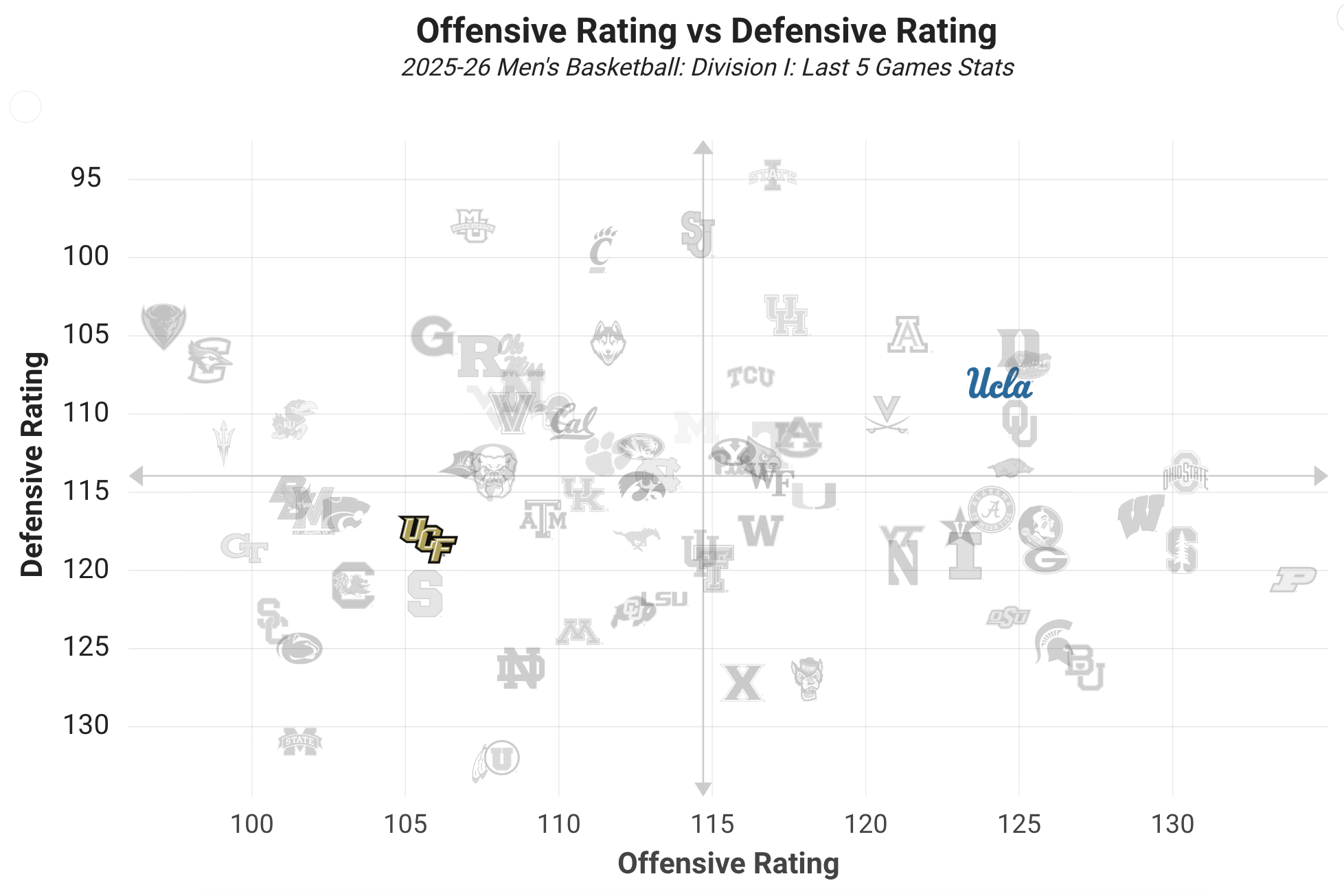
UCLA is shooting 38% on the season and 39% over their last 5 games. Meanwhile, UCF is giving up 37% from the three-point line to teams over their final 5 games. If UCLA is healthy, they may be the most underseeded team in the tournament, given how they played to close out the regular season and how they showed up at the Big Ten Tournament in Chicago.
For UCF to pull off the upset, they’ll need to win in the frontcourt and win off of second chance points and owning the glass, something UCLA has struggled with this season. They’ll also need a solid game from wing Jordan Burks, who is averaging 13 points and 4.8 rebounds on the season. The 6-foot-9 wing will likely have a guard on him for stretches of the game, but he’ll need to improve his efficiency to really exploit that matchup. He’s shooting 37.5% from the field and 10% from three over his last 5 games (45% and 36% average for the season). - Tuck Clarry
(2) Purdue (-25.5) vs. (15) Queens NC, 7:35 PM ET, TruTV.
Kind of rare to see the 2 seed be a far more midrange reliant offense than the 15 seed, but that's what we have with Purdue and Queens. Purdue deliberately runs their actions to the midrange with TKR such a solid short roll decision maker, while Queens is top 20 rim and 3 offense nationally as a mostly positionless drive and kick offense. Queens actually has big, versatile ball handling wings that can move the ball and exploit Purdue's hedge and switch, and they don't turn the ball over at a high rate at all (lowest in the ASUN), which you typically see in "positionless" basketball like this. The problem for the Royals? They played 5 games against top 100 competition and allowed an unreal 1.43 PPP. Queens also generally switches 1-5 with their versatility and single covered the post in the ASUN, which resulted in a 95th percentile post rate allowed at a 7th percentile efficiency rating. Queens will surely realize very early they can't island TKR and Oscar Cluff in the post, who comprised a 95th percentile post rate offense with a 99th percentile efficiency rating. Queens' general philosophy defensively is to not help, but that's clearly not going to work on the block. Queens might put up a solid offensive game with their bigger shot creating wings (especially through Jordan Watford), but the Boilers can likely name their number offensively, and Braden Smith should have the assist record before the first media timeout. - Jordan Majewski
(1) Florida (-31.5) vs. (16) Prairie View A&M, 9:25 PM ET, TNT.
Florida only played five teams ranked below 150 in KenPom this year, and won those games by 40, 41, 30, and 22. The games were so lopsided, that everyone's favorite 7-foot-9 preferred walk-on Olivier Rioux saw time in four of them. Odds are, he sees the floor here.
While Prairie View A&M has certainly improved drastically from the start of the year, the buy-game numbers are pretty brutal. Most notably, in their five games against top-100 teams, they were outrebounded 234-149. And now they draw the best rebounding team in the country. This will likely be an absolute bloodbath on the interior and the glass.
Honestly, there's not much else to say here. Florida will pick its number, and win by that much. This game has the largest spread of any contest of the tournament, and it's for good reason. - Matthew Winick
(4) Kansas (-14.5) vs. (13) Cal Baptist, 9:45 PM ET, CBS.
Kansas' road/neutral offensive woes and shot volume concerns are major red flags in this tournament. The Jayhawks are 308th in eFG% in games away from Phog Allen and 330th in 2PT% offense, and they don't rebound offensively, get to the FT line, shoot a high rate of 3PTAs, or generate turnovers to make up for that. 13 seed Cal Baptist is a very small team on average, but won the WAC on the strength of their strict drop coverage principles defensively, where they denied catch and shoots to the tune of a 15th percentile allowed (and absolutely no one hit the triples they were allowed, as opposing offenses hit threes against the Lancers at the 6th lowest percentage in the country) and defended the rim with an 87th percentile efficiency rating. KU offensively had some consistent efficiency issues against almost every drop coverage they saw this season, and scored in just the 17th percentile in ball screen creation and 28th percentile off the dribble (per Synergy data).
Offensively, the Lancers were carried by Dom Daniels, who is absolutely one of those "elite guards get it done in March" archetypes.
Daniels owns the highest ball screen rate in the entire country, and put up these lines against Big 12 competition this year

(I'm willing to discount that BYU performance given he was on one day rest in back to back altitude). And I have to share this Dom Daniels mixtape:
https://x.com/hoops4_fun/status/2033668211527299246?s=20
Kansas is an elite defensive team despite not forcing turnovers at all, and that's thanks to Flory Bidunga's ability to switch 1-5 or effectively soft hedge and recover with his mobile athleticism, but they have graded out in just the 57th percentile in ball screen defensive efficiency rating. CBU actually owns the shot volume edge here:
(4) Kansas
Shot Volume Index overall: -2.1 (seed average: +4.3)
Easy Shot Volume overall: -2.1 (seed average: +6.3)
SVI, top-150 games only: -3.9
SVI, road/neutral games only: -5.5
ESV, top-150 games only: -3.4
ESV, road/neutral games only: -5.3
Yes, these numbers are accurate. Kansas has the fourth-worst SVI for a 1-4 seed in history. The good news: the other three won in the Round of 64. The bad news: none of them touched the Elite Eight.
(13) Cal Baptist
Shot Volume Index overall: +3.7 (seed average: +3.8)
Easy Shot Volume overall: +9.6 (seed average: +5.1)
SVI, top-150 games only: -2.4
SVI, road/neutral games only: -2.2
ESV, top-150 games only: +2.2
ESV, road/neutral games only: +2.7
Cal Baptist will be just the fifth 13 seed to hold an ESV gap of +10 or better over their 4-seed opponent. The previous four went 2-2, including 2010 Murray State and 2011 Morehead State. If 2026 Cal Baptist wins by exactly one point, you heard it here first.
(Shot Volume data via BUR's own Will Warren)
The Lancers have far less travel coming from the Inland Empire to San Diego, and while their lack of consistent perimeter shooting is more than a bit concerning, there are certainly a few upset elements present here- but more likely a python squeeze final result for Rock Chalk. - Jordan Majewski
(2) UConn (-20.5) vs. (15) Furman, 10 PM ET, TBS.
A lot has been made about Furman’s size (#5 nationally in average height per KenPom) and how it should help the Paladins hold up against the Huskies’ power 5 stature. I’m a little skeptical of that, though, as Furman’s big men are thinner: Cooper Bowser is 6-11, 215 pounds, while Charles Johnston is listed at 6-11, 225. They could be in for a rude awakening against 6-11, 265-pound Tarris Reed and 7-1, 260-pound Eric Reibe. The Paladins did not face a single P5 team this season, so it’s hard to say, but I am skeptical here.
I thought Jordan Majewski made a great point in his region breakdown, though, that Furman has been defending intricate off-ball movement all season in the SoCon. That’s good prep for the Huskies’ web of screening off the ball. To wit: UConn ranks in the 99th percentile in Off Screen frequency on offense; Furman is in the 99th percentile in facing that action defensively. Of course, UConn is a different animal than Chattanooga and Samford.
Furman’s spread offense – typically in four- or five-out alignments – can find some success, but unfortunately, this is arguably Bob Richey’s worst shooting team since arriving at Furman in 2017. The Paladins thrive when ultra-talented freshman point guard Alex Wilkins is attacking off the bounce, but I worry he will not be able to finish against the length and heft of the Huskies, who have been awesome defensively at the rim all year: 54.4% allowed, per CBB Analytics, 98th percentile nationally. UConn may also bug Wilkins’ helter-skelter decision-making, particularly the length and athleticism of Silas Demary.
I’ve been telling myself all season that the SoCon is going to get blasted in the NCAA Tournament. It’s the worst version of the conference in more than a decade, and the No. 6 seed won the conference tournament. Will I listen to myself? Debatable, because I do think the Paladins have a couple paths to keeping this within 10-15 points, and they might actually be the best team in the league when fully healthy. UConn was also not its usual juggernaut self against inferior foes: the Huskies went 1-4 ATS as a big nonconference favorite (20+).
From a gambling line perspective, seeing this sit above the KenPom spread of 19 raises an eyebrow for me, because I believe the current version of Furman is better than the season-long ranking would indicate. Is that true, though? Or did the Paladins benefit from SoCon tournament shooting luck where they shot 44.8% from deep and their opponents hit 34.3%? Since Bowser returned from a foot injury on Feb. 1 (12 games), Furman ranks just 202nd nationally per Bart Torvik. - Jim Root
(7) Miami FL (-1.5) vs. (10) Missouri, 10:10 PM ET, TruTV.
Some well-documented tricky matchup aspects here: Miami assistant CY Young was on Dennis Gates’ staff at Missouri for the last three years, and Hurricanes’ head coach Jai Lucas coached Missouri star Mark Mitchell during their time together at Duke. Those aspects might give Miami a subtle game-planning edge.
Of course, that could be canceled out entirely by the Tigers’ geographical advantage of playing two hours from campus in a city loaded with Mizzou grads. I do push back on the “home game” aspect, though: I’d guess Kentucky and Iowa State fans (both of whom travel extremely well) will glad cheer against the Tigers.
On the court, the clash in the paint is crucial. For the first time in his tenure, Gates has a team that isn’t staggeringly abysmal on the defensive glass:
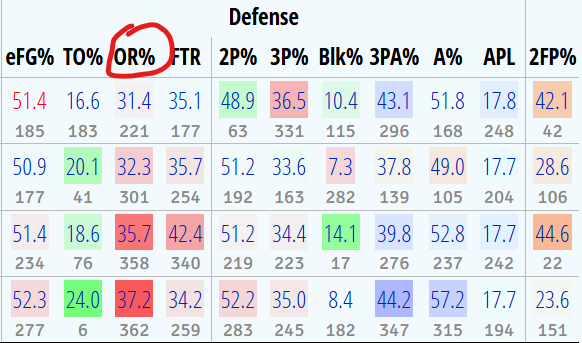
Leaning into much bigger lineups with 6-10 Trent Pierce at the 3, the burly Mitchell at the 4, and 7-footer Shawn Phillips at center has stabilized the glass. Against Miami’s rebounding onslaught led by Ernest Udeh and Malik Reneau, that’s crucial, as the Hurricanes consistently feast on second shots (17th nationally in O-Reb%, per KenPom).
For first shot offense, the Canes want to get Tre Donaldson in ball screens or play through Malik Reneau as a mismatch slasher, the latter of which mirrors Mizzou’s desire to get Mitchell in space against slower or smaller defenders. The two southpaws are interesting mirrors of each other, and any foul trouble for either player would change the game’s dynamic. Mitchell never fouls, though: only 1.6 per 40, 45th lowest rate nationally per KenPom.
The big-bodied, floppy-haired PG matchup of Donaldson and TO Barrett is another potential stalemate. Donaldson is the better shooter and player overall, but both prefer to get downhill off the bounce while using their stout frames to cause problems defensively.
This game likely comes down to the role players. Do Jayden Stone and Pierce knock down tough shots for the Tigers? What about Tru Washington for the Canes? And can Shelton Henderson get downhill off the bounce with his eye-popping athleticism? Both coaches also willingly mix in zone (18.0% of the time for Miami, 14.8% for Missouri, per Synergy), and neither team profiles as a great zone attack. Mizzou at least has a little more shooting.
The build of these teams is similar enough – complete with the crossover of Young on staff – that I could see this becoming a weird slog of the teams battering into each other in the paint. - Jim Root