

Midwest Region Final
(1) Michigan (-8.5) vs. (6) Tennessee, 2:15 PM ET, CBS.
There are various ways on our planet to describe things that we don't expect to happen. Some are surprising. Some are shocking. Some are stunning. Some are such historical outliers that we have no words to really describe them, just various Oh My Gods and No Ways. Tennessee defeating Michigan falls firmly in the surprising category. It would be unlikely, and it would be a moderately off-base outcome, but it would not be stunning, and it would not be a historical outlier. Save for one thing.
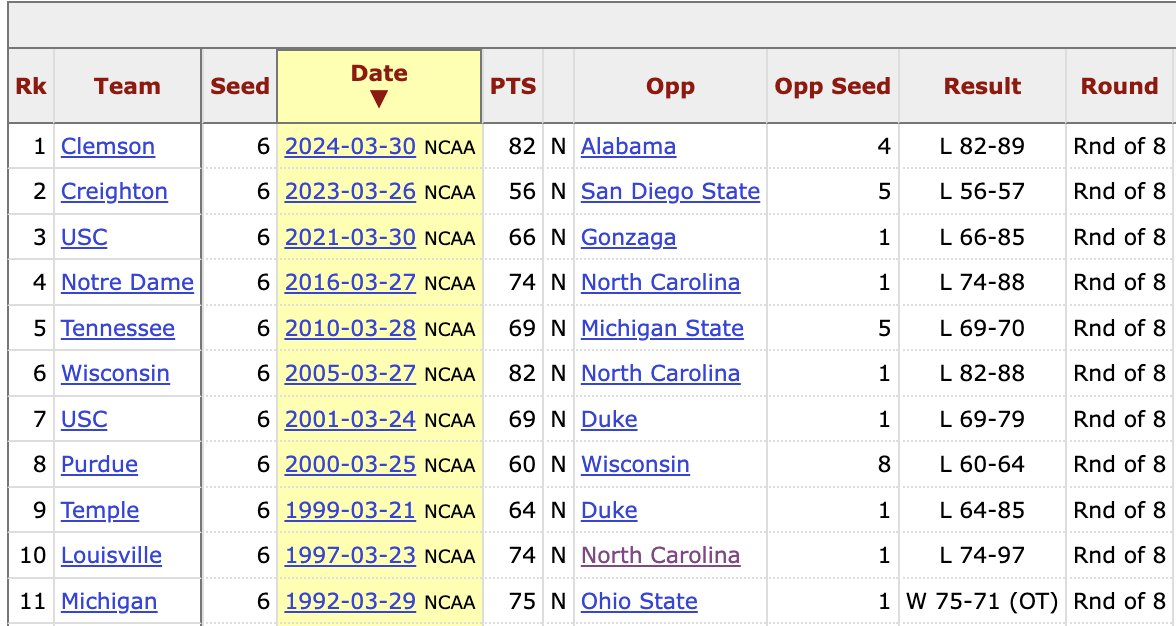
Above are the list of results for 6 seeds in the Elite Eight since Michigan's overtime win over Ohio State in 1992. (I was negative one year old, but Jeez Louise, imagine the vibes for that. 6-over-1 and it's your biggest rival in all sports?) Ten 6-seeds have tried since, and all ten have failed to get over the hump. For 34 years and 32 consecutive NCAA Tournaments, 6 seeds have not made the Final Four. My database of pre-Tournament odds only goes back through 2002, but with the average chance of a 6 seed making the Final Four (4.57% across the last 25 years) extrapolated back to 1993, the odds of 6 seeds going 0-for-128 (or 0-for-131 counting the other three 6s this year), as they have, is 0.3%. Even artificially bumping the odds down to ~4% for the average 6 seed it's still just 0.5%. Moreso than 16-over-1s ever were, it is the greatest statistical outlier in college basketball that most gloss over.
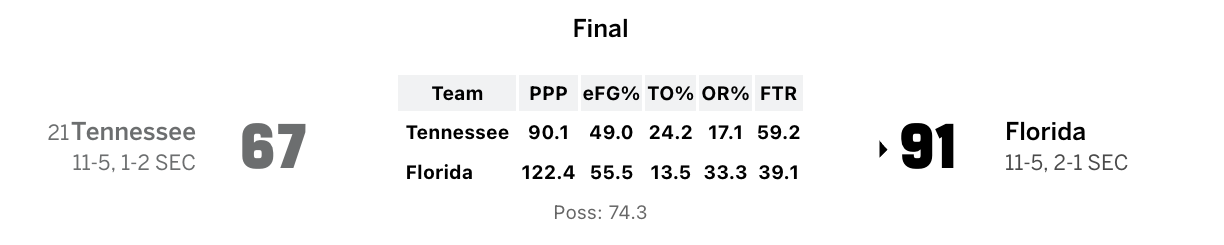
It stands to reason that a 6 seed, any 6 seed, is long overdue to cash in. 34 years is an absurdly long time. Yet viewing this objectively, Michigan is correctly favored to do the normal thing, which is win the game and make another Final Four. They have the best overall player here in Yaxel, probably the third and fourth (and fifth? depending on how you feel about Elliot Cadeau) best players in Mara and Morez...I mean, it should be a clear and obvious advantage, especially given Tennessee's result against the most Michigan-like opponent they've played in Florida. That, if you've forgotten, was a bloodletting.
But hey, it's played on hardwood, not on paper. The first and foremost task for Tennessee is figuring out how to stop a Michigan team in transition that's lit some opponents on fire in the first ten seconds of the shot clock. Against Alabama, a team that will play at NASCAR speeds, Michigan dropped 45 points, 45!!! in the first ten seconds of the shot clock. Through three games, they're at 111 points (37 PPG) in the first ten seconds. Some of that's incredible shooting luck - how often are you gonna continue to make 56% of your transition threes - but a lot of it is pretty simple "we are better, faster, and stronger than you" behavior off of missed shots. And, well...who can disagree?
Tennessee is routinely amongst the nation's best at transition denial, with this year being no exception, but this is also a Tennessee team well-versed in some unfortunate live-ball cough-ups. The Vols have turned it over on nearly 22% of possessions in the Tournament so far, and an absolute demolition of Iowa State on the boards helped cover up a 25% TO%. The only good news for Tennessee there is that 10 of their 17 TOs were of the dead-ball variety, so if you're gonna give Michigan extra possessions at least have the decency to bomb the ball into the fourth row first.
Michigan's half-court attack plan is deceptively simple: lots of pick-and-roll with Cadeau as ball-handler (and some Lendeborg), lots of Mara/Morez in the post, and some off-ball stuff for McKenney/Burnett mixed in. Yaxel will be involved in all of that, as he usually is. Interestingly, Michigan faced a low amount of drop coverage this year thanks to Cadeau (and Lendeborg)'s growth as a shooter, as Basketball Index has them tagged for facing drop on just 8% of possessions. I wouldn't be stunned if Tennessee at least tries it early, and Tennessee does mix coverages exceptionally well, but I probably like Tennessee's odds more to hedge the ball out of Cadeau's hands and force bad passes than I do betting on Cadeau to have a howler out of nowhere. (It's always possible, I guess?)
The post play is a bit more interesting to me. Michigan's fared well regardless of which coverage has been thrown at them, and generally speaking Tennessee prefers to play post-ups 1-on-1. But this is not an elite Tennessee post defense, and the concept of Michigan spamming Mara and Morez in the post over and over against (presumably) some mix of Okpara and Carey is pretty nauseating. That spells tons of foul trouble to me, and both Mara and Morez have smoked their competition 1-on-1 pretty much all year long.
That means Tennessee probably has to double the post a good bit here. I like that much more with Morez than with Mara. The 7'3" Spaniard is as great of a passing big as we've seen in some time. Johnson, while fine at it, is about half the passer Mara is and is more likely to try and bully his way through it. I think you take that chance. I'd also note two things here: that in games against top-30 defenses, Mara's TO% jumps to 24% and his Assist% falls to 14% (18%/20% in all other games). You can induce some Danny Wolf-style "what in God's name are you looking at" passes if you're focused enough in covering the gaps.
The off-ball motion is stuff Tennessee routinely kills before it gets too open, and it's a spot where I imagine Michigan really wishes they had LJ Cason. The real task on those is a lot simpler: you're gonna give up shots in this game, and like it or not it's less scary to let Trey McKenney and Burnett bomb away than it is to get brutally framemogged, or whatever 14-year-olds say now, by the entire Michigan frontline. That might happen anyway but I think you've gotta take the chance of Michigan shooting themselves out of it.
On the other end of the court you should be able to split this game in two: Mara at the 5 and Mara not at the 5. Aday has gotten around ~55% of the minutes against top-25 competition since New Year's. When he's in, Michigan's gonna keep him firmly locked below the free throw line; when he's out and Johnson or even Lendeborg are handling the 5, it's going to be more of a hard hedge. Tennessee is scatterbrained against either, but to my eyes you try and survive the Mara minutes while attempting to thrive with anything else.
Outside of Ja'Kobi Gillespie this isn't really an offense prone to shooting itself out of a jam, and ball-handler Gillespie is less great of a shooter than stationary Gillespie. The good news for the Vols is that drop coverage induces jumpers, which induces variance, which you need to win this game. I thought Gillespie navigated it beautifully against Virginia, and while Michigan is a different animal these are shots you can work with because they're open:
The numerous flex and off-ball cuts Tennessee will run for basically the entire roster matters here, too. Michigan is perhaps only outmatched by Tennessee in terms of stopping off-ball action before it happens, but even the Wolverines got got a few times this year by the Big Ten's better motion offenses. All of Indiana (1.03 PPP), Minnesota (1.04 PPP despite getting one (1) offensive board), and Nebraska (1.01 PPP, but dumped 50 on Michigan in the first half) went north of the 1 PPP border because all three worked to pull Mara out of the paint and make it more of a 5-out game. Tennessee is not going to do exactly that because they've gotta get rebounds, but pulling Mara out opens up driving lanes, which is pretty key here.
I do think offensive rebounding's going to play a real factor here. Tennessee should have the minor shot volume edge here (I'll guess they get off maybe three extra shot attempts), and Michigan did have some rough defensive rebounding days at the office against Michigan State (37.5% OREB% allowed), Duke (39.4%), Purdue (35%) and Illinois (34.3%). If Tennessee can touch that 35% barrier it's going to help their cause a lot, because otherwise this is going to be an appropriately tall task.
Clearly lean Michigan here, and I think the spread is essentially spot-on, but a couple of notes that feel important. One: Michigan has enjoyed the fruits of a 47.3% 3PT% heater in the Tournament so far. It's a three game sample and all, but that's probably not going to continue, as exactly two Final Four teams since 2003 (2009 UNC and 2016 Villanova) have shot north of 45% from deep on the way there. Two: against top-25 defenses, Tennessee has averaged 1.12 PPP. It sounds insane, but that's the rebounding. We'll call it moderate surprise if Michigan doesn't advance, but the path does exist. - Will Warren
Second perspective: Last time these two teams were in this close proximity to each other, Michigan was pulverizing everyone in its path at Players Era in Las Vegas. Tennessee, meanwhile, also went 2-0 in the preliminary rounds but did not get a shot at the championship because that event is a goofy sham with silly rules.
The battle in the paint will be epic. Michigan’s towering trio of Aday Mara, Morez Johnson and Yaxel Lendeborg typically exert their will against overmatched foes, but Tennessee’s deep stable of bruisers – Felix Okpara (aka Blockpara), JP Estrella, Jaylen Carey and DeWayne Brown – can battle tooth and nail with the Wolverines.
Friday night was not really a Mara game. Alabama could move him around with floor-spacing big men and wear him out in a high-tempo game, and he generally struggled, posting only eight points and five rebounds, well below his averages in the past five contests of 16.4 PPG and 6.8 RPG. Against the Vols, though, Mara’s enormous length will be a weapon.
Tennessee consistently has two non-shooting bigs on the floor, meaning the immense Mara should be able to spend more of his time near the rim. The Vols thrive via offensive rebounding – they demolished Iowa State in that department, corralling over half their misses – but Michigan has the size to compete there.
The Wolverines are not impervious on the defensive glass, though. In 22 Q1 games, Michigan has a defensive rebound rate of 71.8%, which ranks 41st in the country. Against Tennessee’s relentless board blitz, even Michigan might succumb at times.
Another key storyline to watch is Tennessee moving Ja’Kobi Gillespie off the ball more frequently. After Friday night’s win over ISU, Rick Barnes spoke glowingly about the development of both Bishop Boswell and Ethan Burg on the ball. Both are known more for their defense, but they have provided some creation that allows Gillespie to hunt shots, and he is a tremendous mover without the ball. Gillespie ranks in the 92nd percentile nationally in frequency of Off Screen possessions, per Synergy, and his movement also draws the attention of the defense.
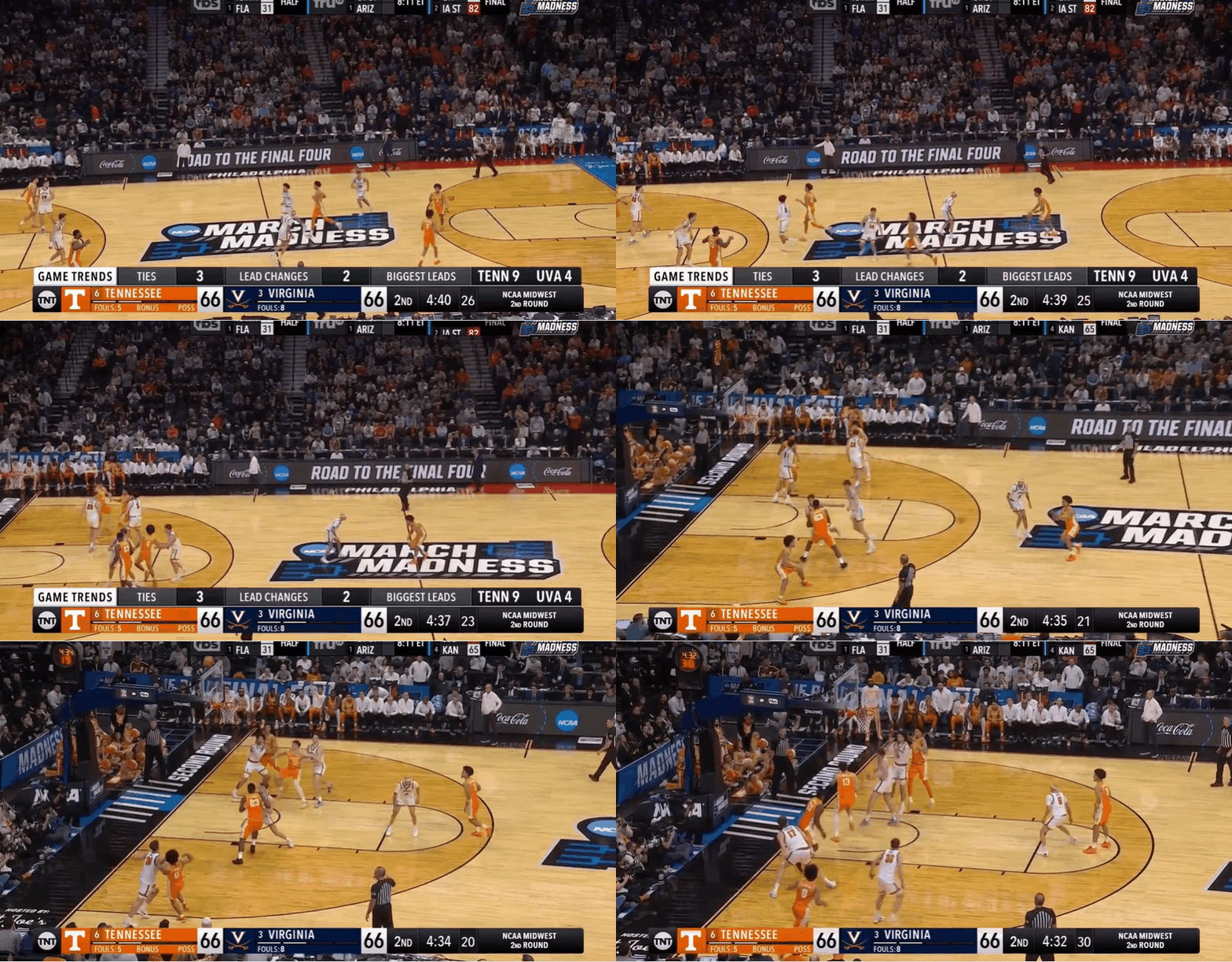
That’s a miss, but it shows how much easier it can be to free their best shooter when he isn’t handling the rock.
For Michigan’s offense, the transition game is a massive part of the Wolverines’ success. They push off makes, misses, turnovers – it doesn’t much matter, as Dusty May’s squad wants to get quick, high-value looks whenever possible. Yaxel Lendeborg is a terror when he gets downhill, and Michigan’s wings – Roddy Gayle, Trey McKenney and Nimari Burnett – thrive when getting shots in the open floor.
Rick Barnes is a fantastic teacher of transition defense, and Tennessee limits both the opportunity and the effectiveness of its opponents in transition. That will absolutely need to be the case here for Tennessee to compete; this game must be a half court affair.
In the half court, Michigan will play through the post quite a bit, and Tennessee’s ability to limit that could be pivotal. The Vols grade out as just average in post defense, per Synergy, but they do have the physicality and the compact scheme to bother Michigan’s bludgeoning bigs.
The Volunteers thrive via winning the paint war while Gillespie and Ament make enough plays offensively. Against a Michigan team that can neutralize that interior advantage, and one that has arguably the nation’s best defender for Ament (Lendeborg), the Vols could be in trouble. I lean Michigan here, though at some point, the Wolverines probably will not shoot 48% from 3. If they do, they’ll roll through this game. - Jim Root
East Region Final
(1) Duke (-5.5) vs. (2) UConn, 5:05 PM ET, CBS.
Duke survived an insane shooting night from St. John's (even Dillon Mitchell hit a 3) and the Johnnies' disruptive pressure by dominating the rim yet again, outscoring their opponent 41-22 at the rim for the second straight tournament game. Caleb Foster put forth a heroic second half effort, scoring 11 points and routinely cracking the St. John's ball pressure with his dribble.
Duke also tripled up the Johnnies at the free throw line, and I have no time for a "Duke whistle" narrative here, as the Blue Devil defensive game plan worked to perfection in terms of keeping St. John's off the rim and making them jump shooters, thus limiting their aggression. Duke was the far more aggressive offense, and that was reflected in the free throw disparity. Only 30% of St. John's offensive possessions ended at the rim, which tied for their lowest rate of the entire season. This game wouldn't have been the thriller it was without the Johnnies getting 10 combined threes from Zuby, Darling, Prey (4-4!), Mitchell, and Hopkins.
UConn meanwhile jumped all over Michigan State early, sustained the inevitable Sparty counterpunch when Izzo changed his defensive alignment, and held on late. UConn scored 15 points via off-ball screen, their second highest total of the season, at a 1.4 PPP clip
often using Sparty's two bigs against them. Notably Solo Ball hit two triples in this game (the first time all tournament he’s done, which also meant the first time he’s scored in double figures since March 12) and required Sparty's full attention defensively. Sparty’s defensive attention required off the ball led to multiple mismatches for Tarris Reed (a core tenet of the UConn offensive scheme), which in turn put Michigan State’s defense in a bind, as they couldn’t defend him 1v1. Then when Izzo did decide to help on Reed, he started dropping dimes as a 5 out hub passer.
The core of this matchup is UConn’s perpetual motion machine offensively (UConn didn’t score a single point on the ball last night against Sparty) vs Duke’s ability to disrupt it with 1-4 and 1-5 switching- an elite drop big and 1-4 switching has long been the “defensive skeleton key” against Hurley’s 4-5 out spacing and motion- but it also creates those Reed mismatches in the post.
Duke has been slightly vulnerable defending off ball screening action (52nd percentile efficiency rating), but notably no opponent has scored double digit points in off-ball screens against Duke all season, something UConn has achieved in 18 games this year, and twice in three games this tournament. Again, Duke is going to throw a wrench into this screening action by either switching 1-5 with Maliq Brown's disruptive hands or switching everything on the perimeter and dropping Pat Ngongba- all with the intent of making UConn ball screen/iso creators, where they simply don't operate extensively or efficiently. This was the way of the KalkDrop, where Ryan Kalkbrenner would sit in drop and direct defensive traffic.
Duke forces an 81st percentile isolation rate, and UConn hasn't scored a single point in iso since February 6 against St. John's switching ball pressure, and have scored 9 total points in isolation in the calendar year 2026. Scoring on the ball just isn't a focal point of the Hurley scheme, which makes offensive scoring recourse something of a chore when they face a defense that can effectively switch their actions, like Duke can.
UConn's offensive recourse however can theoretically come from those Tarris Reed post ups, where he has been a dominant force this tournament with UConn clearing out so much space with the window dressing of the off-ball actions.
Reed has made 12 post field goals this tournament after just 10 over the prior 5 games ahead of the tournament. He's also been elite hitting cutters and shooters when their is any form of help or scramble on his touches.
Duke has only doubled the post on 16 total possessions this season, so Reed is going to have potential advantage 1v1 opportunities with the way Duke is going to switch, and we've seen the Blue Devils give up 20 post points in the loss to UNC
and 17 to Texas Tech in the stunner at MSG.
You can "get" Duke in post defense when you target Brown (allowing 1.3 PPP in 1v1 post defense, a 6th percentile grade out per Synergy data) and Boozer (26th percentile efficiency rating grade out). Ngongba's ability to play effective minutes (both he and Foster's health on short rest is a significant story line) against Reed in 1v1 drop coverage is going to be essential, as he's allowed just .64 PPP in that regard, the hands down best post defender in Duke's frontcourt.
Offensively Duke is similarly not a PNR reliant offense, but they will go to the inverted on-balls with Cam Boozer, and Foster as noted changed the course of the game with his on-ball offense. They tend to run just as much flowery off-ball action as UConn, with the difference being they're an elite isolation offense when they have to be thanks to Boozer, Foster, and now Slim Evans' blow by game (all told, Duke scores at a 94th percentile isolation efficiency, per Synergy). UConn isn't necessarily as switch heavy as Duke defensively and they don't play in the gaps generally, preferring to hedge and recover with Reed- but they will do a lot of disguised late switching. UConn's preference to "guard their yard" mostly backfired in the Big East championship, where they surrendered a season high in isolation on 1.2 PPP with Ejiofor and Hopkins routinely isolating at the key and just matriculating their way to the rim.
If Duke turns this into an isolation heavy game on both ends of the floor, they're going to win. I wouldn't be surprised to see Duke struggle a bit out of the gate on short prep against UConn's screening actions and the way their switch can often leave some backside open shots available, but Scheyer has been rivaled by maybe only McCollum and May in terms of second half adjustments in this tournament, and Duke has the highest second half scoring margin in the country season long, per TeamRankings data (UConn meanwhile is top 10 in 1H scoring margin).
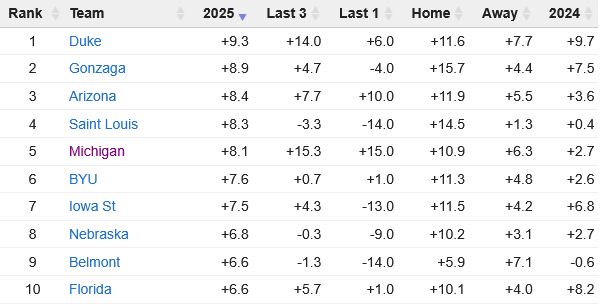
Ultimately I think Duke advances, but I'm skeptical to pick against a man who is undefeated ATS advancing this far into the tournament, so I'll hedge myself with a UConn 1H, Duke 2H and full game cover. - Jordan Majewski
Second Opinion: Since Jordan did such an excellent and thorough job breaking this game down, I'm going to focus on one key area where I think Duke has a massive advantage, and that would be the rim. In short, the Blue Devils will win the game with a big afternoon on the interior, and UConn will win with a giant performance from beyond the arc. But Duke's pathway to success has far less variance.
UConn's defense will always be based on denying assisted threes, ranking No. 1 in fewest field goals allowed on spot-up attempts and No. 9 in fewest makes on catch-and-shoots. Of course the other side of that coin is that the Huskies allow a ton of downhill action and free throws. UConn combats that with elite rim protection, but if you can score efficiently on downhill rim attempts over size and length, there are scoring opportunities. Now let's see who leads the country in points at the rim...
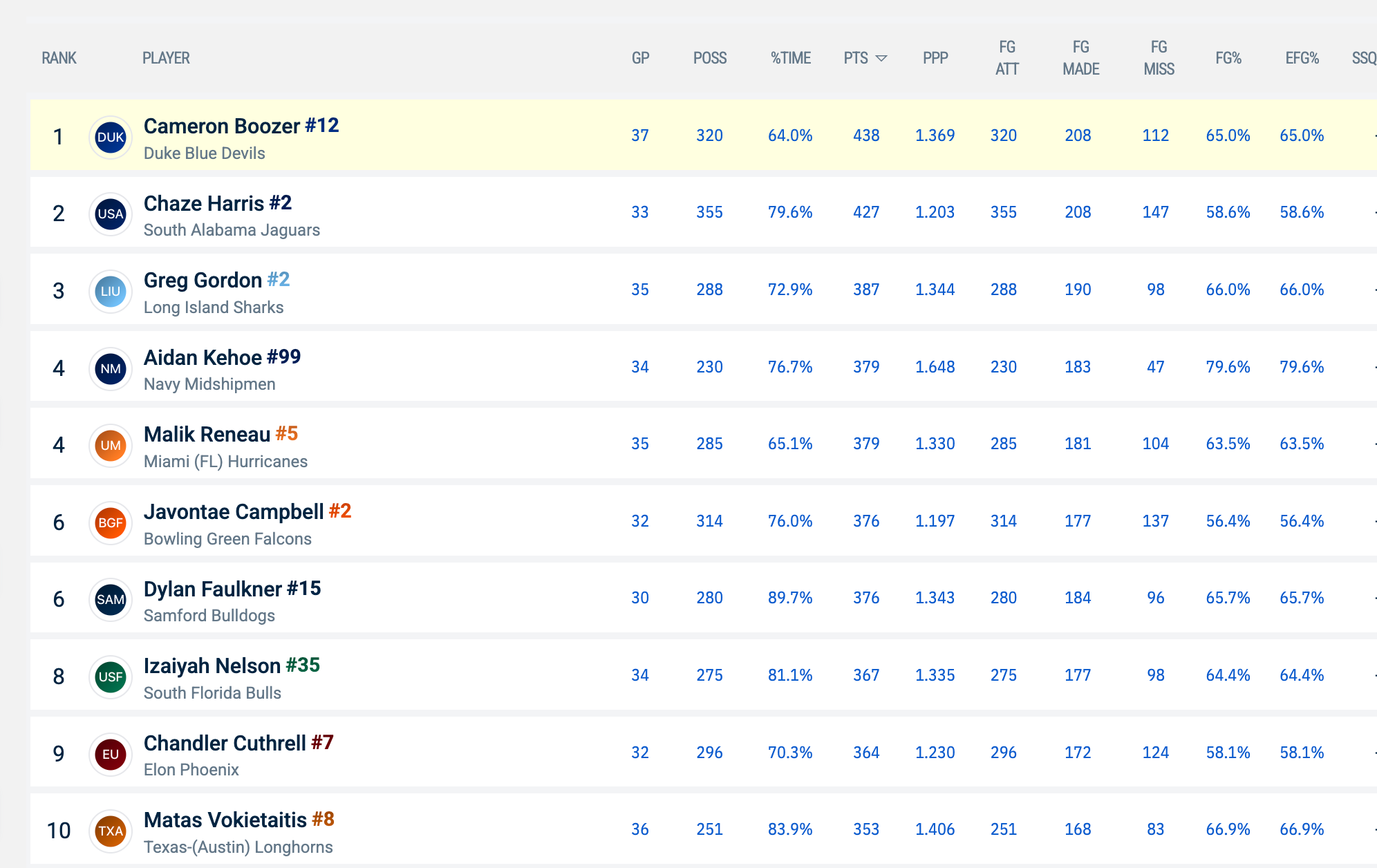
Diving into this further, UConn is 4-3 when teams make more than 20 field goals inside the arc this season. The Huskies average 1.11 points per possession allowed in those games, and it constitutes six of their 10 worst defensive performances of the season. On the flipside, Duke has hit more than 20 2-point field goals in nine of the 12 games it has had a 3-point rate under 40%, which is quite likely here.
In simpler terms, UConn's defense struggles when teams can score at volume on the interior because of how well it denies easy threes, and Duke, a top 25 rim offense in the sport with the best rim scorer in the game, should be able to hit the quota that puts UConn in the danger zone.
Duke's rim offense is actually the inferior interior unit compared to its defense. No power conference team allowed fewer points per game at the rim than the Blue Devils. Interestingly, the No. 2 team in that stat is Michigan State, and the Huskies actually fared admirably in that regard.
As Jordan mentioned, UConn's rim opportunities will largely come from Reed with how well Duke denies drives and how rarely the Huskies attack one-on-one. It's very much possible that Reed scores over 50% of UConn's total rim points here.
That brings me to my last key point here, and that's Reed's ability to stay on the court with foul trouble. UConn already fouls a ton with how much it allows at the rim, and obviously the bigs take a brunt of that number. In the six games UConn has played against Top 50 offenses that get to the free throw line at a 38%+ rate, the Huskies got outshot 145-84 at the charity stripe.
With how good Duke is at getting downhill, Reed is going to pick up fouls here. Two early ones for a team 305th in 2-foul participation would completely suck the life out of UConn's interior attack, and make them extraordinarily perimeter dependant. The Huskies were 22 points per 100 possessions better in Big East play with Reed on the floor, and their effective field goal percentage dropped by nearly 6%. That would be a case where UConn would need to get red hot from deep to compete.
All in all, I think the rim is the biggest difference in this game. My prediction is Reed only gets 30 minutes of court time, Duke scores at least 40 points inside the arc, and the Blue Devils win this game by the largest spread of the Elite Eight. - Matthew Winick
