

South Region Final
(3) Illinois (-6.5) vs. (9) Iowa, 6:09 PM ET, TBS.
The key number for Illinois is 1.1. When teams score under 1.1 points per possession against them, the Fighting Illini are 23-0. Above that number, 4-8.
Iowa has played 10 games against Top 25 defenses (Illinois is No. 21), and have cleared 1.1PPP three times in those contests. Which games were those, you might ask?
- Round of 64 vs. Clemson, 1.25PPP
- Round of 32 vs. Florida, 1.19PPP
- Sweet 16 vs. Nebraska, 1.27PPP
Yes, Iowa did not score 1.1PPP in any of its seven games against Top 25 defenses in the regular season, but have done so in all three March Madness contests. Even crazier, the Hawkeyes are shooting below their season average from deep across the three games.
Even crazier is that Iowa has won these games by doing what these defenses wanted them to do.
Clemson is an elite defensive rebounding team, but Iowa handed the Tigers their worst game on the glass all year, grabbing 47% of their misses.
Florida is the No. 8 2-point percentage defense this year, and yet Iowa shot 70.4% inside the arc, the worst game that Gators had all season in that stat.
Nebraska is the No. 18 3-point percentage defense this year, and of course, Iowa shot 43%, which is 5.5% better than any other team has shot all season.
Iowa not only beat three very good teams, but beat them by doing exactly what their opponent is good at preventing. Ben McCollum is simply in his bag right now, as the kids would say.
Even though the Fighting Illini won their first meeting against the Hawkeyes, the interesting stat to me is that Iowa posted the second-highest assist rate Illinois has allowed all year, racking up 19 helpers on 27 made field goals. Iowa big Cam Manyawu played just eight minutes and none in the second half, and I don't think it was a coincidence that he's the team's only non-shooter. With Manyawu out of the game, Iowa plays a true 5-out, which should draw Illinois' gigantic frontline away from the paint, as there is no Chris Cenac-type of punk option on the perimeter.
Look at how open this backdoor was with Tomislav Ivisic worried about Tavion Banks, and David Mirkovic needing to play up on Alvaro Folgueiras. Height advantage negated.
Because Illinois is so giant, the less the defense has to move and shift, the better. Iowa's floor spacing allowed them to score 10 points off of cuts like the action shown above. In the other four games Illinois has allowed that high a tally on cutting action, the team is 1-3 while allowing 1.07, 1.12, 1.31, and 1.26 points per possession.
In other words, expect Iowa to try and spread Illinois out as much as possible and make the pass its friend.
On the other end, Iowa actually has not been very impressive in the Big Dance. The scoring defense is fine, but it's because the games have been absurdly slow. Iowa has allowed over 1.14 points per possession in each of the three contests. That number will almost surely be surpassed by the No. 2 offense in the country.
Though Iowa playing small will help the offense, it has a chance to cripple the defense, with Illinois having either a height and/or physicality advantage at every position. The Fighting Illini may be the best team in the country and hunting and exposing mismatches, and they will have plenty of options here.
Illinois' shot profile was spectacular in the first meeting, taking 20 uncontested Catch-and-Shoot threes, 26 rim attempts, and 11 of everything else. It's hard to do any better than that. However, Illinois went just 7-of-20 (35%) on its open looks. Perhaps that is partially because more than half of them were taken by Illinois' three worst shooters, the Ivisic brothers and Andrej Stojakovic. That's Iowa defense, baby!
The reality is both of these coaches are truly exceptional and gameplanning, and both will be more than prepared in this one. This game will come down to execution, which is something Illinois has done better than nearly any team in the country all season, but that arguably no one is doing better than Iowa right now, especially on the offensive end.
It's pretty absurd that Iowa has made it this far with superstar Stirtz going 6-for-28 from deep. If he breaks out from beyond the arc, I think Iowa finds a way to pull this out. Otherwise, Illinois' positional size advantages at all positions likely break down Iowa's defense enough to pull out a win. - Matthew Winick
Second perspective: It’s an all-Big Ten brawl for a Final Four berth in Houston, as both teams pulled (very slight) upsets on Thursday night to advance to Saturday’s Elite Eight showdown. These two conference mates met only once in the regular season, with Illinois winning at Iowa, 75-69 – though that final score is somewhat misleading as Illinois dominated the game from start to finish.
It’s hard to take too much from the initial matchup, though. Iowa was reportedly impacted heavily by the flu (and may have transferred it to Illinois during that contest), and Iowa’s best rebounder, Cam Manyawu, only played eight minutes.
A few notable statistics from that game, nonetheless: Illinois outshot Iowa inside the arc, 62% to 49%, and outrebounded the Hawkeyes, 38-31. The Illini’s size should theoretically be a major asset, but Iowa’s shocking stand against Florida’s enormous frontline (even on the glass) provides hope that this could come down to ball movement and shot making.
This will be a two-way battle of ball screens, as both teams are built around a ball-dominant star who loves to create out of that action (Iowa’s Bennett Stirtz, Illinois’ Keaton Wagler). Both teams are elite on extraordinary volume – screenshots below per Synergy (Iowa on top, Illinois on bottom):
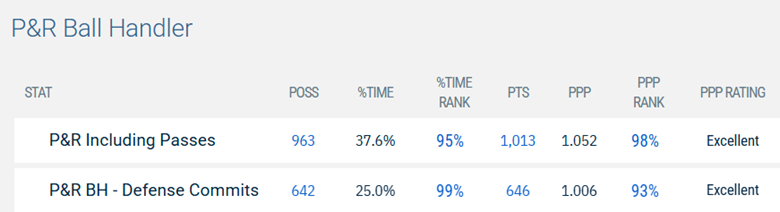
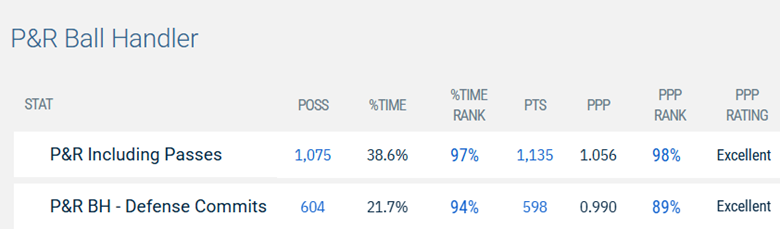
In the first meeting, Iowa leaned more heavily on PnR (36 possessions to Illinois’ 25). The Illini made up the difference by attacking mismatches in the post, and we could see that approach again:
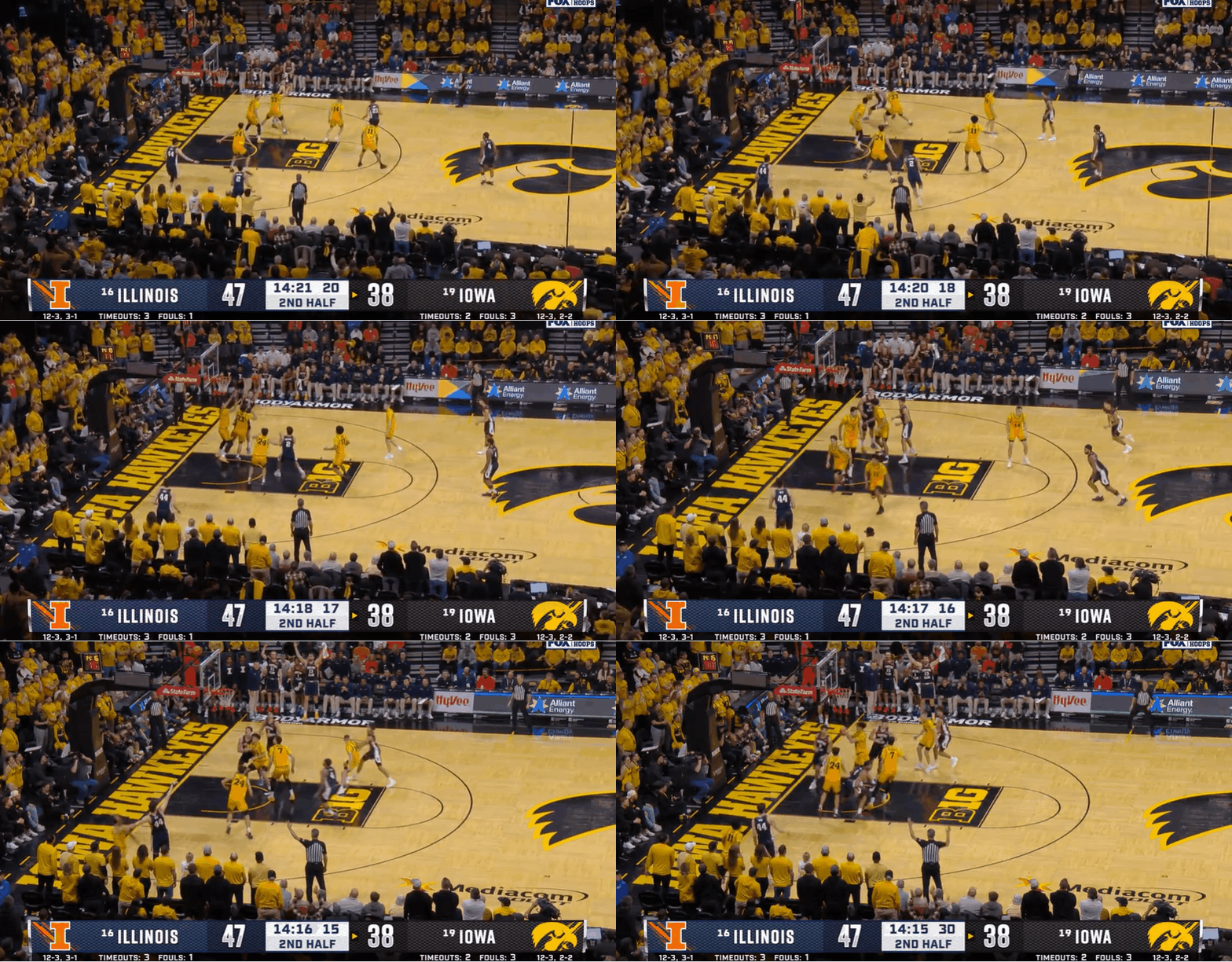
Notably, though, the primary post player did not score a single point in that game. Illinois instead scored via kickouts like the above. Iowa may be best suited to single cover and hope Illinois leans too far into this approach.
On the other end, Illinois repeatedly over-committed on the ball to try and take it out of Stirtz’s hands, forcing the Iowa role players to make plays and shots. Stirtz still got 17 shots up at the basket, but he was horribly inefficient (5-of-17 from the field for 12 points), and the Illini’s immense length at every single position did seem to bother him at times.
Stirtz has played all 120 minutes of the NCAA Tournament thus far, though at Iowa’s pace, that is far less taxing. To this point, he has committed just one turnover and zero fouls; he will play all 40 again barring a blowout one way or the other.
I fully expect a half court slog here, as both teams firmly prefer that style given their constructions (Illinois’ colossal size, Iowa’s lack of playmaking depth). The first meeting had just 58 possessions entering the final two minutes, with fouling goosing the final tally up to 66. Considering how both teams have played so far in the NCAA Tournament, a sub-60 possession game would not be the least bit surprising.
This game looks a lot closer to a one-possession game to me than the spread indicates. Granted, McCollum only has 48 hours to game plan and deploy his March wizardry, but that’s plenty of time to scheme up a plan against a familiar conference opponent. Underwood and his staff are plenty sharp, too, so this could be a constantly evolving chess match. - Jim Root
West Region Final
(1) Arizona (-6.5) vs. (2) Purdue, 8:49 PM ET, TBS.
At first glance, my thought was "this spread is too high," and indeed Torvik has it around Arizona -4 and KenPom the same. The extra 2.5 points are probably driven from Arizona's overperformance/Purdue's underperformance on Thursday, and frankly I'm going to wager not many people are lining up to take Purdue here. A quick check of the betting splits at time of writing says "correct, young man."
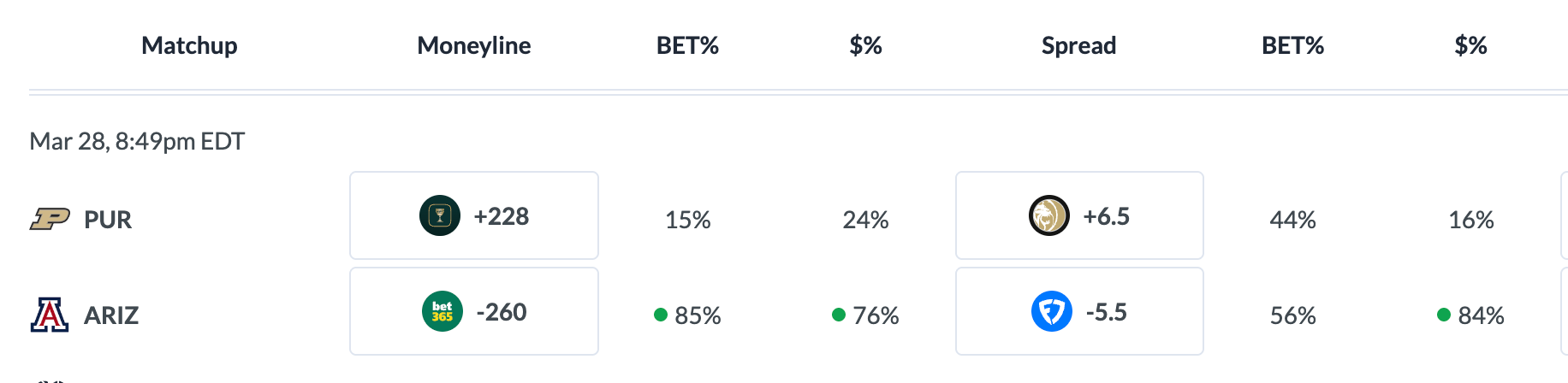
Both of these teams are excellent, not just the one. Our own Matt Winick did raise a great point that Purdue's season was on the rocks barely two weeks ago, but I'd argue a lot of that could've simply been bad vibes produced by bad shooting variance. (In their big five home losses at Mackey, their opponents shot 48% from three and 53% on midrange twos. All other games against top-50 teams: 33% 3PT, 47% midrange.) Even against Texas, after experiencing a couple of great games of shooting variance, they got this result and yet still won:
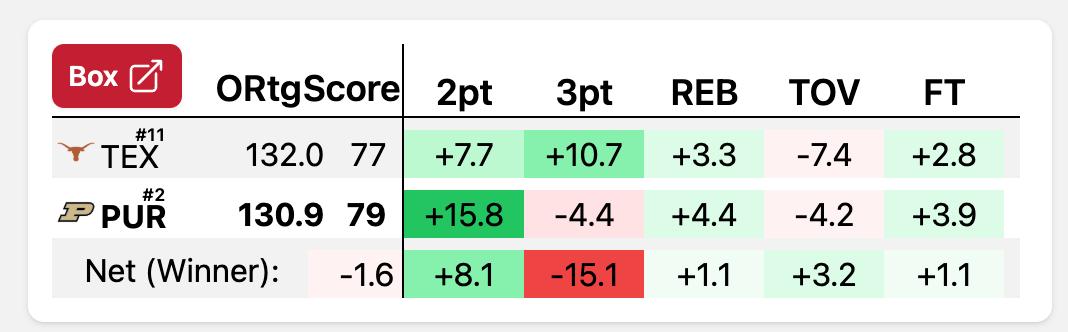
Which means on a 'normal' shooting night where Tramon Mark isn't going ballistic and Purdue isn't 20% from deep they probably win this game by double digits. I find this interesting when compared with Arizona's own game against a (better) SEC opponent:
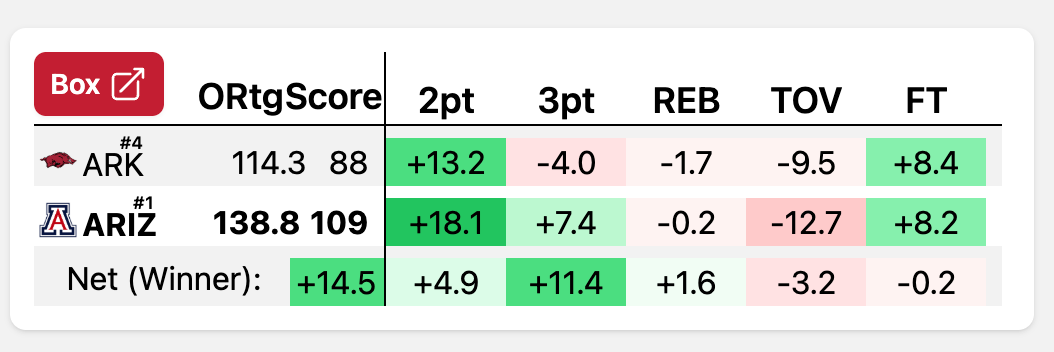
In a 'normalized' setting where Arizona wins by 14 or something but Purdue wins by...I don't know, 8, is the spread still 6.5? I guess I've got my doubts.
Anyway, the actual game feels like an awesome styles clash that could be twisted nearly any way you'd like, but starting with the favorite, I am pretty certain Arizona will want to do their usual here: lots of attacking through P&R against a weak Purdue P&R defense, lots of attacking through the post against a just-okay Purdue post defense. That's if they can get it to the post, though, because Purdue may only be outpaced by Iowa State as (surprisingly!) the best post denial defense left in the field.
Generally speaking, Purdue may have the two (yes, sue me) best offensive options in this game, and if Fletcher Loyer is making shots, it could be the three best. But in terms of pure depth and defensive matchups, I think Arizona should be pretty well-prepped for Purdue's hedge having come from the Big 12 of all leagues. The best version of Arizona in terms of success against P&R defensive styles probably goes hedge > drop > switch, and I definitely don't think Purdue can or should switch here because that's an isolation nightmare. As such, Purdue is likely going to try and drop more to force Arizona into being midrange merchants. It's not a version of Purdue we've seen much at all...until the Sweet Sixteen, when they confusingly deployed drop against Texas of all teams and got rocked:
(NOTE: I think Painter got away with one with this game. Some really strange decisions - what was with the critical Omer Mayer minutes when he's easily Purdue's worst defender? Why drop/at-the-level coverage against TEXAS? Again, on a normalized shooting day it's probably an 11-point win or something, but...)
However, Texas is a 93rd-percentile P&R ball-handler offense at Synergy, while Arizona is merely 85th-percentile. The key difference here is that Texas's rollers and screeners are significantly less effective at finishing than, you know, Koa freaking Peat and Tobe freaking Awaka, so that's why I would still try to drop (or play at the level) first if I were the Boilermakers. There are no great options against an elite side in Arizona, but death by Bradley/Burries is likely preferable to death by Peat/Awaka/Krivas, especially considering the odds of another Oscar Cluff foul-out and/or TKR foul trouble.
In general this is a middling-at-best half-court defense, which makes basically any matchup against good competition potentially deadly. Here, though, it's notable Arizona barely does any of the two items that frequently kill Purdue: ISOs on Fletcher Loyer/TKR and/or off-ball motion that forces Braden Smith to play through contact. The Big Ten offenses that did work to get Purdue in motion on the perimeter (Nebraska, Indiana, Michigan) all had good days against the Boilermakers; those who didn't rely on off-ball motion (Illinois, Wisconsin) won but required extreme outlier 3PT days to get it done.
The other side of the ball offers some surprising upside for Purdue. Arizona's primary is drop coverage, and while they aren't religious about it the last time I felt they were primarily hedge coverage was the Houston Big 12 title game. Even against Arkansas, who should be the team you'd least want to drop against, Arizona stuck to their guns for large portions of the game. We had the shot quality discussion for Purdue/Texas here, but we might as well have it again here. Texas did hedge a little more than usual, but Purdue was given free reign to hunt the midrange and was pretty effective at finding it:
If Krivas is at the 5 this is going to be Purdue's bread and butter. Purdue's offense was exceptional against any coverage, but dropping too far is going to lead to open jumper after open jumper, and this is an outstanding rebounding team in Purdue even with missed shots. It's not impossible to get second chance points against Arizona, and of all teams Iowa State and Kansas found ways to exploit the Wildcats on the boards in outright upsets or surprisingly close games. The rebounding battle seems dead even to me, and given that the turnover battle may slightly favor Purdue I kinda think the Boilers have a surprise path to a minor shot volume advantage.
Mostly, I'm very curious about how Purdue elects to attack the post. It is the pre-eminent part of their offense with both TKR and Cluff and is the way to get Arizona in foul trouble, which opens up more paths to a win. Arizona is excellent at post denial, but a lot of opponents haven't even bothered to try attacking them down low. The few elite post offenses they played this year actually had some really nice outings: pre-injury JT Toppin with 31 on 22 shots, and the 'surprise' Florida loss in November that looks way more explicable in hindsight saw the Gators go 21-29 at the rim, with Thomas Haugh having a gigantic day (27 on 13 shots, 12-14 at the line). It's an outstanding defense, but there are no perfect teams in college basketball, and this strikes me as a two-way paint battle for the ages.
This feels coin-flippy to me, slanted 55/45 or 60/40 to Arizona, with a lot hinging on those Purdue jumpers. There's zero argument to me for them as the pre-eminent shot-making offense in college basketball, and what they don't hit they have a strong success rate at getting back on the boards. The base expectation here is a tight Arizona win, but worth noting against the most similar B1G opposition (Illinois, Michigan) Purdue went 1-2 in real life yet 3-0 at ShotQuality, shot 57% on twos, won the paint battle by 9.3 PPG, and committed turnovers on just 5% of possessions. Could be nothing, could be something. - Will Warren
Will has excellently hit all the major points in this matchup, so I'm likely just repackaging some of the same statistical and schematic highlights. Purdue cannot keep the ball in front of them defensively. They haven't done it all season and are especially attackable at POA and the wings (highlighted repeatedly in the Miami game). Thus Matt Painter has schemed his defense entirely on denying the rim and consistently hedging with Oscar Cluff to flatten out the drive and generally overhelping vs isolation/dribble drive. This has led to just a 4th percentile season long rim rate. Nominally, this is excellent statistical news for the Boilers against an Arizona offense that owns an 87th percentile rim rate with an 89th percentile efficiency rating, per Synergy data. The Wildcats dominate the paint offensively in virtually every matchup, and play with a 2 big physicality on that end that creates a ton of driving gaps to get the ball going downhill through a high rate of empty corner PNRs (83rd percentile PNR rate with an 87th percentile efficiency rating)
and post ups. Purdue however has played more drop coverage this tournament than I've seen them play all season (personally I found it an odd schematic decision against Texas' elite on-ball wings and dribble creators)
but it's also curiously led to a 45% rim rate from their opponents through 3 games, as opposed to their season long rate of 33%. Purdue had not allowed 30+ rim attempts in a single game all season, but both Queens and Miami have gone over that mark in the NCAA Tournament. We can neglect the Queens rim rate given the blowout nature of that game, but the Canes' ability to consistently get two feet in the paint at multiple positions is not a particularly great omen for this matchup against Arizona.
If Purdue surrenders 30+ rim attempts to Arizona (Wildcats have averaged just under 30 rim attempts this tournament) like they did against the Canes, the Boilers likely won't be advancing to the Final Four.
Offensively, Purdue's hot perimeter shooting really nosedived against Texas, going 4-20 from 3 after shooting 22-38 from 3 in the first two rounds. Friend of Basket Under Review @clevta identified the likelihood of Purdue struggling from the perimeter against Texas:
I think Purdue wins tonight but I have to assume this 3pt shooting cools off and really interested to see if TX can take advantage if it does cool off. Went back over the last 25 years and could only find 16 other teams that shot >50% from 3 in the first two rounds like Purdue (a… https://t.co/Adormo7wyK
— Clevta (@Clevta) March 26, 2026
@clevta via X
Purdue offensively will target a high rate of their actions to the open midrange against the Big Mo Drop (99th percentile midrange efficiency rating for the Boilers) and of course Braden Smith is no stranger to dissecting drop coverage, but as BUR colleague Matthew Winick noted ahead of the Texas game, Smith as a scorer is exactly where you want him.
Here's a stat ahead of Texas vs. Purdue:
— Matthew Winick (@matthewwinick) March 25, 2026
Purdue is 5-6 when Braden Smith takes more than 12 shots against power conference teams
Purdue is 11-1 when Braden Smith takes fewer than 10 shots against power conference teams
Texas' D scheme will look to force Smith to be a scorer.
Smith ended the night with 16 field goal attempts, and Purdue's tournament nearly ended in an upset to a team who barely made the field. Arizona's defense funnels offense to primary ball screens operators (94th percentile rate) and isolation (88th percentile rate). Purdue scores out of the ball screen at just a 25th percentile efficiency rating and works in just a 44th percentile isolation rate. Purdue also won't likely be able to supplement on the offensive glass against an elite two rebounding team like Arizona, nor will the Wildcats foul like demons like Texas did.
While Purdue is going to score against Arizona at what will likely be a reasonably efficient clip (this is the most efficient offense in the country after all), it will still be done in ways they don't generally prefer, but I will say there's some hidden ability attack Arizona's 1v1 post coverage, which no one has really tried against Krivas with just a 15th percentile post rate. The one instance of sustained post success against Arizona's frontcourt came from Flory Bidunga and Kansas, who repeatedly went straight into Krivas' chest.
Purdue doesn't want to score 1v1 generally, but this is where they can perhaps find some success with TKR more versatile post arsenal, and a happy by-product could be some Krivas foul trouble (he and Awaka are basically the only guys who foul for Arizona), which in turn changes the entire complexion of Arizona's defensive structure.
On the other end, Purdue has lived on the edge with their protective defensive scheme in this tournament, whether in drop, hedge, or switch, and allowing an increasing rim rate against Arizona is very ill-advised.
A Purdue cover wouldn't surprise me and I lean that way, as on paper the Boilers check two primary boxes against Arizona in terms of rim and transition denial (Arizona has played just 7 games all season where 90% or more of their offensive possessions were in the halfcourt, where they were 3-4 ATS in those games, while Purdue as a defense has forced 23 such games). Plus I doubt Arizona's 111-48 free throw advantage through 3 games in this tournament carries over against a Purdue defense that has the 8th lowest free throw rate allowed in the country (although their 333rd offensive free throw rate doesn't do much the other way). But overall I'm more inclined towards Arizona advancing to Indy by imposing their will at the rim and forcing Purdue's offense into more 1v1/isolations and Braden Smith field goal attempts to score rather than through their elite ball movement. - Jordan Majewski