

(2) Purdue (-7.5) vs. (7) Miami FL, 12:10 PM ET, CBS.
Braden Smith set the NCAA assist record and apparently decided to become an elite scorer on the ball, pouring in 26 in a dismantling of Queens. Purdue predictably did whatever they wanted against the Royals (the entire TKR post arsenal was on display), but have a much stiffer test obviously with Miami, who dominated down the stretch against Missouri in front of a very partisan St. Louis crowd.
Miami offensively is transition and rim forward (82nd percentile and 98th percentile rates, respectively), and will be in a two big alignment between Malik Reneau (the offensive big) and Ernest Udeh (the defensive big). While Reneau scored 24 points, the Canes killed Mizzou from the perimeter, scoring a non buy game season high 23 points on open catch and shoots, mostly borne from the attention Reneau was drawing in the paint. Miami isn't a high 3PT attempt rate offense (330th per KenPom), but the triples they do take are generally wide open (99th percentile unguarded catch and shoot rate) because of their rim onslaught and ability to collapse the defense, either through dribble penetration between Tre Donaldson and Shelton Henderson, or Reneau in the post.
Matt Painter is certainly familiar with Reneau's catalogue from his days in Bloomington, and Purdue generally flustered him with post doubles and attacked his questionable footwork defensively, generally drawing him into almost immediate foul trouble in every meeting. Purdue will defend him much the same way this year, matching two bigs with TKR and Oscar Cluff, but Purdue's strength defensively is occurs in rim deterrence (4th percentile rate allowed), not rim protection (29th percentile efficiency rating), and thus the Boilers are an extreme help defense, typically sending wings down on the post.
However, Jai Lucas, a more modern minded basketball coach than Mike Woodson (to put it mildly) uses Reneau way more as a screener on the perimeter and in the pocket, not just a post target.
Miami is also an elite PNR offense with Tre Donaldson on the ball and Shelton Henderson slashing, both scoring in ball screens at efficient levels for an offense that's an 86th percentile efficient offense in PNR. This is where it gets dicey for the Boilers, who defend ball screens and PNR overall both in just the 13th percentile in terms of efficiency rating. Cluff's hedge and Purdue's highly exploitable switch with less athletic wing defenders has been the primary source of consternation for Purdue's defense all season. Drop, switch, or hedge, Purdue hasn't defended well in PNR all season, and I think this is going to be a major issue against the Canes.
On the other end, Miami's defense shifts frequently between a trapping zone pressure that falls back into a matchup zone but will morph into Udeh soft hedging on the ball screen, often in the same possession.
There really isn't a great option against Purdue's PNR attack, but generally speaking, the historical record shows that hedging aggressively on Smith's ball screen is the preferred mode of attack, and just hope that Fletcher Loyer isn't hitting threes at a 47% clip, which he's been doing since the calendar flipped to February, and that TKR and Cluff are making poor decisions in the short roll (which is rare)- like I said, no real good option against Purdue's PNR, so these defenses are more or less in the same boat.
The final venue for this battle is the glass, where Purdue dominates thanks to Cluff, who has been vacuuming offensive rebounds at a god like level down the stretch. Miami however owns a top 20 DREB% per KenPom and that translated in 13 games vs top 50 competition as well.
I generally think these two teams are extremely similar- two bigs (one offensive, one defensive), elite PNR offenses, and questionable PNR defenses. I trust Purdue's offense to score here, but I don't trust their defense to keep Donaldson and Henderson from completely collapsing their overhelp- can the Canes hit enough jump shots again to actually pull off the upset is the question. The Canes are elite at creating them, and Purdue's over rotation gives them up (90th percentile unguarded catch and shoot rate allowed, per Synergy data). The consensus school of thought has been rim reliant Miami struggles against floor shrinking defensive schemes, but I don't think that's necessarily been factually correct.
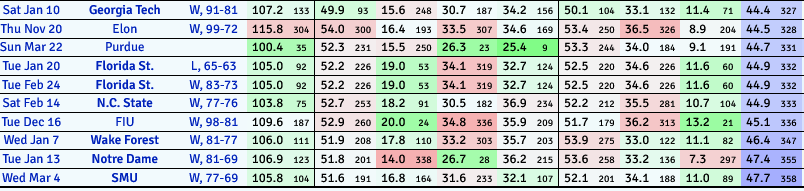
I think the Canes are likely in this game til the end, but I'll admit I'm getting a little gun shy after seeing the top seeds completely bury upset bids in the final 10 minutes all week. - Jordan Majewski
(2) Iowa State (-4.5) vs. (7) Kentucky, 2:45 PM ET, CBS.
It is extremely fair to assume that Iowa State superstar Joshua Jefferson will not be playing in this contest with the injury he suffered in the Round of 64. That not only knocks out the Cyclones' leader in usage by a wide margin, but also the runner-up behind Cameron Boozer for KenPom Player of the Year. When your on/off numbers look like this, you are probably an important player.
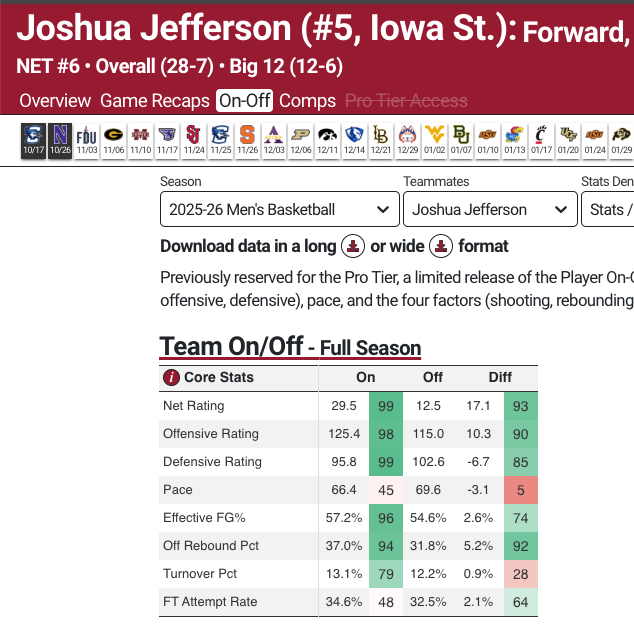
Without Jefferson, Milan Momcilovic is basically always playing at the 4-spot. Every other lineup option is exceptionally low on offensive options. It will also mean spot minutes for Dominick Nelson, who played 19 against Tennessee State after playing just 11 in the last 16 games. He's a downhill driver at 6-foot-5 who hasn't made a 3-pointer this season.
Jefferson's most valuable skill to Iowa State's offense is his playmaking. Iowa State's assist rate drops nearly 4% when he's off the floor. That in particular will be a problem against a Kentucky team that forces one of the higher assist rates in the country.
With Jefferson off the court, it allows a team to have someone trail Momcilovic at all times, and basically let the other four Cyclones play 4-on-4. That was what Arizona did in an easy win over Iowa State on March 2 when Jefferson only played 28 minutes due to foul trouble. Momcilovic only took eight shots all game.
On that possession, Jaden Bradley basically did not care what was going on outside of Momcilovic, and it led to a mid-range pull-up. As Mark Pope and Kentucky prepare for Iowa State, I would strongly imagine this is the defense they will play.
In that case, Iowa State is going to need a masterful defensive performance to win. It's very possible, given they are the No. 4 turnover defense in the country and Kentucky is just average at ball control offensively. They also have not played a power conference team in the top 40 in turnover defense.
Furthermore, coughing up the ball has had a big impact on Kentucky winning games. Against Top 100 teams, the Wildcats are just 4-10 when turning it over on at least 15% of possessions. Iowa State has hit that number in all but four games this year.
Kentucky doesn't really have a true point guard but still run tons of pick-and-roll, which is basically a worst case scenario for Iowa State's aggressive hedge, a defense it has not seen once all year. It means the roster probably doesn't have the court vision to make quick reads out of doubles, but will still need to set those screen to create good looks. There is no Amari Williams release valve on this squad.
Inevitably, I think the Jefferson absence shows up more noticeably on offense, and it hurts Momcilovic the most, but my guess is Otzelberger and Co. just double down on their defensive philosophy, and squeeze out a tight one here. - Matthew Winick
(4) Kansas vs. (5) St. John's (-3.5), 5:15 PM ET, CBS
If Zuby Ejiofor is going to be more physical than usual like some narratives suggest with a matchup against his former team in Kansas, than we must all pray for the safety of Flory Bidunga down low. Ejiofor has a motor like no other star big man in the sport.
To that end, Ejiofor and his Big East-leading 6.7 fouls drawn per 40 minutes may end up being a big deal against Bidunga, who doesn't foul a ton, but has picked up at least four fouls against contact magnet opponents like Cameron Boozer/Duke, Tarris Reed/UConn, Xavier Edmonds/TCU, and the giants of Cal Baptist in the Round of 32. I just made a note on how drastic Joshua Jefferson's on/off splits are for Iowa State, but Bidunga's are somehow even more gargantuan.
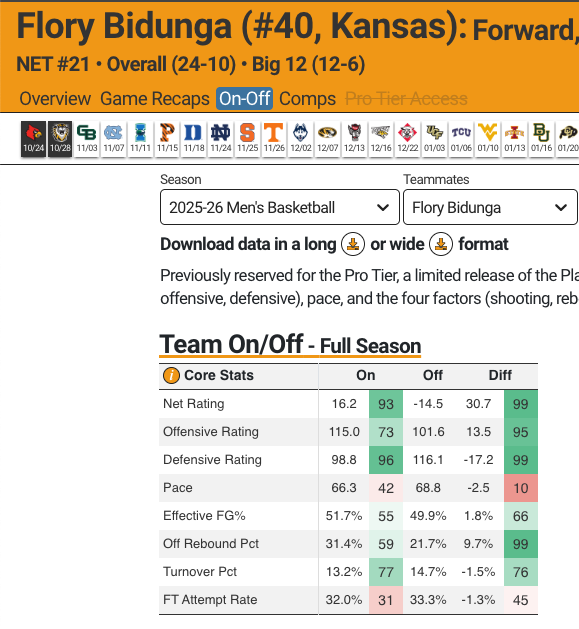
Kansas is not a good basketball team without Bidunga, and have no one else that can guard Ejiofor that Bill Self actually wants to put in the game. The refs blowing the whistle here could lead to early disaster for the Jayhawks.
Kansas is also a horrible shot volume team, sitting as one of the worst turnover defenses in the nation with one of the worst rebounding margins in the Big 12. Their drive-denying defense can be spectacular at limiting field goal makes, but that can only matter so much if the opponent takes 15 more shots, which is what St. John's is threatening here.
The Jayhawks are 1-5 with three double digit losses when allowing a 31%+ offensive rebounding rate and turning it over on 16%+ of possessions, both multiple points below the Red Storm average.
Kansas wins in this game if the Johnnies are horrific shotmakers or Darryn Peterson puts on a legacy performance. Both of which are fully within the realm of possibilities, especially after Peterson exploded for a stretch on Friday, and we are just weeks removed from the Red Storm putting up 40 points in a college basketball game.
But the Jayhawks unequivocally need 35 minutes from Bidunga to get that job done. With how aggressive and dominant Ejiofor has looked this season, I think he will deliver the knockout punch to his old squad. - Matthew Winick
(3) Virginia vs. (6) Tennessee (-1.5), 6:10 PM ET, TNT
Brutality versus brutality, frontcourt versus frontcourt, lead guard versus lead guard. Lot of similarities here, and this doesn't touch on how they both wear orange of that their coaches' names both start with R or that this is the second time they've met in the Round of 32 on a Sunday where Virginia was the higher seed but also the underdog:
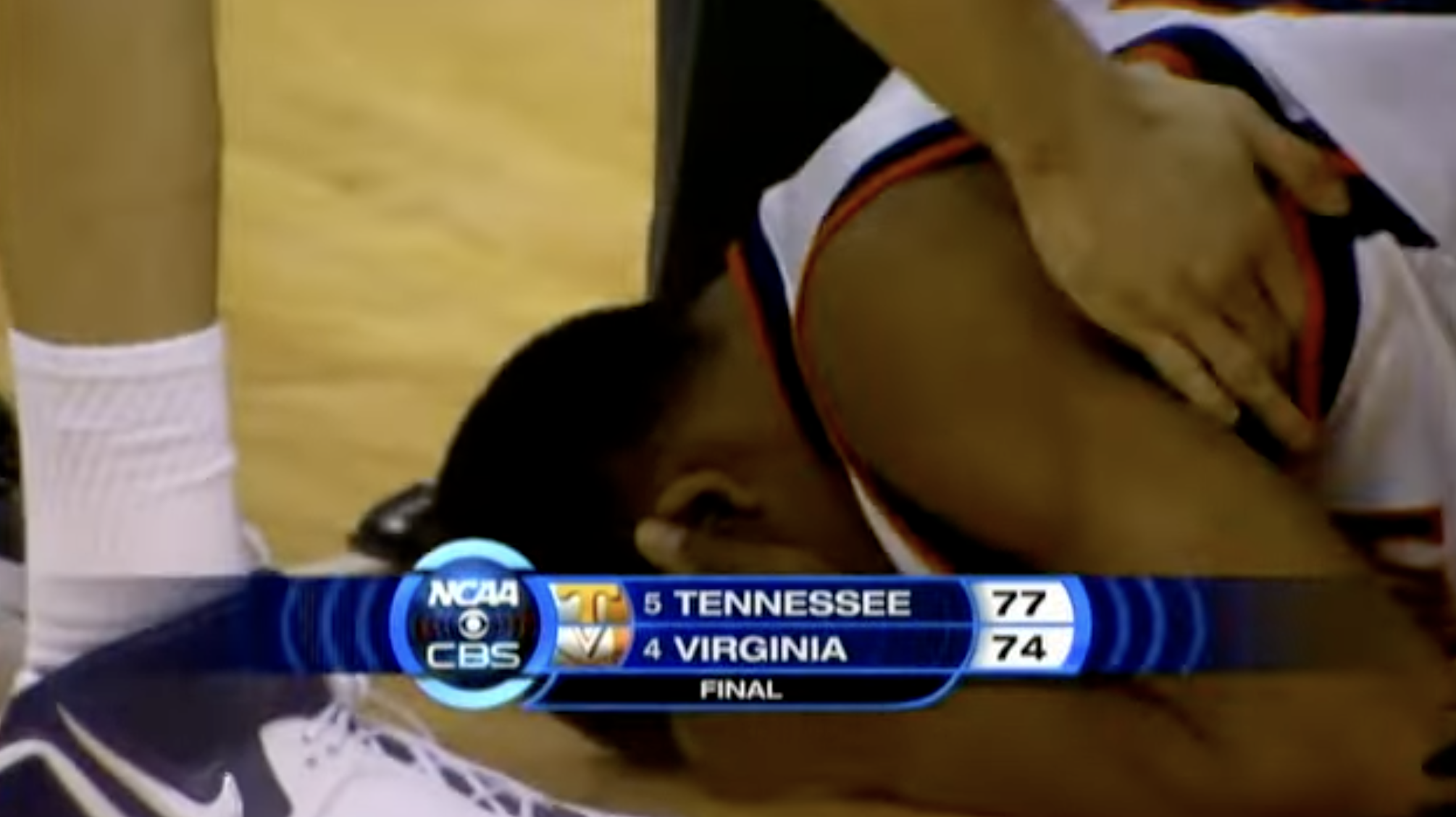
None of that! Just the parts where these are two similarly flawed teams, but Virginia went 8-3 in games decided by six points or less while Tennessee went 5-7. Flip the records and Tennessee's probably the team with the 3 seed. That's not how it went, but it's educational for explaining to you how a 30-5 3 seed from the ACC is an underdog in the second round to an 11-loss team that managed to lose to Syracuse this year.
As mentioned, what you have here are two near-carbon copies of one another, and you can't do the "superior version wins" thing because efficiency-wise Tennessee holds a miniscule edge if any. The Vols will run all the usual off-ball motion, screens, DHOs, and such they've run the entire Barnes era, which is likely a good idea against a UVA drop coverage that plays very similarly (though better) to Texas and Alabama defenses Tennessee had great days against (1.27, 1.18, 1.1 PPP). Virginia defended off-ball motion well this year, but drop coverages will always be vulnerable to off-ball screens and DHOs, neither of which UVA was elite against (74th-percentile in screen defense, 47th DHOs):
That's obviously going to be top of the scouting report for Ryan Odom, who has shown a willingness to hedge against some teams (NC State is who I'm recalling most here) and probably needs to up the perimeter pressure to force some Tennessee turnovers. Other key question here: is Tennessee really going to try and pound the post against arguably the best 1-on-1 post defense left in the field? I wouldn't advise it, but Tennessee has to attack the lane somehow, and as gawky as he looks sometimes JP Estrella is putting up 1.21 PPP on post-ups this year, complete with the arm length to get his shot up over UVA's frontcourt.
However, the key swing piece here is very simply Ja'Kobi Gillespie. Nate Ament looked limited against Miami (OH) and is still nursing an ankle injury. It didn't matter because Gillespie had his best game in weeks, but Gillespie's performance against drop has been an adventure this year, shooting 29% off the dribble (25% from deep). However, he has to hit at least three threes here to give Tennessee something from the perimeter. Alternately, maybe 48 hours of rest gives Ament some juice. TBD.
On the other end of the court, I've mentioned this isn't quite the same elite Tennessee defense of past years though they certainly looked the part against a great Miami offense on Friday. That game was more attuned to Tennessee's strengths in terms of playing perimeter-oriented offenses without much in the way of a frontcourt presence, meaning Tennessee could apply their usual perimeter pressure up top and pack it in for defensive rebounding down low while owning the paint on the other end, too. Virginia's not going to allow that, and while the Hoos are actually dramatically inefficient when playing through the post, their big-to-big passing and frontcourt passing in general will be up there with the best Tennessee's seen this year:
Against hard hedge teams, Thjis De Ridder's passing has been a big key to good Virginia days on offense. He's not the best (Chance Mallory) or most prolific (Dallin Hall) passer on the roster, but he may be the most important because of the unusual mix of skills he brings to playing at the 4. The closest 'true' comp to TDR in the SEC is maybe Texas A&M's Rashaun Agee, who got five offensive boards against the Vols in January and helped get that game to double overtime.
There's a couple of clear issues on this end I'm spotting for UVA though. They offer a pretty good mix of ball screens and off-ball motion on the average night, but either Tennessee or Michigan (depending on your preference) is the best team left in the Tournament at denying off-ball motion, routinely shutting down dribble handoffs before they happen and forcing long, fruitless possessions:
That's probably going to make UVA more ball-screen reliant in this game, which could be good or bad depending on your purview. Good because this isn't as elite a P&R defense as Tennessee has had in the past, but bad because 1) the Vols did improve in P&R defense towards the end of the season, outside of the whole "having to play against Tyler Tanner and Labaron Philon" thing, and 2) against defenses that can switch a ball screen without dying, UVA's generally had tougher offensive days. The number of 'good' defenses in the ACC that do this is functionally zero, but against Dayton (the switchiest top-50 group they've played by far) and Boston College (a top-70 defense!), UVA put up 21 turnovers versus the Flyers and shot 17% from deep against BC.
That's a tiny sample but this is a game with really thin two-way margins, so I'm scrapping for anything. It probably helps Tennessee to play the pre-eminent kickout three team twice a year in Alabama, and in the four games against top-30 defenses they played, UVA turned it over on 21% of possessions while taking nearly 55% of their shots from deep. I'd deem that notable because against everyone south of 30th, those numbers are 16% and 47%.
In general, this is a fascinating clash because I can see where both defenses could have a huge day, but the offenses will have areas of opportunity themselves. It's not an elite half-court Tennessee defense this year, one vulnerable to middle ball screens, and until JP Estrella improves defensively it'll stay that way. On the other end, the Virginia defense has some serious shot suppression issues against top-50 competition (how does a -4.4 turnover margin per 100 sound?) and will be vulnerable to both off-ball motion and Ja'Kobi Gillespie in general, who is easily the best guard in a game against a team with perimeter guarding issues. Lean Tennessee by a hair, maybe a 55/45 coin flip, and as with literally any NCAA Tournament game this can be decided by threes alone. - Will Warren
(1) Florida (-10.5) vs. (9) Iowa, 7:10 PM ET, TBS.
In general this website is pro-John Fanta, and who am I to argue with his process towards declaring a Barstool Sports employee a 'child':
.@John_Fanta was disgusted that @Blutman27 would think that Iowa has a chance to take down Florida
— Wake Up Barstool (@wakeupbarstool) March 16, 2026
"Child, please..." pic.twitter.com/GrV4hUb2WM
But I would like to offer a note to Sir Fanta. While I do agree with the assertion that Iowa is unlikely to beat Florida, I disagree with the assertion that any Ben McCollum game in March is going to be a demolition in either direction. I put it on Twitter, but take a look at McCollum's March results over his last four seasons of coaching:
Ben McCollum's final two years at Northwest Missouri; Ben McCollum's two NCAA Tournament wins so far. The game is played on his terms pic.twitter.com/BCwcmRRvny
— Will Warren (@statsbywill) March 21, 2026
Even the Texas Tech loss last year in the Round of 32 was a McCollum Game at 61 possessions, but the Red Raiders dumped 16 points on Drake in the final five minutes to make the scoring look a bit more than it really was. Even Iowa's Big Ten Tournament results - 75-64 on 66 possessions, 72-69 on 58 - all share the same key thread of the Hawkeyes dragging the opponent into the mud and the final scoring margin being fairly close regardless of how good or not-good the opponent is. When the second-most points you've allowed in any NCAA Tournament (D1 and D2) game after COVID is 61 it kinda tells the story for you.
So, no, I don't think Iowa is completely lost here. They need a specific style of game to go their way, but it's not impossible. When Iowa has the ball, they will screen, re-screen, re-screen a third time, and probably re-screen a fourth time until Bennett Stirtz finds the look he wants. Iowa's Slop Ball is actually a very intriguing counterpoint to a Florida defense that quietly ranks in just the 39th-percentile in defending opposing ball handlers in P&R. That's a major potential issue against a 99th-percentile ball handler offense, almost all of which flows through Stirtz (and okay, some Kael Combs):
The clear defensive (and maybe offensive) comp to Florida in the Big Ten is Michigan, and the course of that game feels logistically similar to how this one goes. It was tight the entire way, with the individual 10-minute segments looking like this:
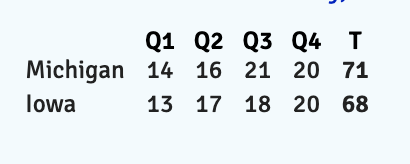
And its 65-possession pace was heavily inflated, with this being a 60-possession game after 39 minutes per KenPom. In that game, Iowa did two interesting things: they had their third-highest rate of ISOs all year long and their third-highest rate of off-ball cuts in league play. McCollum used the ball screens less as true screens and more to get Stirtz in a plus 1-on-1 matchup. A large amount of Iowa's second-half comeback came because of Stirtz going matchup-hunting, which is obviously easier said than done, but I'd think if it can work against Michigan it can work against Florida.
The main interesting aspect for Iowa, to me, is that compared to everyone else in the field they faced a pretty remarkably low amount of drop and/or switch coverage. Teams upped their hedge/blitz rate against the Hawkeyes extremely high to get the ball out of Stirtz's hands, but that's not really Florida's way of operation. Interested to see what philosophy Golden and crew take here: would you rather make Stirtz do it all on his own and risk a heater but ensure no one else scores, or would you rather make everyone else beat you instead of Stirtz but risk a lot of 4-on-3s? Considering Iowa was dramatically better against drop/switch coverages in the times they got to face either this year, it makes for a fascinating tactics battle.
My guess-timate here is that Iowa probably needs to hit at least nine threes to hang here, though, because on the other end I'm not sure how on earth magician McCollum can stack up stops with a defense that allowed top-50 offenses to shoot 55% from two and 67% at the rim. Iowa has a very good defense despite this in large part because it does well on the defensive glass and is super-aggressive in passing lanes/blitzing P&R, but...I mean, this is a 10th-percentile post defense playing Florida.
I'm not sure how you can overcome that, even against a Florida offense that isn't as efficient as you might think when pounding the post. If McCollum was a zone guy I might play that angle up a bit, but he's essentially never been a zone guy, instead preferring to use aggressive perimeter pressure to create longer possessions and shut down passing lanes. What this opens up is the potential for Iowa to get backdoor cut to death.
All in all I think there are paths to Iowa hanging around here, and an outright upset would not be the most stunning thing in world history. Said outright win probably requires Florida to 1) have their worst defensive game in two months, and 2) shoot under 20% from 3. With the SuperBall anything's possible, and as always I'll note Iowa is quite good on the boards themselves, but this feels like a step or two too far for Year One McCollum. Plausible Florida gets held under 70 for the first time since January just due to the sheer slowness of this game. - Will Warren
(1) Arizona (-11.5) vs. (9) Utah State, 7:50 PM ET, TruTV.
Let's kick off this preview with a fun little statistical nugget from USU's win over Villanova (glad to see my Hoosiers making a March appearance finally):
Villanova became just the second team in NCAA Tournament history to lose a game where they made 14+ threes and the opponent made 2 or fewer.
— Matthew Winick (@matthewwinick) March 20, 2026
Joining Indiana’s 90-80 loss to Gonzaga in the 2006 Round of 32. https://t.co/cj92p4xznJ
That +36 in 3PT shooting for Villanova was completely negated by Utah State shooting 74% on their 2PT attempts and outscoring the Wildcats 40-20 at the rim and +22 at the free throw line. USU was the far more aggressive team attacking the rim, scoring on a litany of off-ball screens and cuts, totaling 34 points scored off the ball (and now famously efficient on BLOBs, which prompted a viral moment from Kevin Willard). Jerrod Calhoun was in his bag, as the kids say:
Defensively, USU didn't even use their 1-3-1 matchup zone to shut down Nova's PNR attack, but did have some trouble getting caught in switch on the "pop" in guard-guard screens, which resulted in several of Nova's 14 triples.
So how does that all matchup against the monstrous Arizona Wildcats? Rim cuts aren't typically available against the Big Mo Drop, with Arizona shutting down cuts to the tune of a 16th percentile rate with an 89th percentile efficiency rating. However, several teams through the course of the year have screened around Krivas in the paint and used his unwillingness to untether from the paint against the Wildcats, most notably and most recently Iowa State in the Big 12 tournament:
This is USU's window offensively, because you're not going to score 26 transition points against Arizona (98th percentile efficiency rating) or 40 at the rim (99th percentile efficiency rating) like you did against Nova- and USU isn't a high rate PNR offense that can spread and attack on the ball, where they were just 7th percentile in efficiency rating, per Synergy data.
Defensively I will be interested to see if Calhoun busts out the matchup zone on short prep. We have seen Tommy Lloyd and the Wildcats struggle against a similar concept vs Kyle Smith and Washington State, and I think USU switching 1-5 like they do in man is going to lead to a high rate of post mismatches, which Arizona dominates (I will note USU's 2PT% defense has actually improved in 8 top 50 games, performing at a top 30 efficiency in those matchups, per Torvik filtering). Arizona hasn't seen a sustained zone since West Virginia went there out of desperation at McKale, but the Wildcats proceeded to score 1.4 PPP in zone offense that game. USU is already poor on the defensive glass (far from ideal against the Wildcats' top 5 offensive rebounding rate), and I'm not sure Calhoun is willing to risk further exposure in zone defense in that regard- but it might be the only option.
USU is way faster and more athletic than perhaps most non-MWC watchers realize, and Calhoun is an elite schemer who will introduce wrinkles on both ends of the floor to keep the Aggies viable for at least a half+ before Arizona's size and physicality takes its toll, similar to what we saw from fellow 1 seeds Duke and Michigan yesterday. - Jordan Majewski
(2) UConn (-4.5) vs. (7) UCLA, 8:45 PM ET, TNT.
There are a few factors to this matchup that make this one an interesting battle worth an upset watch, but how these two teams fair with their outstanding injury concerns could be an immediate impact on who wins this game. The Huskies without Silas Demary struggled to initiate offense against Furman on Friday night and the Bruins without Tyler Bilodeau struggled on switches and defending the stretch wings and forwards of UCF in the second half.
Bilodeau went through walkarounds on Friday and was a late scratch. Both are going to be gametime decisions Sunday night. Demary is the fourth leading three point shooter for the Huskies who shot 5 for 25 from deep on Friday. UConn shot 34.7% from deep this season but is 30.3% over their last 5 games. Dan Hurley may need to lean heavily on Tarris Reed again, following his 31 points and 27 rebounds performance, but the Bruins’ frontcourt has significantly more size than what the Paladins could throw at the Husky big.
This game could be the defining matchup for Xavier Booker in his first season in Westwood. He scored 15 points and grabbed 8 rebounds against UCF, but consistency has been an underlying issue for the 6-foot-11 forward throughout his three seasons in college. Prior to the Big Ten Championship and Friday, Booker didn’t play more than 15 minutes in his last 5 games.
But on Friday Booker was indispensable, holding the best plus-minus on the team at +12. And in large part his value held thanks to the inability to stay out of foul trouble and prevent second chance points by fellow big Steven Jammerson, who held the worst plus-minus on the team at -4. Booker is going to need to be able to stay on the floor and provide an impact as a stretch 5 and lob threat to make Reed work on defense. With either big on the floor, the Bruins are not an adept two-point defense in the paint or at the rim, giving up 56.6% of looks within the paint.
If Donovan Dent and UCLA’s three-point shooting can exploit spacing and draw fouls, UConn could be in a dangerous spot if Demary doesn’t play. If UConn is able to own the glass like they should and two of Alex Karaban, Braylon Mullins and Solo Ball are able to make shots and lessen the scoring burden on Reed while playing sound, closeout defense then the Huskies could be preparing for the second weekend. - Tuck Clarry
(4) Alabama (-1.5) vs. (5) Texas Tech, 9:45 PM ET, TBS.
The first weekend of the tournament ends with perhaps the most entertaining individual matchup you could ask for with Labaron Philon Jr. and Christian Anderson facing off to get to the second weekend of the tournament. Both guards have plenty of NBA Draft buzz surrounding them and have taken on an even more absurd scoring responsibility than they previously held because their usage partners, JT Toppin and Aden Holloway, are no longer available.
Against Hofstra, Philon took over a quarter of Alabama’s shots and went a blistering 10 for 18 from the field, finishing with 29 points, 7 assists, 8 rebounds and 3 steals while playing 36 minutes. Philon was able to score at all three levels and was effective in the halfcourt against Hofstra’s guards, going 7 for 14 and slithering his way to 4 for 7 shooting within the paint and at the rim.
Bama guard LaBaron Philon was HOOPING against Hofstra 🔥
— B/R Hoops (@brhoops) March 20, 2026
29 PTS | 8 REB | 7 AST pic.twitter.com/SIGMTdkgjW
Anderson’s 18 points, 5 assists and 4 steals aren’t as gaudy as Philon’s performance, but he does have 8 games with over 25 points under his belt this season. Anderson is able to score from all areas of the court and 57.1% of his three-pointers and 80.5% of his 2-point attempts come off the dribble and unassisted, showcasing an ability to take advantage of how defenders try to guard him.
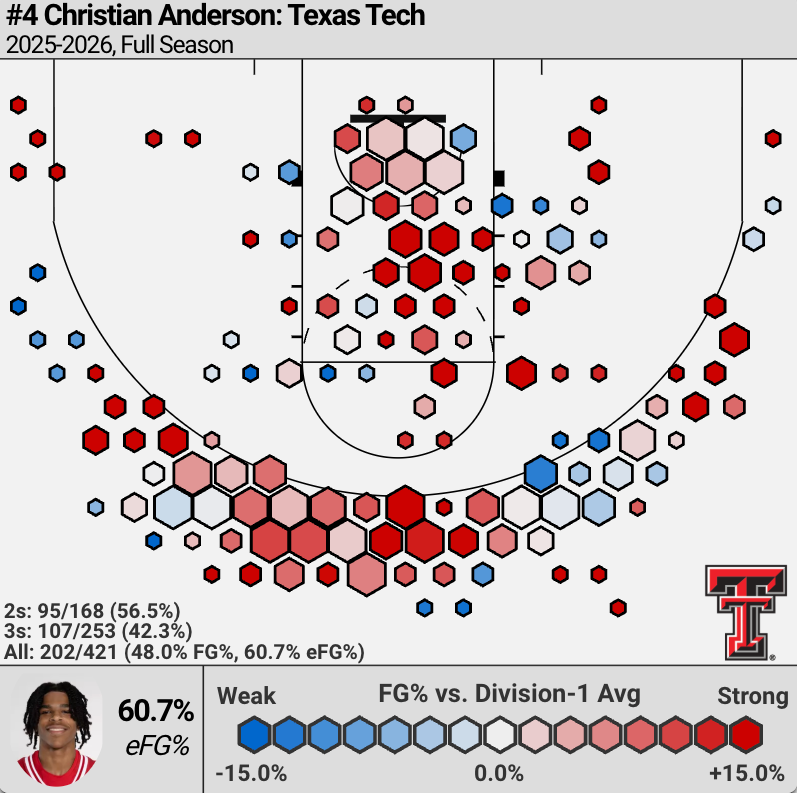
Beyond the individual matchup, this game will likely be decided by who is able to best compliment their lead guard’s scoring. Freshman Jaylen Petty had a hell of an NCAA Tournament debut, scoring 24 points and making 5 of 7 three-point attempts against Akron. Donovan Atwell hit 4 of his 6 three-point attempts as well. Anderson, Petty and Atwell played 39, 38 and 35 minutes respectively.
Because of the lack of options and development from Alabama’s frontcourt, Texas Tech’s JT Toppin-sized hole on offense and defense won’t be as devastating as it may could have been against other #4 seeds. Latreel Wrightsell Sr. didn’t provide the steady second-option production that the Tide were hoping for, going 4 for 11 from the field and 2 for 8 from deep. Alabama will need him to come closer to his season long average of 35% from three or better for them to win this one. - Tuck Clarry