

(1) Michigan (-12.5) vs. (9) Saint Louis, 12:10 PM ET, CBS.
Two years too late, Robbie Avila got his March Moment by way of SLU absolutely demolishing a Georgia team that looked more invested in where they’ll be next year than what they had to do last night. I’m going to wager Dusty May is much better at prepping for the SLU system than Mike White ever will be, especially having played first and especially with May/Schertz being very good friends outside of the context of this game.
Saint Louis’s off-ball motion and cuts are unmatched at a lot of levels, but Michigan was elite at off-ball denial this year. The Wolverines actually faced one of the lowest rates of off-ball screens of anyone in the field, and for a very large team they defended DHOs exceptionally well. Certainly, SLU’s style can and should spread Michigan out but it’s not a style that has particularly worked against May’s crew this year. Per Basketball Index, motion-centric offenses (Minnesota, Nebraska, and Indiana are the main Big Ten examples) took 58% of their shots from deep against M, barely touching the paint at all. That could add a ton of variance, but those teams also got back just 13% of their misses…which is less than ideal if you’re SLU, who got back only 25.7% of their misses in their four games against top-40 defenses.
The other end of the court is more interesting to me, surprisingly. Josh Schertz’s defense is routinely among the very best at forcing guarded, off-balance threes, and you don’t need me to tell you that basically every shooter on the Michigan roster can run hot and cold any given night. The closest thing to SLU’s defensive strategy in the Big Ten is maybe something like an Indiana, who alternates between drop and playing at the level. Less than optimal for SLU if that’s the main comp here, as Michigan dumped 1.23 PPP on the Hoosiers and were up 19-5 ten minutes in. I actually like SLU’s P&R coverage a lot and they should be okay there, but in true post play even against a team that doubles the post a lot it could be a really bad day in the frontcourt and on the boards. KenPom spread of Wolverines -13 feels bang on to me, and it could be much worse if Michigan’s getting to the line with high frequency like I think they could. - Will Warren
(3) Michigan State (-4.5) vs. (6) Louisville, 2:45 PM ET, CBS.
Louisville got very, very lucky on Thursday. Obviously the Cardinals are a better shooting team than South Florida, but to win the 3-point battle 52% to 15% and only win by four tells us that if these teams were remotely close to their season averages from deep, the Bulls would have won easily. Am I still bitter because I had South Florida in my Sweet 16? Perhaps.
The Cardinals losing the offensive boards 18-11 is also a bad sign for their matchup with one of the very best rebounding teams in the country in Michigan State. Considering Louisville doesn't force many turnovers against a Spartans team that has a tendency to cough it up too much, it tells us that Michigan State should be able to win the shot volume battle pretty easily here.
Schematically, Louisville is going to be exceptionally 3-point dependant against a Michigan State team that denies the rim and driving lanes at an elite rate. Louisville as a heavy rim-and-3 offense will likely be settling for a gigantic 3-point rate because of it. Duke and Michigan State both allow an identical 31% rim rate on near-even efficiency, and Louisville wound up taking over 60% of its looks from beyond the arc in those two games against the Blue Devils. Tennessee's similar scheme forced Louisville into a 59% 3-point rate.
Notably, Louisville also did not hit 1 point per possession in any of those three games, and had a hilarious 5-for-20 showing from 2-point range in one of the Duke losses. If that number sounds familiar, it's because that's the exact same 2-point number Michigan State allowed to Nebraska, the most 3-point dependant team in the Big Ten. Point is, Louisville will take so many threes here.
On the other end, Louisville is going to look to force tons of isolation out of the Spartans, who are low on individual shot creators. Weirdly, that has been fine for Michigan State, who is 14-3 when forced to below its season-average assist rate and 12-4 when hitting above that number. This team is obviously not a great dribble scoring group, but can take advantage of individual matchup advantages.
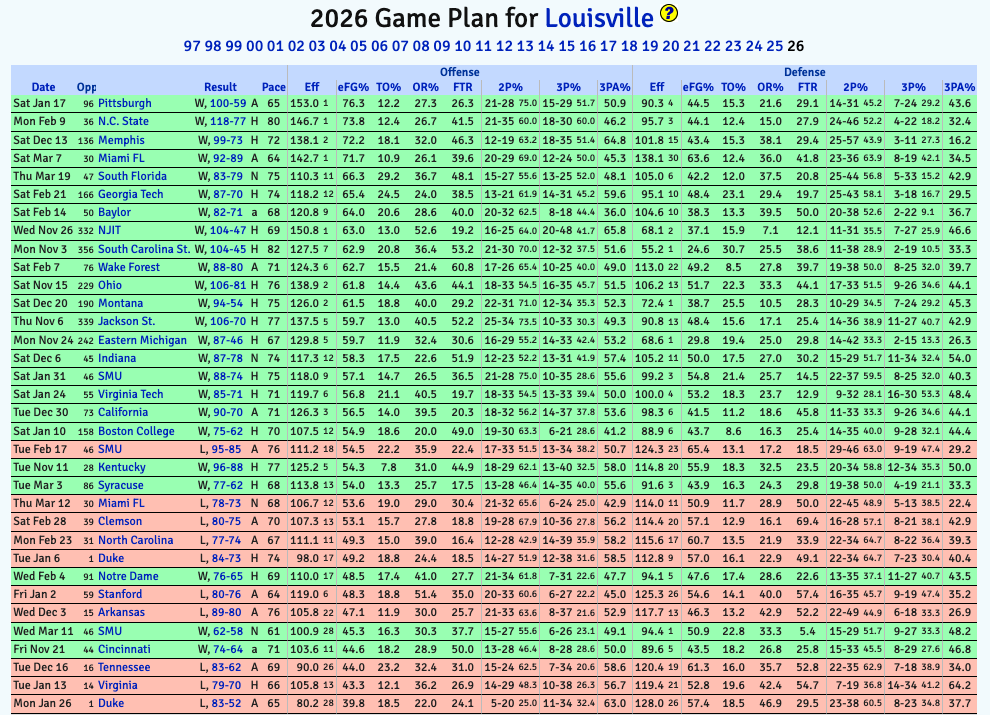
Inevitably, the magic number for Louisville is 55% effective field goal percentage. As you can see by Louisville's games sorted by EFG%, the Cardinals are 10-0 against Top 100 teams when they surpass that number, and 5-10 when they shoot below it. And yet, in the 10 times where they've shot at least 55% of their field goal attempts from deep against those teams, they've only cleared 55% efg twice.
If that was too many numbers, Louisville will not get to the rim here and shoot lots of threes, they need to be efficient from the floor to win, and they have proven to be more inefficient when they shoot more threes. Trends are meant to be broken, but Michigan State should be fine in this matchup. - Matthew Winick
(1) Duke (-10.5) vs. (9) TCU, 5:15 PM ET, CBS.
Everyone and their mother is lining up to take TCU here after Duke’s disastrous performance on Thursday, especially after Duke’s focus was questioned by the players themselves:
"We thought it was going to be a cakewalk going into this game so now we know what it is so we just have to respond back."
— CBS Sports College Basketball 🏀 (@CBSSportsCBB) March 19, 2026
Duke's Maliq Brown spoke with @TracyWolfson at halftime. pic.twitter.com/m5L8winCV9
And after Jon Scheyer himself admitted he did a very bad job of preparing for the game:
"G-Mac, he outcoached me."
— CBS Sports College Basketball 🏀 (@CBSSportsCBB) March 19, 2026
Jon Scheyer told @TracyWolfson that there's a lot Duke can learn from this game. pic.twitter.com/DHUzWEkMRM
But I think I zig where others zag here, even without factoring in Duke holding a closed-to-the-media practice which is a classic “we just got embarrassed” move by a younger coach trying to prove a point. For one, Siena’s defensive structure matched up pretty well (though obviously way better than anyone anticipated) with Duke’s personnel. The Devils graded out significantly worse against drop coverage than any other type of coverage, which is Siena’s primary look, and the zone Siena tossed out was a great move against a Duke offense that wasn’t able to shoot itself out of it. Neither of these are items TCU offers, as the Horned Frogs hedge on the perimeter extremely hard, never switch, and ran exactly three possessions of zone defense after January ended.
Even without Caleb Foster handy Duke tore up hedge coverage better than anything else this year, as Cayden Boozer is actually significantly more efficient in P&R particularly when being forced to pass. (We’ll pass on discussing his shooting at this time.) Hedge coverages of fame in the ACC include Wake Forest (1.39 PPP), California (1.1 PPP, but 70% on twos), and Louisville (1.13 and 1.28 PPP). In exactly zero of those games did Duke shoot better than 34% from deep, which makes averaging 1.23 PPP against decent defenses who play this coverage quite the achievement. Kinda as simple as Duke going 6-2 now against primary drop teams and 27-0 against any other type of primary coverage, because if you hedge Duke the possessions often turn into 4-on-3 power plays where Boozer can take it in the short roll and dictate the conditions of the game.
As such, my read of the game is that this is much more a Bad Matchup for TCU than it is for the Blue Devils, particularly in a game where Duke is most likely going to be +10 or better on the boards and against a Duke defense that’s outstanding in limiting transition opportunities. A half-court battle is Not Good for TCU, whose main source of offense goes through David Punch in the post. Even without Ngongba that’s not the ideal way to attack Duke, a team most vulnerable against offenses who can attack through middle ball screens and whose two losses came to teams with heavy ball screen usage. I’d bet on this being a return to form for Duke, more or less, than I would on a second straight horrendous performance. - Will Warren
(2) Houston (-8.5) vs. (10) Texas A&M, 6:10 PM ET, TNT.
While yes, this is a wild contrast in styles between Texas A&M, the No. 39 tempo in the country, and Houston, the 15th-slowest tempo in the country, these are actually both the two defenses forcing the longest possessions in their respective conferences.
Houston's defense allows long possessions because of its relentless pressure on the ball, forcing tons of turnovers in both live and dead-ball scenarios, and making teams swing the ball against its length. That shouldn't be the biggest deal for Texas A&M, who are a very rare team that are both elite in assist rate and offensive turnover percentage.
That said, playing in an SEC who's only real pressure team is A&M themselves, the Aggies haven't really been tested with this style of defense. The closest they've seen is probably Florida State, who is way worse at actually executing that style, so it's basically not worth the comparison.
My strong suspicion is because Bucky Ball refuses to take mid-range or dribble pull-ups, that the Aggies will shoot near their season-high in 3-point rate. They are just 3-5 when taking more than 50% of their looks from deep against power conference teams, with three double-digit losses and no wins against NCAA Tournament teams.
On the other side, Texas A&M allowed the longest possessions in the SEC because they were one of the only teams who dared pressure all the elite guards in the conference. The Aggies rank second in press rate nationally behind November darlings IU Indy.
That said, I do not think the press is going to bother Houston much. At least nothing like Saint Mary's, who turned it over on a whopping 30% of its possessions in the Round of 64.
For one, Houston is the seventh-best turnover prevention offense in the entire country, with three elite ball-control guards in Kingston Flemings, Emanuel Sharp, and Milos Uzan having the ball in their hands basically always. And for two, in the 190 possessions Houston has been pressed this year, it reverted to halfcourt offense on 181 of them, and pushed in transition on just nine. That 95.3% transition rate is the second-highest in the entire country.
The team in the SEC with the highest halfcourt rate on press possessions is Texas, and I do not think it's a coincidence that the Longhorns combined to turn it over just 19 times in two games, playing slower contests and dominating the offensive boards. That will be what Houston does here.
Lastly, all four (yes, just four!) wins Texas A&M has had against NCAA Tournament teams came when it forced them into grabbing one third of their misses or less. Though not as dominant as other Houston teams, this Cougars squad is still primed to have an excellent rebounding game against one of the worst defensive glass teams in power conference hoops.
In summary, Houston will not get sped up, won't turn it over a ton, will dominate the boards, and force Texas A&M into a 50%+ 3-point rate, which has not lent itself well for the Aggies. Either Texas A&M goes nuclear from beyond the arc, Flemings suddenly becomes a mortal freshman, or Houston wins relatively easily. - Matthew Winick
(3) Gonzaga (-5.5) vs. (11) Texas, 7:10 PM ET, TBS/TruTV.
In Gonzaga’s 73-64 win, the absence of Braden Huff was as glaring as it’s been maybe all season. The Bulldogs were in a grappling contest for 40 minutes and had most of their success in the short roll with Jalen Warley, who served as a more limited roller that would finish through contact vs. Huff’s ability to finish with junpers over his man. The offense was putrid for stretches nad resulted in a three possession game for stretches late into the second half.
Physicality will remain a major component in their next game as Sean Miller’s Texas looks for contact. The Longhorns are in the 99th percentile for free throw rate in college basketball, shooting free throws off of 45.7% of the team’s field goal attempts. Center Matas Vokietaitis leads tournament players in foulds drawn and free throws attempted per 40 minutes for the season, drawing 7.1 fouls and taking 8.2 free throws per game.
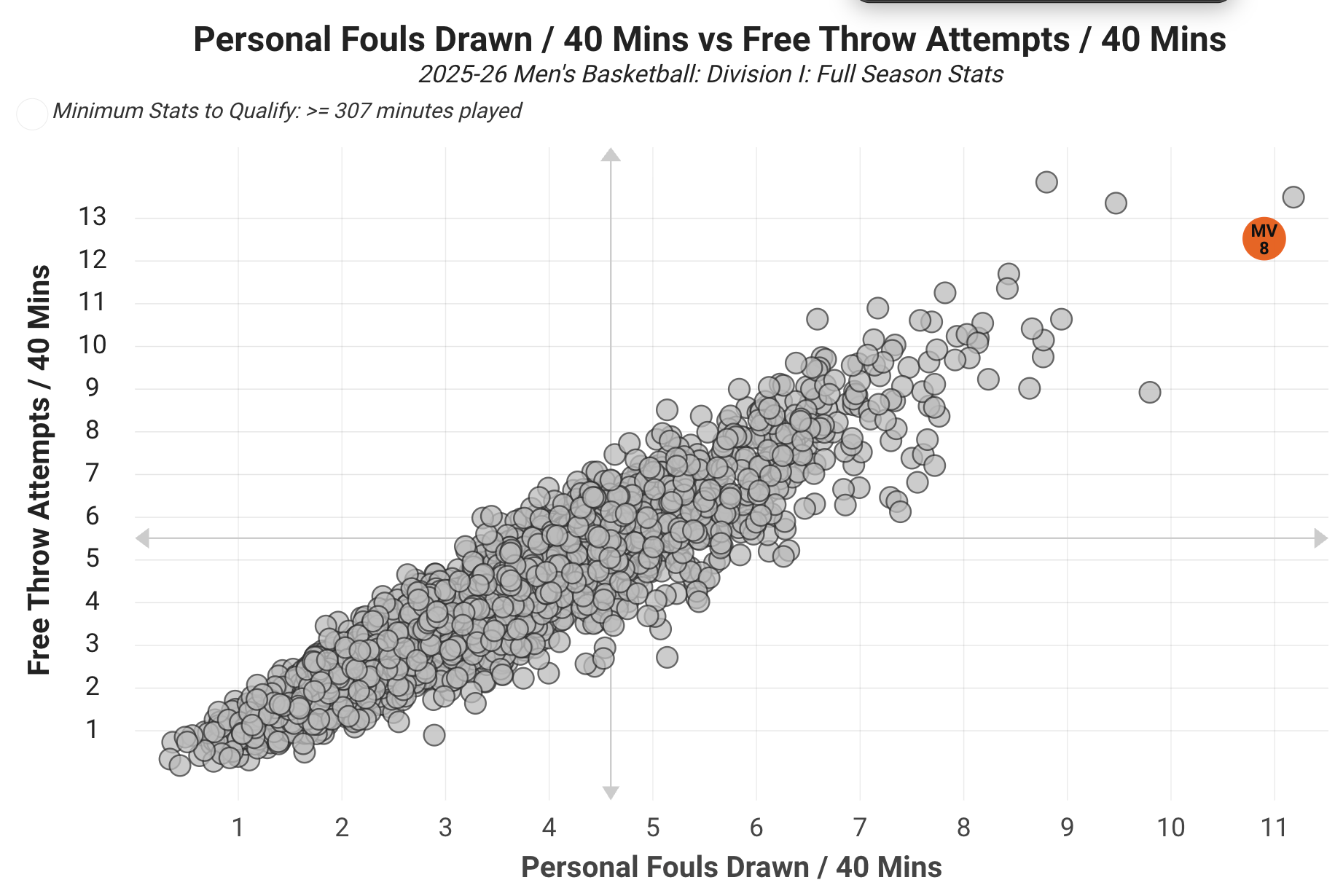
The issue for Vokietaitis is that as good as he is at attacking defenders and drawing fouls, he picks up his fair share as well. He’s averaging 3.5 fouls this season and has committed 4 fouls or more in 18 games this season.
Texas on this tournament win streak hasn’t been playing out of their minds or have looked like a different team, they’ve mostly exploited lackluster teams that are heavily reliant in isolation offense, helping cover up a bit of the defensive inadequacies of this Longhorns defense. On the other end, it is worth noting that the Longhorns played two sub-50 defenses according to KenPom and could only meet their season averages. How they look against a Gonzaga defense that is holding Quad 1 teams at 41.2% field goal shooting will be something to watch.
Tramon Mark is shooting 5 for 11 from three in his two tournament appearances this season, if Gonzaga doesn’t find scoring options from the perimeter or the backcourt, this could come down to what frontcourt stays out of foul trouble. - Tuck Clarry
(3) Illinois (-10.5) vs. (11) VCU, 7:50 PM ET, CBS.
VCU had massive issues with Henri Veesaar's inside out versatility (at least for about 35 minutes), which doesn't bode well against Illinois, a frontcourt built on inside out Euro bigs (although its been a while since the Ivisics were major impacts offensively), and David Mirkovic completely dominated in every aspect against Penn last night- he's a matchup nightmare for VCU as a trailer against their press
and schematic desire to defend in drop coverage and eliminate the 3PT line.
Speaking of drop coverage, Keaton Wagler typically loves it as an elite on ball creator (95th percentile ball screen rate/95th percentile efficiency rating, 82nd percentile rate off the dribble/94th percentile efficiency rating), and his late season productivity dip occurred when B1G defenses started making him see two more consistently and taking their chances with Illinois' perimeter shooting (a literal hit or miss proposition). But generally speaking, you can't drop against Illinois, you can't switch because they're so elite in iso hunting, and hedging is a very dangerous roll of the dice- no wonder they're the best offense in the country.
Illinois' own drop coverage could be something of an issue here however. Although it took a bit of time, VCU's guards eventually started exploiting UNC's switch and ball screen coverage, particularly Terrence Hill, who has carried VCU offensively this month.
Kylan Boswell however won't be switching off Hill, and VCU's drive and kick heavy offense could suffer as a result. Conversely, Illinois is the undisputed champ of isolating and backing down mismatches and switches they like, and they're going to find some against VCU. - Jordan Majewski
(4) Nebraska vs. (5) Vanderbilt (-2.5), 8:45 PM ET, TNT.
In several respects, Vanderbilt is facing the same defensive ethos against Nebraska that they saw against McNeese, just with less athleticism and pressure on the ball. Like McNeese, the Huskers will hedge and deny the ball screen/PNR game (7th percentile ball screen rate allowed) and trap/double the post (91st percentile post double rate, resulting in a 1st percentile post rate allowed), which all adds up to the lowest rim rate allowed in the country- you beat the Huskers over the top with elite ball movement (bottom 10 in 3PTA rate allowed and assist rate allowed). Vanderbilt offensively wants to spread you out and attack with a massive PNR rate (93rd percentile rate, 95th percentile efficiency rating) from a small but extremely quick, positionless lineup, which is going to be difficult to achieve against this over-shifted Husker defensive scheme. Vandy actually scored 31 points at the rim against McNeese, the most the Cowboys have allowed since 56 (!) by Michigan in OOC play, but Nebraska's defense and rotations are tighter and less chaotic, far more connected than McNeese, who is way overleveraged on gambling for steals and thus attackable.
Vandy does have heavy drive and kick elements to their offense (hard to achieve against Nebraska), but their ball movement and spacing has been elite against packed in/help heavy/hedging/however else you want to achieve rim denial defenses. Versus defenses that allow a 40% or higher 3PTA rate, Vandy is 14-2 scoring 1.2 PPP.
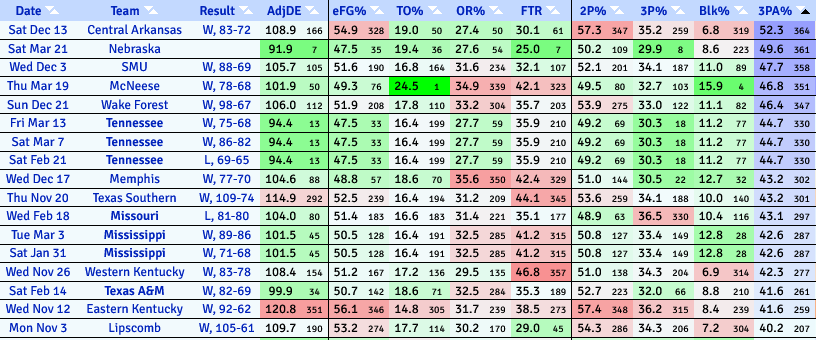
It's just very difficult to keep Duke Miles (whose hand is reportedly fine) and Tyler Tanner out of the paint for 40 minutes with the spacing and lanes Vandy's offense creates. Nebraska is going to take Vandy out of their PNRs, but elite on-ball guards have been able to get going downhill against Nebraska via side ball screens and short roll creation when the defense is overshifted and in scramble mode- this is where Vandy scores.
On the other end, Nebraska won't be overwhelmed by Vandy's similar lack of size, which was a recurring issue in the Big Ten, and the Huskers aren't particularly bothered by on-ball pressure because they don't run much offense on the ball, but that's also a curse against Vandy's defense, who typically switches 5 ways and forces a high isolation rate (97th percentile, per Synergy data), which negates the Huskers' off-ball screening and cutting advantages. Vandy allows just a 14th percentile cut rate and defends off-ball screening action in the 87th percentile. Nebraska will have a substantial "home court advantage" in Oklahoma City, but I think the Dores have the schematic advantages. - Jordan Majewski
(4) Arkansas (-11.5) vs. (12) High Point, 9:45 PM ET, TBS/TruTV.
Tempted to call this Wisconsin Part Two for High Point, because a lot of the problems Wisconsin has are the same ones Arkansas has, especially on defense. Wisconsin ranked 54th defensively and 205th in 2PT% allowed; Arkansas, 48th and 262nd. Wisconsin ranks 327th in turnovers forced; Arkansas is 238th. Neither team fouls much, both make their bigs either drop or play at the level, and both are openly bad P&R defenses with weak rim protection. The main difference is that Arkansas also allows a lot of second chance points.
I'd still take Arkansas's defense first in some sort of draft simply because Trevon Brazile is easily the best defender on either roster, but much of the same areas of opportunity HPU exploited on Thursday should be available here too. The Panthers dumped an unbelievable 1.31 PPP on Wisconsin on ball screen sets, scoring at will whether it was single coverage:
And when Rob Martin or Conrad Martinez navigated the ball screen correctly and got to the paint, their kickouts to open shooters may have swung the game:
Simply put, High Point exploited a weak defensive scheme that struggled with ball screen coverage and got smoked on the boards. Their next opponent has a weak defensive scheme that struggles with ball screen coverage and got outrebounded in conference play.
Arkansas is going to be able to match High Point athletically in a way Wisconsin simply couldn't, but if they get through this game unscathed on the defensive end I'll be pretty surprised. It's the same team that had to escape Winthrop 84-83 and Samford 79-75 at home; while clearly talented they also have major focus issues on the defensive end likely to bite them in the rear at some point. High Point should battle to a draw in the shot volume department if not win it outright, as against their fellow compatriots in the top-25 of offensive TO%, Arkansas has forced turnovers on just 13% of possessions.
The problem here: a lot of what High Point runs has some amount of dribble-drive principles to it...which is perhaps not great when going up against the dribble-drive coach. The only team who runs a somewhat similar style to this in the SEC is Georgia, who did beat Arkansas but got pretty fortunate to enjoy the fruits of an Arkansas off day. (Georgia's 90 points is less impressive when it comes on 83 possessions.) I'd like to see HPU play through Martin ball screens, and through Owen Aquino in the post (whose pass-outs have been excellent) a little more than simply pounding into the teeth of the Arkansas defense over and over.
Arkansas would be wise to drop more than they hedge, as while High Point did have a good day from deep against Wisconsin it's not an elite shooting team and is a bit more rim-reliant. Especially with the Tournament SuperBall, forcing someone to shoot over the top of you may be the best plan.
On the other end, I have no idea what High Point's plan is to hold Darius Acuff and Meleek Thomas in check. This will be unlike anything they've played all year. Certainly you could've said the same about Wisconsin, but college-level great is a little different in this setting than the NBA-level great Acuff and Thomas are going to bring. Can't claim I'm encouraged much when HPU gave up 49 combined to Blackwell and Boyd, who are both very good players but aren't on the level of an Acuff in particular right now.
It's in this game where I wonder if Clayman may try a few zone possessions here and there. Arkansas was excellent against both man and zone this year, but trying anything and everything to slow this game down without the ball in their hands is HPU's best shot. This is an elite 1-on-1 and transition offense without an optimal coverage to stop them, even with High Point's high level of athleticism for a mid-major. Lean Arkansas but think HPU can/should keep this close for a long while because neither defense seems terribly well-equipped to stop the other. Worth noting various troubling trends for the Hogs, though - 310th in Haslametrics' Away-From-Home rating and running an uber-hot 42% from 3 over their last 10 games. - Will Warren