


Marred by the pain and discouragement of his past, Logan Duncomb stepped onto the floor of Xavier’s student rec center looking for a spark.
Duncomb could look on Ebay to find his face on a Bowman basketball card that once indicated stock was worth investing in. He could look back on his recruiting profile, which had four stars on it and a full list of power-five offers that would’ve resulted in a life-changing payday had they been extended a few years later. Yet, this was the extent of the competitive basketball Duncomb participated in as a college junior. This was his life now.
A year later, Winthrop would give Duncomb a chance to find himself again–and he would take advantage of it. As the once-lauded big man walked around Xavier’s campus he knew that even if a revitalization opportunity eventually presented itself, he’d have to endure a painstaking path to pursue it.
The one-time commodity of a big man had just stepped away from organized basketball prior to the season for what he said at the time were health reasons and was going through life as a regular student at Xavier.
“It just wasn't a good time,” Duncomb told Basket Under Review. “I didn't really do much and I seriously was like ‘what am I gonna do in the future? Like, what am I gonna do with my life? Like, am I gonna get a job? Like, what am I going to school for? Was I going to school for a career?’ I just wasn’t doing a very good job.”
Duncomb admits that his school year away from basketball made him “miserable” and that his decision to “quit” at Xavier was the “worst decision” he could’ve made. He knew he had to get basketball back.
So, there Duncomb was playing pickup basketball with “random” kids and looking for 1-on-1 games. The spotlight was gone. The shine of Duncomb’s basketball pedigree had worn down. The expectations were gone.
“It was difficult from the perspective of we felt for Logan," Duncomb’s high school basketball coach Carl Kremer told Basket Under Review. “We knew what a great kid he was and what a great basketball player he was and we knew that he was in a place to where he wasn’t able to realize those gifts. That’s always scary and you never know for sure if you can get on the other side of that dark tunnel.”
The onus was on Duncomb. He could easily choose for this all to be over, for his college basketball journey to be something that he tried before pivoting to a new life. He could choose for his only claim to college basketball fame to be 18 career appearances at Indiana and a body of work that made him a trivia answer, a player that those who love the programs he played for pondered the ultimate fate of.
Riding off into the figurative sunset and letting a 106-word statement become his last hurrah as a college basketball player didn’t sound appealing to Duncomb, though.
“I was just a regular student and I didn't like it. I wanted to be a basketball player,” Duncomb said. “I was like ‘man, I really need basketball.’ Basketball really gave me a lot of structure.”
The idea that Duncomb was here longing for purpose, a jolt of passion and any opportunity that would allow him to get basketball back was almost unthinkable as Duncomb joined Indiana in the summer of 2021 with a wave of confidence as bold as his flowing mullet. Here he was, though.
Duncomb admits that he was “not really prepared” for the nature of college basketball and the workload that it required as he stepped onto Indiana’s campus for the first time. He’d seen what it was like to play against Division-I players and knew that he could hold his own, but he had no idea how difficult the road ahead would be.
Kremer says Duncomb has always been “his own man,” that he was always “genuine” and that “if he thought it, he said it.” Duncomb’s unfiltered temperament and the challenge it presented “made it even more fun” to coach him, Kremer said. The Archbishop Moeller High School head coach says Duncomb grew in the way he handled himself as he went through high school.
It appeared as if confidence wasn’t always easy to come by as Duncomb worked through the summers at Indiana, though.
Pair the “long practices” and extra work required with the idea that former Indiana coach Archie Miller—who Duncomb was recruited by—was fired prior to Duncomb’s freshman summer and Duncomb’s future decision to leave Bloomington didn’t appear to be all that unpredictable. “That’s kind of where it started, the adversity and struggle,” Cincinnati Moeller assistant coach Mike Sussli said. Sussli’s words didn’t even take into account the stable of upperclassman bigs that took the floor ahead of Duncomb and a sinus issue that sidelined him for the majority of the 2022-23 season.
As difficult as the road to playing time appeared to be for Duncomb, the climb towards finding joy appeared to be foggier and equally difficult. Then-Indiana head coach Mike Woodson always indicated publicly that he had plans for Duncomb, but the now-Winthrop big man says he “didn’t know what the coaches were thinking” and “didn’t really have any” coaches that were consistently “talking” or “helping” him along the way. Duncomb was also set back by a shoulder injury and septum issues while fighting an uphill battle for playing time.
“It was always tough to make any progress at Indiana,” Duncomb said. “I was just completely by myself and I just didn’t know anything. It was hard and I had trouble making strong relationships with anyone. It was really lonely and I felt lost and basketball wasn’t going my way. I didn’t really know what my purpose was there.”
In the end, Duncomb says his time at Indiana “felt like a waste” by the end of his tenure there. Perhaps the veteran big man doesn’t feel that way as a result of hindsight, but through two seasons the trophy case was all but barren for Duncomb. At a place in which many midwesterners form legacies that live forever, Duncomb finished his final season averaging 2.9 points per game. His destiny was clearly going to be different than that of the historically great bigs that catapulted their careers at Indiana.
Duncomb knew he needed something new. He needed something more comfortable. He needed a chance.
The idea manifested itself in Duncomb opting to go home to Xavier–which is 15 minutes from his high school and was a serious option out of high school. “That’s kind of where the struggles continued,” Sussli said.
Sussli says that then-Xavier coach Sean Miller and company kept Duncomb “in the family and on scholarship,” but Duncomb’s fall down the depth chart prior to the season had already caused him to re-evaluate whether this was for him.
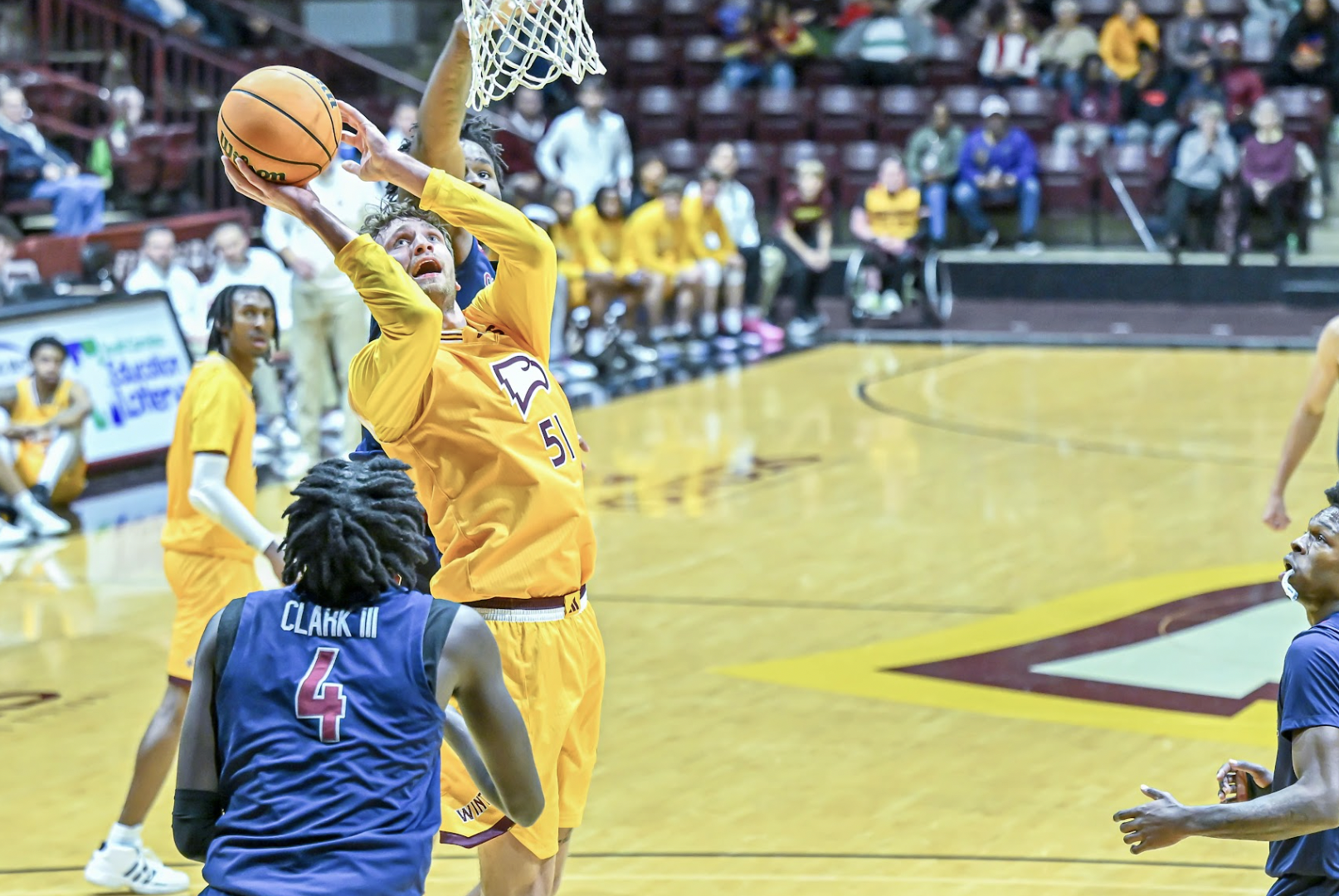
It’s almost as if Winthrop head coach Mark Prosser drew up his program mission statement with Duncomb in mind. The young, bubbly leader of the program that has platformed Duncomb to form a resurgence as a college basketball player didn’t just pull this out of his rear end in an effort to land Duncomb as a transfer, though.
Winthrop basketball’s “culture of joy” defines it in the Prosser era and differentiates it in college basketball’s most transactional era to date. It also met the partly-jaded version of Duncomb that joined it before the 2024-25 season right where he was.
“We want all of our student athletes to come and enjoy playing the game that we love and we have passion for,” Prosser told Basket Under Review. “What we really were hoping for Logan very openly is that he’d have a place to go play and have fun playing, no stress, no pressure, just go in and be the person and player that he is.”
Throughout a less than 20 minute conversation, Prosser continuously harps on the idea that it’s important to him to set each individual within his program up for a “good student-athlete” experience. He works to deal directly and to deal in facts while making sure that basketball is a priority for his players, but few have ever accused the Winthrop head coach of sucking the enjoyment out of college basketball.
Prosser doesn’t want this to feel transactional or like a business. He was hired by Winthrop in 2021 to replace now-Louisville head coach Pat Kelsey and to continue the program’s winning ways–which he’s done enough to receive a contract extension through 2029–but he’s unafraid to admit that this isn’t all about results to him.
“It’s still a game, there’s a lot of things that go on that are much more important than a basketball game,” Prosser admits in a way that many in his profession likely wouldn’t. The Winthrop coach says he believes some of his players will eventually use the game as a profession and have to know the seriousness of it, but appears to believe that it doesn’t have to be tense or heavy.
By the time Duncomb was on Prosser’s radar as a transfer portal prospect, he had become evidence of Prosser’s theory that “there’s a lot of pressure on student-athletes.” In some evaluators’ eyes Duncomb had already fizzled out, Prosser took a different angle to the recruitment, though.
Instead of viewing the former Indiana and Xavier big man as a detriment because of his past, he viewed his situation as an opportunity to help Duncomb find his purpose.
“I think that’s the point of college,” Prosser said. “It’s not gonna be linear and I think that’s what it’s supposed to be. I think it’s that way for a lot of people. I think that’s what it’s there for is to figure out what you’re passionate about and who you are.”
Duncomb says Appalachian State and Miami were involved in his recruitment alongside Winthrop as he searched for his third school–although he says Miami told him his grades weren’t good enough to go there.
The veteran big man respected the other pitches he received, but the environment provided at Winthrop appeared to be eerily similar to what an outsider would assume Duncomb would draw up as his ideal situation. Perhaps it wasn’t Indiana, but Winthrop appeared to represent fate in this situation. Duncomb said the culture of joy pitch was “cool” to him and joined Prosser’s program.
“That’s exactly what he needed,” Kremer said. “I think they have great culture in their program and it was the perfect place for Logan to enter.”
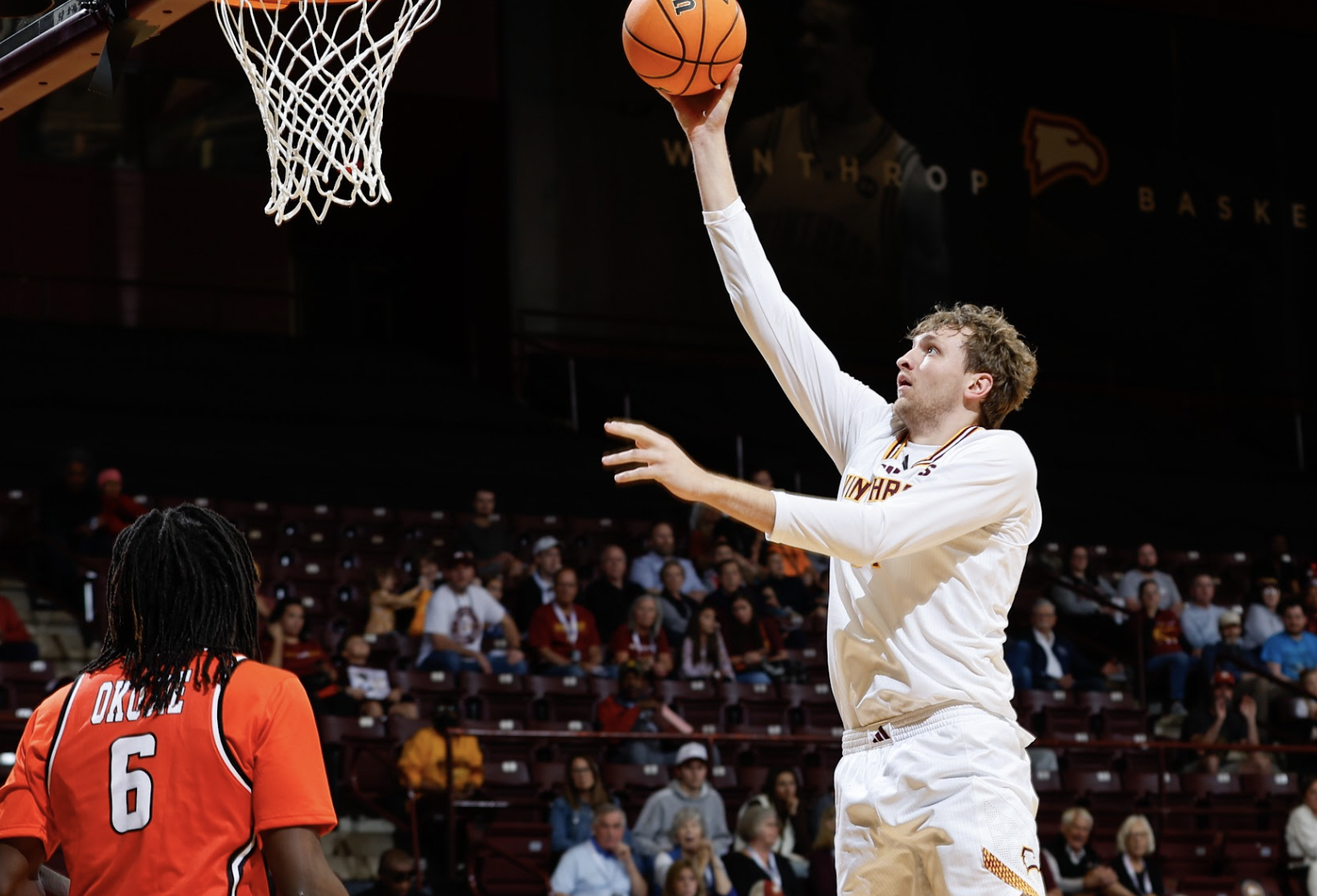
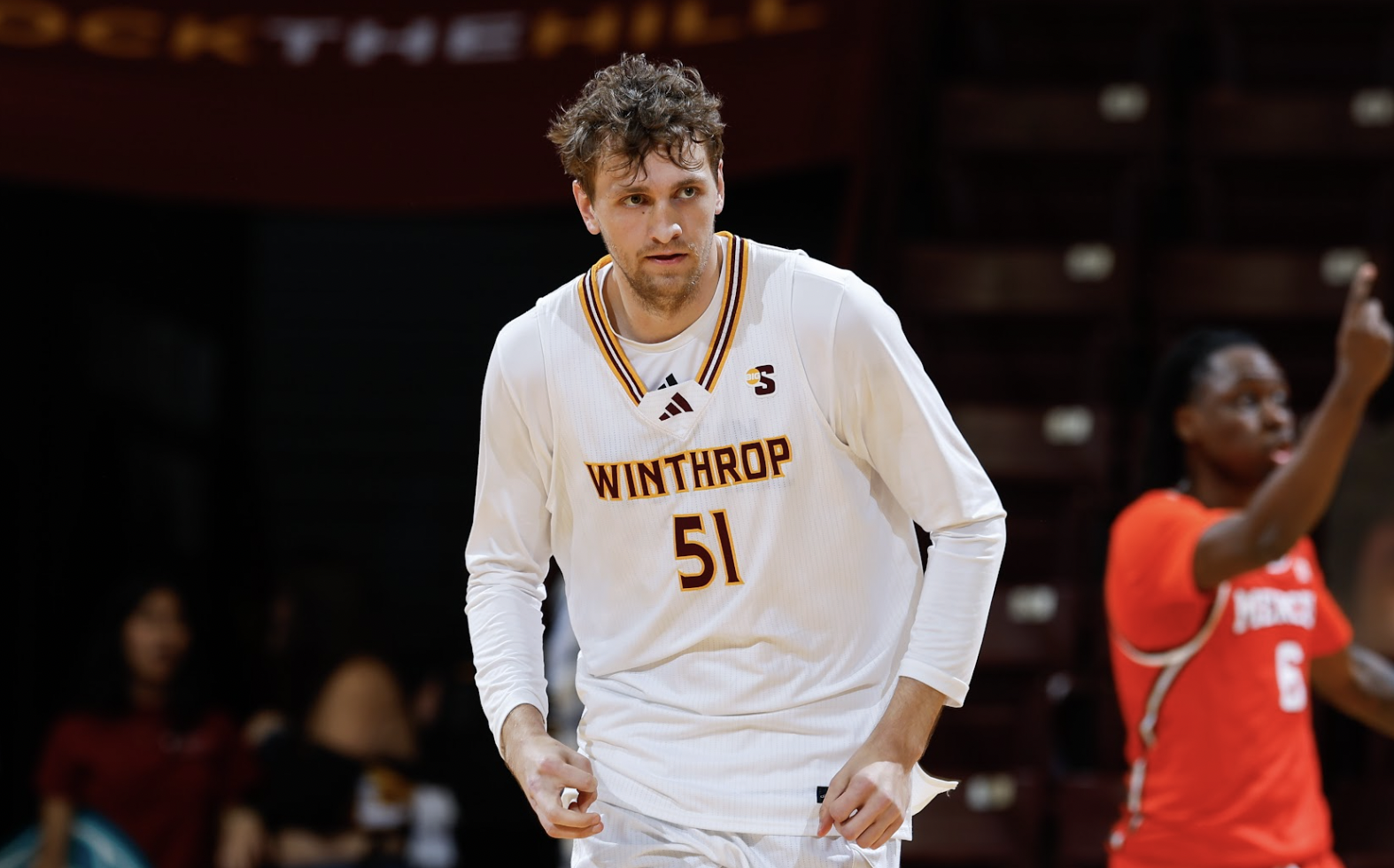
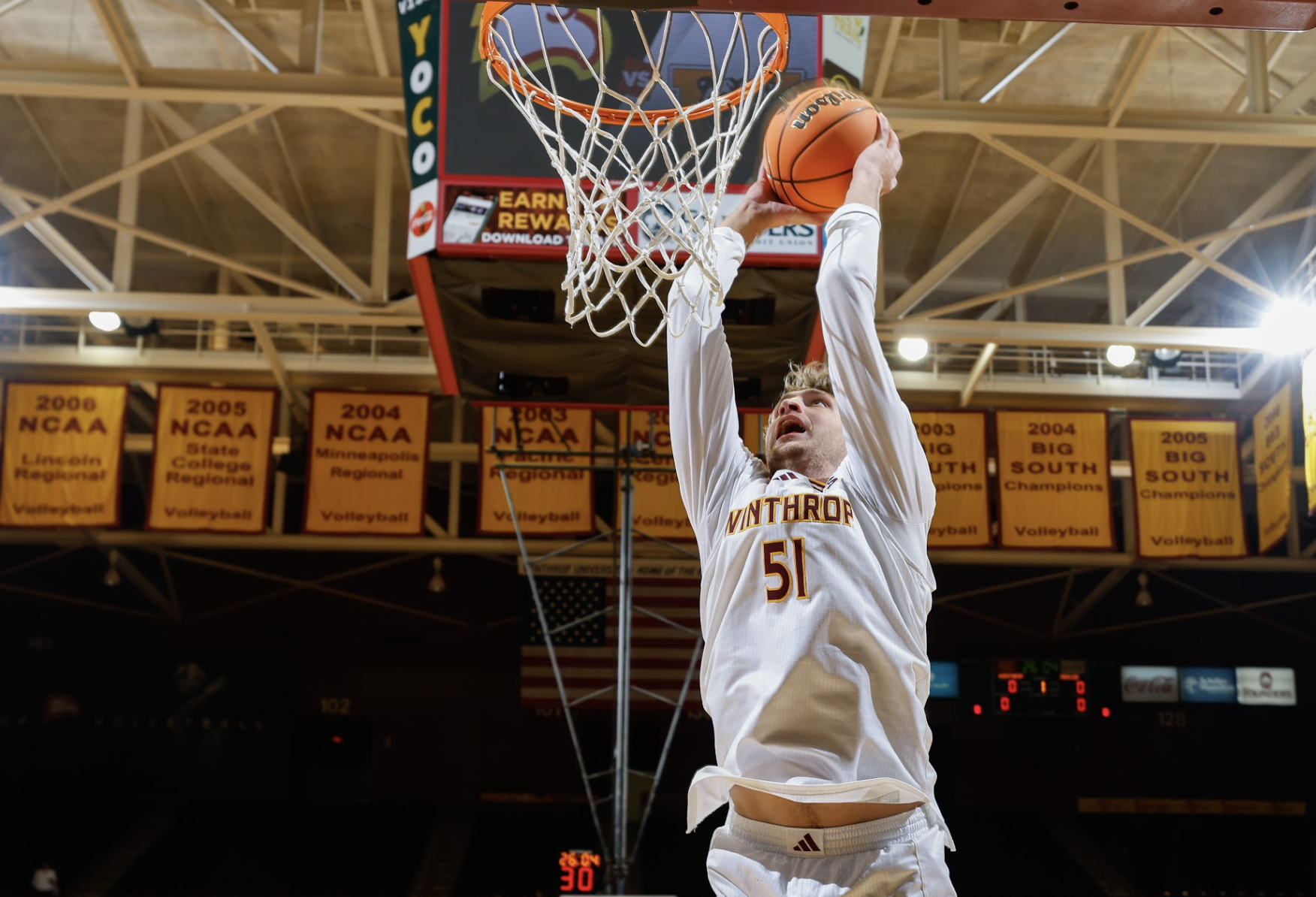
The white long-sleeve shirt that covers Duncomb’s arms and his 6-foot-10 frame makes him stand out as he trots up and down the floor between two black baselines labeled “Rock The Hill” at Winthrop Coliseum in Rock Hill, South Carolina. If the look wasn’t jarring enough, Duncomb’s 21-point double-double in which he went 7-for-8 from the field made him the unmistakable star of the show in Winthrop’s first Big South win.
If it were Duncomb’s Indiana days and he had put on a show like that in the days following a 31-point performance on the road, he would’ve found his name overtaking any media channel he could think of and would’ve had to fight to keep his NBA aspirations in the back of his head. But, life has changed for Duncomb since he blindly walked a path toward stardom that seemed to have no destination in sight.
As Duncomb and his Winthrop teammates left the floor after its 88-77 win over Gardner Webb–which played well enough to give Duncomb and company a scare despite its 2-14 record–the roar was mild, though. Winthrop’s crowd of 1,234 appreciated Duncomb for what he had done, but they were about 15,000 people short of the groups that used to gather around Duncomb’s teams at Assembly Hall. If Duncomb had gone to search for written documentation of his outing, all he would’ve found was a few box scores, a few posts made on Winthrop’s social media channels and a short Associated Press article created with help from Data Skrine.
The glitz and glamour of the power-five life faded–along with Duncomb’s love for all this–a long time ago. Duncomb has found something greater than that at Winthrop, though.

“I see myself blossoming into the player that I always thought I could be,” Duncomb said. “I’m just thankful to the coaches for giving me a chance to come back to the Division-I level and to prove to people that I can play, that I do belong–and to myself, really.”
If the Big South Player of the Week graphic that displayed Duncomb with a smile alongside a few video-game like numbers is any indication, Duncomb is achieving what he had set out to.
Duncomb’s resurgence has included him averaging 16.8 points, 8.1 rebounds and 0.8 blocks per game. His Big South Player of the Week campaign was catapulted by a two-game span in which he averaged 26 points per game on 79.2% from the field and grabbed 11.5 rebounds as well as 5.0 offensive rebounds a night.
“Seeing his face smiling and then his face with that kind of look like I'm gonna kick your butt, it brings back a lot and the journey,” Sussli told Basket Under Review. “It's pretty emotional. To where he was to where he is now, it's great. His prayers were answered, and he is now taking his life to the next level.”
Prosser says that Duncomb has seemed to “find that joy, find that fun” that comes with playing Division-I basketball at a high level. Perhaps Duncomb took the joy for granted a bit as a high schooler that contributed to 75 wins in three seasons, but he isn’t anymore. He knows better than that these days.
He also knows better than to look back on this tumultuous journey with any regrets.
“It was all like part of my process,” Duncomb said. “I think it was all necessary.It taught me a lot of things that taught me a lot about basketball, a lot about life, a lot about myself. I'm very happy with where I'm at now and I think that all the steps in my journey were part of the process of shaping me into who I am right now.”
