

Love it or hate it, the transfer portal has made its presence known at the Final Four.
With the NCAA's decision to officially open the portal on April 7, the day after March Madness declares a national champion, programs are looking not only to find new players for next season, but to retain those they already have.
It's easy to classify portal adds as quick fixes or bandaids for a roster. In some cases they are, but when used with intentionality, intelligence, and patience, winning with the help of portal players becomes much more feasible.
There's no better example of this than simply looking at the teams in still playing in the Big Dance. Michigan, Arizona, UConn, and Illinois have all taken different approaches to the transfer portal this season, but none of those schools would be here without the contributions they've gotten from players that came from elsewhere.
There's no 100% right way to do the transfer portal, and the teams left in the field as testaments to that. Let's break down how they succeeded in finding the right guys, and putting them in the right spots.
Michigan: Emphasis on the Analytics
I am decidedly not a "points per game" guy. I haven't looked at a player's points per game in years. If I ever needed to make a case as to why I feel that way, I'd reference Michigan's trio of Elliot Cadeau, Morez Johnson, and Aday Mara.
Those three players combined to average 22.8 points per game last year. None of them averaged 10. They are now all starting for the No. 1 team in college basketball.
In retrospect, it's easy to see why Michigan succeeded with those three guys. Cadeau has always been a gifted passer. Johnson's defensive versatility at his size pops when he's on the floor. Mara is giant like a giraffe and graceful like a gazelle. But there were numbers that backed up their potential value, and it barely involved box score stats at all.
Using CBB Analytics' RAPM (Regularized Adjusted Plus/Minus) calculation, all three of those guys stood out far more than their counting stats suggested. Especially on the defensive end. The RAPM calculation measures how valuable a player is to his team, relative to overall team lineups, along with lineups where that player is on vs. off the floor. With so few defensive stats that can accurately depict value on that end, Defensive RAPM can be a game changer.
Morez Johnson played under 20 minutes per game last year as a freshman at Illinois. Even diving into the advanced rate stats, Johnson posted a pedestrian 5.5% block rate. But under the hood, he had the No. 1 Defensive RAPM in the Big Ten, and the 14th-best mark in the country.
In short, Johnson was ranked so high in this stat because he played for a good defense, that was great when he was on the floor. Illinois had a 95th% defensive rating of 98.4 when Johnson was on the floor, and a 109.4 rating when he sat. That's an 11-point per 100 possession gap. That number was identical in league and non-conference play. Further, Johnson's low block numbers were a by-product of his system. Illinois played a strict drop with very little help, more focused on denying the rim than protecting it. The team finished just 177th in block rate despite being 13th in height.
For Mara, his defensive on/offs told a similar story. Mara was 20th in the Big Ten in DRAPM, but more specifically, posted a 99th% effective field goal margin when he was on the floor for UCLA. The Bruins were 7.5% better at defending field goals with the Spanish behemoth on the court.
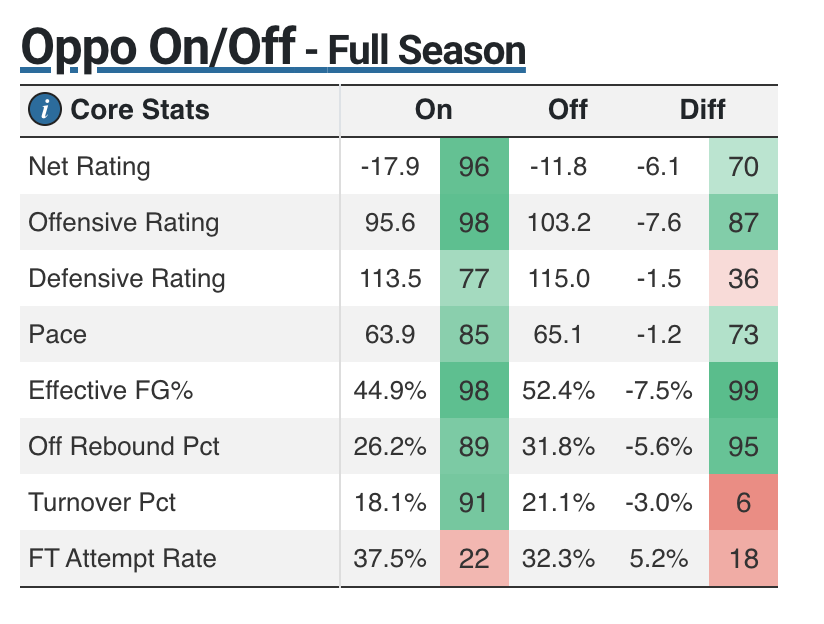
As seen in how opponents fared against Mara and Mara-less lineups, you can see that his overall opponent offensive rating was somewhat muted because teams turned it over less and got to the free throw line more. This is likely because Mick Cronin's defense is a very aggressive bunch that helps far more than most in the name of getting steals, a style Mara probably wasn't built for.
For Michigan and Dusty May, a program that helps way less and is more focused on elite rim protection, it was that effective field goal and rebounding percentage dominance seen in the chart above that mattered most. Mara's absurd ability to deny the rim has led to the Wolverines ranking first nationally in effective field goal percentage defense as a unit. Changing schemes turned Mara from a great defender to one of the game's best.
Cadeau's DRAPM was elite as both a freshman and a sophomore. He finished 17th nationally in that measure as a freshman, and 18th amongst ACC guards as a sophomore (because the team defense was way worse).
Cadeau was always known primarily for his passing, isn't very big, and never had a high steal rate, so how good could he really be defensively? May has referred to Cadeau as a "psycho" competitor multiple times leading up to the Final Four. But there is no stat for defensive compete level.
While defensive on/offs can be tricky and dependant on lineup usage, comparing Cadeau to the other guards around him tells the whole story. Cadeau played with fellow guards RJ Davis and Seth Trimble both years at North Carolina, Cormac Ryan as a freshman, and Ian Jackson as a sophomore. Let's take a look at everyone's defensive on/off percentile nationally through those one or two seasons.
- Elliot Cadeau: 94th%
- RJ Davis: 50th%
- Seth Trimble: 37th%
- Cormac Ryan: 22nd%
- Ian Jackson: 1st%
Of course, a part of that gap in numbers is that naturally, Cadeau lineups being better defensively meant some of the lineups featuring the other guards were destined to be worse. But as a whole, Cadeau being this much better than his peers at his position over a two-year sample should have demonstrated his defensive value.
Inevitably, Michigan using advanced analytics and lineup data for three players with good-t0-great physical tools coming from power conference leagues allowed them to create a pretty strong guess on how they'd translate defensively. And now they sit in the Final Four with the sport's top defensive unit.
Illinois: Role Reallocation
Andrej Stojakovic, Zvonimir Ivisic, Ben Humrichous, and Jake Davis are four of Illinois' five D-I transfers on the roster this year, but they also all have something else in common.
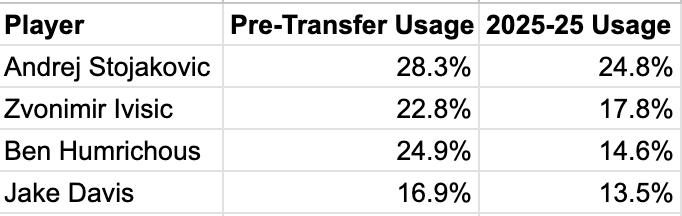
All four players have seen a usage dip of at least 3.4% between their last year at their previous schools compared to their current numbers. In basically all of their cases, they're playing entirely different roles than they did at their last stops. Maybe some of it was luck, but Illinois' ability to project these players in a different offensive role was a big part of hitting on them in the portal.
For Stojakovic, his 2-point percentage is up 11.2% from last year, but his rim efficiency is only up 5%. That's because he's gone from 103 non-rim twos last year, to 59 this year. Illinois was probably quite unconcerned with Stojakovic shooting just 22-of-69 on pull-up twos last year, because that's a shot that Brad Underwood's teams never take. They were mostly likely only looking at the 57.6% rim shooting, a really solid mark for an on-ball player. That number has only gone up this year.
Ivisic is a similar story. His non-rim twos have gone from 44 last year to five this year. He attempted 51 post-ups last year at Arkansas, and is down to 22 now. When you think about it, a guy that dunks the ball about 55% of the time around the rim throughout his three-year college career should be taking as many of his shots from there as possible. And just like with Stojakovic, Ivisic's sky-high dunk rate at 7-foot-2 was likely by far the most valuable offensive stat Illinois saw in his profile with how they intended to use him.
Making Ivisic a rim-runner and spot-up shooter only has also cut down dramatically on his turnovers. He has played nearly the exact same amount of minutes this year compared to last, but his turnover tally has plummeted from 49 to 18. His lack of ball skills was a significant reason for his muted playing time at Arkansas. It's made it that even though his 3-point shooting has fallen off a cliff this year, he's still having his most efficient D-I campaign.
Humrichous is the most unique of the bunch, having played three years at the NAIA level, but actually setting a career-high in scoring at Evansville in the Missouri Valley. Humrichous took 40 more twos at Evansville than in his two years at Illinois combined.
The stat that stands out with Humrichous is his exceptionally low turnover rate, even back then, when his usage was way higher, and he was tasked with running pick-and-rolls and isolations. His Evansville season is on a very short list of forwards that had a 13%+ assist rate with a 10% or lower turnover rate while maintaining high volume.
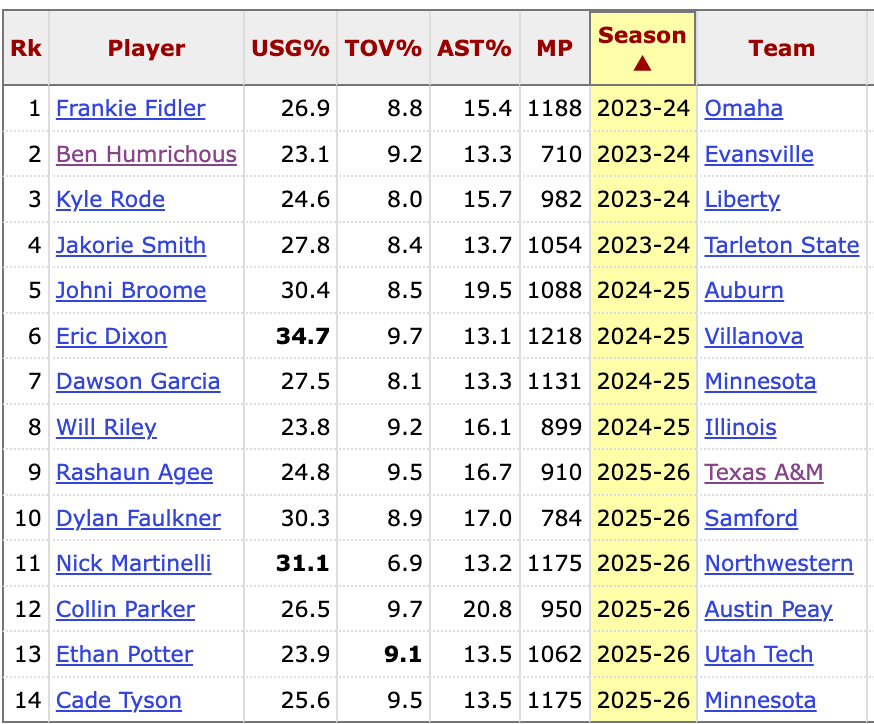
That ability to stay under control while still maintaining a substantial usage load has transitioned to him being the most prolific anti-turnover player in college basketball history. Once he got his 3-pointer falling in his second year with the Fighting Illini, he became one of the most critical pieces on the roster.
Lastly with Davis, we have someone who finished 29th in the Southern Conference in offensive rating at Mercer to someone leading the entire country in that stat this year. And he's shooting the exact same percentage from deep while doing it.
There's not too much to break down here. Underwood and Co. saw someone at 6-foot-6 who made 40% of his threes and went 6-for-20 in the pick-and-roll who had low assist and high turnover numbers and figured he fit their emphasis on positional size and shooting if he bought in to a low usage role. And now he's starting on a Final Four team.
Davis, and these Illinois transfers, are the embodiment to what I mean when I say role is the most important part of a transfer evaluation.
UConn: Patience is a Virtue
It was undeniable that when Tarris Reed and Silas Demary transferred to UConn, they were both incredibly gifted players. But it didn't click immediately for either player.
When Reed came to Storrs two years ago, it was off two very inefficient seasons at Michigan. Hurley's system fixed the rim efficiency nearly immediately, but Reed's improving conditioning and his constant foul trouble prevented him from playing big minutes.
If you're a believer in per/40 minutes or per/100 possession stats, I suppose you could have said you'd seen the monster NCAA Tournament breakout Reed is having as inevitable. His per/40 stats over the last two years are nearly identical to what he's put up in the Big Dance.
Even this year, with Reed beginning the season in and out of the lineup due to injury, his true impact was not yet felt. Dan Hurley said as much in a press conference ahead of UConn's eventual dramatic win over Duke last week.
"I think just at some point you hope that the light switch comes on in time," said Hurley, "Maybe it's the life or death urgency to this time of year, which has created that urgency, that focus, that concentration, that locking into the identity, the motor, where like it's now or never."
Whatever the light switch was, those flashes that made Reed a tantalizing project out of high school, and a hopeful heir apparent to Adama Sanogo and Donovan Clingan, has finally been realized.
As it pertains to Demary, his growth from just the start of the season until now has been massive.
In November and December, Demary was averaging a 46.4% effective field goal percentage, and a 37.6% assist percentage. From the start of January until he got hurt in mid-March, those numbers soared to 58.1% EFG% and 39.5% AST%.
Like Illinois' transfers, Demary is another player who benefited greatly from a refined offensive role. Remarkably, he went from shooting 30.6% on pull-up jumpers last year, to 44.2% this year, a top 40 mark in the country. A lot of that simply stems from him learning the offense over time. If you compare what a dribble jumper looked like for Demary at Georgia vs. UConn, the giant jump makes sense.
Though Demary's injury has held him back in March Madness, he should be considered one of the best point guards in the country next season, even if it took a little time to get there in Year One at his second program.
At the end of the day, Reed and Demary both came to the Huskies "looking" the part, but the program being patient with their development is a big part of what's propelled UConn to the Final Four.
Arizona: Stay True To Your Game
Admittedly, Arizona is the hardest team to pull a true takeaway from, as the Wildcats only have three former transfers in their rotation, none of which were from this year. But something stands out with both Jaden Bradley and Tobe Awaka.
Bradley was a very inefficient non-shooting point guard who turned it over way too much at Alabama as a freshman. Since then, he's cut down on his turnovers and become one of the best point guards in America.
But Tommy Lloyd and Co. didn't force Bradley to become a shooter. He's still shooting under 20% of his attempts from deep, just like he did at Alabama. They didn't force him to be a high usage player. His 21.2% possession usage is identical to his number in Tuscaloosa. The player Bradley was at Alabama is the same player he is at the Final Four multiple years later, just refined.
Awaka is in the same boat. He was one of the most-efficient rebounders by percentage in NCAA history, and that's largely all he did at Tennessee. Arizona hasn't tried to force a 3-pointer onto him, or get him to make plays at the top of the key. Allowing him to stay true to his game while becoming more comfortable playing D-I hoops and fouling way less has led him to being one of the sport's best rebounders ever, now that he's actually playing enough minutes to qualify.
As our very own Trilly Donovan loves to say, some of the best gets are the ones you already have. But by the same token, some of the best transfers you do end up adding are the ones who need to change nothing about their games to fit into your system.