

After Niko Medved left Colorado State for Minnesota, Ali Farokhmanesh, who was an assistant coach at Colorado State for seven years, was named the next head coach of the Colorado State Rams. Even though he was promoted from within, Farokhmanesh still had to put a largely new roster together, only having about 10% of returning minutes per Kenpom. Despite having to do that, the Rams have been elite offensively to start the season, currently ranking as a top 20 offense per Kenpom. Arguably the biggest reason why?
Three point shooting.
Before getting into the film on how they're doing this, we need to put into context just how good of a shooting team that Colorado State has been.
The Stats
It's an understatement to say that Colorado State has been just a great three point shooting team, they've been an absolutely ELITE team from beyond the arc. In their 10 games against D1 competition, Colorado State is shooting 45.4% from three, which ranks #1 in the country by over a full percentage point at the time of this writing.
In the three point era (1986-87 on), there have been 49 teams to shoot over 45% from three for the entire season. Colorado State would be the 50th if this rate was to hold. If we sort it by year though, something interesting happens.
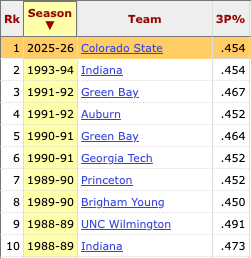
No team has accomplished this feat since Indiana did it in the 1993-94 season. Indiana took 401 3s for the entire season, coming out to 13.4 a game. Colorado State has already taken 262 through their first 10 games.
The pure shot making has been incredible, but the fact that they're doing it while taking 50% of their shots from three is simply absurd.
Colorado State is currently shooting 45.4% from three on 26.2 attempts a game against D1 competition.

If those numbers were to hold, Colorado State would be the first team in college basketball HISTORY to shoot 45+% as a team while taking at least 25 threes a game.
It's probably not fair to fully expect Colorado State to maintain those historic numbers, so if we relax the requirements just a bit, this is the list we get.
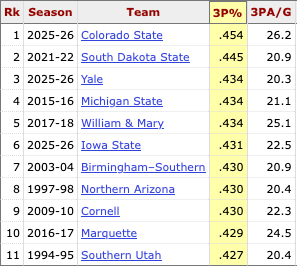
There are currently 11 teams that fit the criteria of shooting 42.5% from three as a team, while taking at least 20 a game. Colorado State, Yale, and Iowa State are all making the list for this current season, so that means only 8 teams have ever done it before.
That's a very roundabout way to say "hey, this Colorado State team can shoot the leather off the ball." I promise, we're going to get into the film of how it happens in just a second, but there's one more statistical query I want to show first (shoutout Stathead.com).
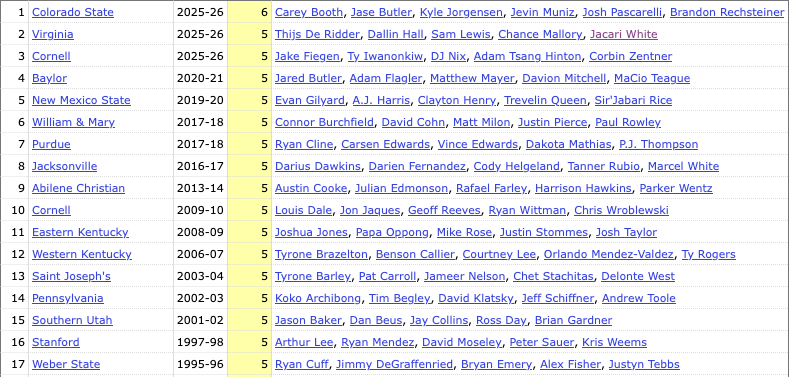
Colorado State currently has 6 players who are shooting over 38% from three on at least 2.5 attempts per game. They would be the first team in history to have 6 players accomplish this (although it's worth noting that Cornell this season just barely misses this cutoff). The math probably says that not all 6 of these players will be meeting this requirement by season end, but it shows the depth that Colorado State has with shooting the ball.
The System
Colorado State runs a Princeton styled offense that's built on movement, cutting, and using everyone as facilitators. Four different players for Colorado State have an assist rate of over 19%, and Colorado State as a team is 12th in the country in assist rate.
Because this team bombs away from three, it might seem like they struggle to get the ball in the paint. However, it's the opposite of that as they still have a good enough rim rate. The three point shooting doesn't just work because they have great shooters, but it also works because their cutting and screening sets up so many good looks at the rim, that teams have a lot to deal with.
Elbow Flex Curl - Layup
Take the play above for example, as it's a pretty common set within the Colorado State system. Colorado State starts with a weave type action before entering the ball into the elbow, something that they love to do. From there, #1 (Josh Pascarelli) cuts through the paint to setup a Flex Screen. This is a screen that gets set for someone to cut from the weakside corner, through the paint. It's often followed with a pindown for the initial screener. This is what happens here as Pascarelli eventually gets a pindown after setting a flex screen. With the defender being late and having to chase, the big defender for Darthmouth shows a bit of help. Pascarelli then curls the screen to get downhill, and thanks to a good seal from #23, Nikola Djapa, and because the big defender was worried about the three, Colorado State is able to get a look at the rim.
This is the same exact set from earlier in that game. Again, Colorado State gets the ball into the elbow before flowing into flex action. A similar thing happens where the defender gets caught trailing. The only difference this time is the big defender doesn't show any help, and although it's a miss, #2, Brandon Rechsteiner, is able to get a really good look from three.
And that's how the offense is balanced. Yes, Colorado State is more than willing to put up a ton of threes, but the interior and perimeter game work together to create their looks. If a team wants to sell out on taking away the three, Colorado State will just counter by either back cutting or curling screens to get downhill. If they don't show any help, then basically everyone on the floor for the Rams has the green light to fire away.
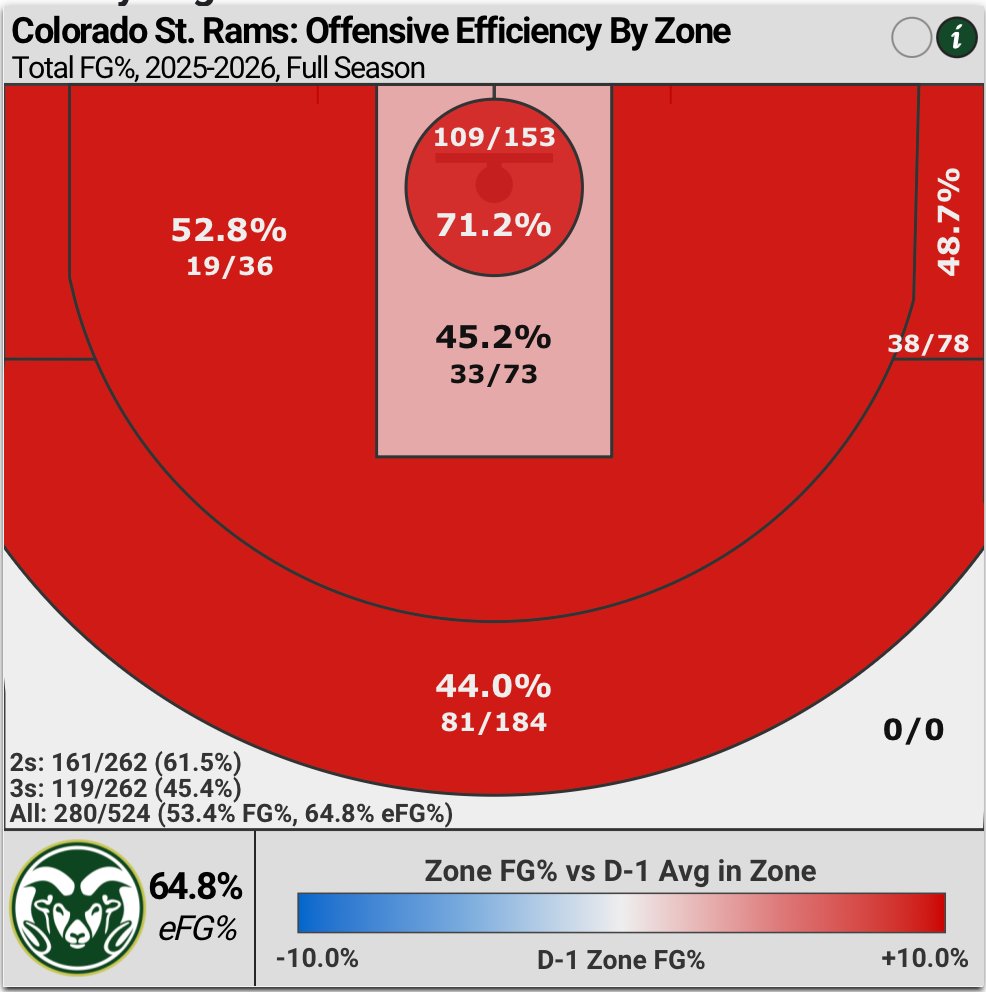
Above is the shooting chart for Colorado State this season, and this sums up why this offense is so elite. Yes, the Rams are the best shooting team in the country on incredible volume, but they aren't a one trick pony. They have enough balance within their offensive system to try and punish teams in different ways.
Let's take a look at another way that the balance comes in.
Colorado State Offense - Back screens
Colorado State loves to use variations of back screens to get their looks. There are two clips shown above, and although the screens are slightly different, they accomplish basically the same thing.
In the first clip, Colorado State starts with their weave action before entering the ball into the elbow (I can't emphasize enough how often they start plays this way). #55, Jevin Muniz, fakes like he's cutting through the paint (very similar to the flex actions we looked at before), but this time he stops and sets a Rip Screen on #0, Carey Booth. The rip screen is a backscreen set by a guard for a big. In this setting, it's also essentially a Chin Screen, a backscreen set at the weakside slot. Semantics aside, the backscreen gets set, and the Denver defense both step towards the shooter, opening up the layup for Booth.
In the second clip, Colorado State runs a similar concept, although the opening was a bit different. They still entered the ball into the elbow before cutting through. Rechsteiner then stops as he cuts through to curl and set that rip screen on Djapa. In this one, instead of both defenders going to the shooter, both help on the big. This allows Rechsteiner to be able to slip out to the top of the key and knock down a three.
Colorado State currently uses cuts and off-ball screens more than most teams in the country, and they've been incredibly efficient in both areas. As already shown in the film, they have counters for the defense, and defenses have to be incredibly on point with their communication to be able to take everything away.
As shown above, Colorado State loves entering the ball into the elbow to initiate a lot of their actions. This is generally the catalyst for a lot of their movement because if the big has the ball at the elbow, that means all 4 other players have freedom of movement off ball. There are so many variations and sets they can run off of it, including the two mentioned above.
Colorado State - Horns Pindown Flare
In this clip above, Colorado State enters the ball into the elbow via a Horns set, which includes having two bigs at the elbows and two players in the corners. As the ball gets entered, there's a simple pindown on the weakside. The Colorado defender is looking to try and cheat the screen to take away a clean look off the screen, but Pascarelli recognizes this and immediately turns it into a flare screen. Based on how the pass is, it almost seems like this was by design, knowing that Colorado would try to cheat under the screen.
Colorado State - Post Kickout Three
Colorado State does have one of the highest post up rates in the entire country, and they do a good job of creating looks at multiple levels out of it. On the season, the Rams are currently shooting 12/19 (63.2%) on kickout threes from the post.
In the clip above, Colorado State, to the shock of presumably no one at this point in the article, enters the ball into the elbow to initiate their action. Colorado State then acts like they're flowing into Zoom action, a pindown into a handoff, before #11, Augustinas Kiudulas, slips the screen and sets himself up in the post. Cal Poly sends help baseline from the weakside corner, and this is where it all comes together. Because the defender is sunk into the paint, Colorado State has their weakside wing player do a 45 cut through the paint, taking his defender with him. This opens up the skip pass three from the post. Colorado State is elite at manipulating spacing to their advantage.
Colorado State - Wide Screens
Another action that Colorado State loves to use is a Wide Screen. This is essentially just a screen for a player to move from the weakside wing towards the ball. Above shows three clips in which Colorado State is able to generate three different types of threes via it.
In the first clip, South Florida tries to switch the screen, but there's too much separation on it. Because of this, Pascarelli is able to flare out just a bit and fire the ball up as soon as he catches it.
In the second clip, Wichita State has their big more in a 'drop' type coverage, spotting him in the paint. #4, Jase Butler, curls this wide screen to bring his defender in the paint, and with the big being in the paint as well, this opens up #35, Kyle Jorgensen, to be able to pop out and knock down a three.
In the third clip, Incarnate Word late switches as they got caught being late to cover the screen. This meant the big eventually switched onto the ball, although it didn't happen right away. Muniz is then able to drive the ball against the big and collapse the defense before kicking out to Booth on the three point line.
This was the same action, and all three resulted in three pointers, but all three of them did it in different varieties. That, to me, is what makes this Colorado State team so difficult to guard and game plan for. As a defense, at some point you just have to live with the fact that they're going to get pretty good looks, and you just want to make Colorado State at least have to work a bit to get them.
The one thing we haven't talked about yet is the pick and roll, and it's for a reason. Colorado State is near the bottom in pick and roll usage in the country. However, it's 2025 (or I guess 2026 depending on when you read this), and every team runs pick and rolls to some capacity. (I looked it up and currently William & Mary runs the fewest pick and rolls in the country, accounting for just 7% of possessions.)
For Colorado State, the pick and roll is generally something that they can flow into within their offense. They aren't a team that's going to walk the ball up and just set a single high ball screen much. There seemed to be three main ways that they get into their ball screening actions - Empty pick and roll, Step up screens, and Butt screens.
Colorado State - Empty Pick and Roll
Starting with the empty pick and rolls, this is a ball screen that happens when there's no one in the strong side corner. If Colorado State has the ball at the top of the key and it gets swung to someone in the corner/wing area, they will generally follow with a screen being set by whoever passed the ball. That's what happens in the clip above, and the Rams are able to collapse the defense before kicking the ball out for three.
That is probably their most common way to get into pick and rolls based on the film that I watched. It allows them to still run their free flowing offense without feeling like it has to become stagnant to get into a ball screen.
Colorado State - Step Up Screen
This clip shows the Step Up screen that Colorado State uses. After their weave action, Colorado State essentially does a boomerang pass, immediately passing back to the top of the key after passing to the wing. As these passes happen, Djapa "steps up" to be able to set the screen on ball as soon as Muniz catches it. Again, Colorado State is able to collapse the defense before kicking out for three.
Colorado State - Butt Screen
This last clip essentially is a bunch of decoy action for the first 12 seconds before getting into their look. Similar to what Niko Medved does at Minnesota, Colorado State will often have their big set a screen while facing towards the basket, coined as a butt screen. This makes it easier for the big to be set to either catch and shoot on the pop or drive the ball if the defense closes out. That's what happens in this one with Colorado in drop coverage, opening up the pop.
Colorado State will also initiate sets using this at times, often in a 1-3 Across look, where 3 players will be along the baseline.
This Colorado State team has been incredibly fun to watch because of their ability to light it up from three while also having the balance to punish teams who sell out on stopping that. Teams have to decide if they want to just try and switch every action and live with the consequences, or do they try to stay in a shell scheme to take away the cuts. Either way, the Rams have the counters to get the looks that they want.
