


How James Nnaji changes this Baylor team
The qualms, concerns and deliberations on the justification for James Nnaji playing college basketball feel well covered, so instead I’d like to discuss what impact adding the former pro center to Scott Drew’s team offers the Baylor Bears. The seven-footer from Nigeria offers size that the Bears desperately need in the frontcourt and adds valuable depth for a team currently rolling out a 7-man rotation.
Nnaji is not just tall, he’s massive. The center weighed in at over 250 pounds during the draft process. He has a 7-foot-7 wingspan to add to his frame and a standing reach of 9-feet-4 inches. His mobility instantly makes him of the biggest paint threats in the conference and gives Baylor an option to slow down the formidable frontcourts throughout the league.
James Nnaji is an elite rim protector. His physical tools are off the charts as he measured in at 7’0” with a 7’7” wingspan. He has nice bounce and solid timing on his blocks. The second youngest prospect in the draft with some enticing defensive upside. pic.twitter.com/XGedRRqWHL
— Global Scouting (@GlobalScouting_) June 20, 2023
The former pro is an elite athlete at the center position. It’s why he was drafted 31st overall in 2023. His ability to stay in front of his man and protect the rim in pick-and-roll coverages instantly helps a Baylor team that is giving up 65% shooting at the rim on defense. He also provides great verticality on both ends. He averaged nearly a block a game in just over 16 minutes per contest in ACB play last season and should have even greater success at a level of basketball with less finesse and footwork around the rim.
Nnaji is mostly a lob threat on offense, lacking the touch to shoot more than 10 feet from the basket. Baylor is averaging 41.6 points in the paint per game, but a healthy chunk of those baskets are coming in fast-break opportunities (19.6% of their points come in transition). Nnaji’s athleticism could make him an ideal finisher as a trailer in the fastbreak and he provides a post-up ability not currently available from the rest of the frontcourt.
Nnaji’s biggest question mark has remained his motor and his willingness to fight for loose balls. His size will help with this at the collegiate level, but a vertical 7-footer with a wide frame should be capable of securing more than 4 rebounds over 16 minutes of action.
If the center’s midseason integration goes as optimally as possible, Baylor moves further up to the tier of BYU, Houston, Kansas and Texas Tech. But getting a guy up to speed with your system and on the same page as seven other players isn't necessarily a given.
Get ready for a contentious conference season
We’re still at the point in the season where teams’ analytics can be a bit wonky despite the methods of weighting that the great math wizards try to use to lessen the ambiguity. However, things are shaping up for this Big 12 season to be a significant improvement in competitiveness compared to the first season of 15 teams in the conference, coupled with the strongest collection of top talent since arguably the 2021-2022 season.
Comparing the last three seasons, the KenPom Net Rating of the conference (Adjusted Efficiency Margin of victory for a team if they were to place the “average” Division I team for that season) comes in as its most competitive this season. The difference in margin for the conference’s highest-ranked KenPom team compared to the sixth-ranked team and for the first-ranked team and the 14th-ranked team is the tightest it’s been since expansion.
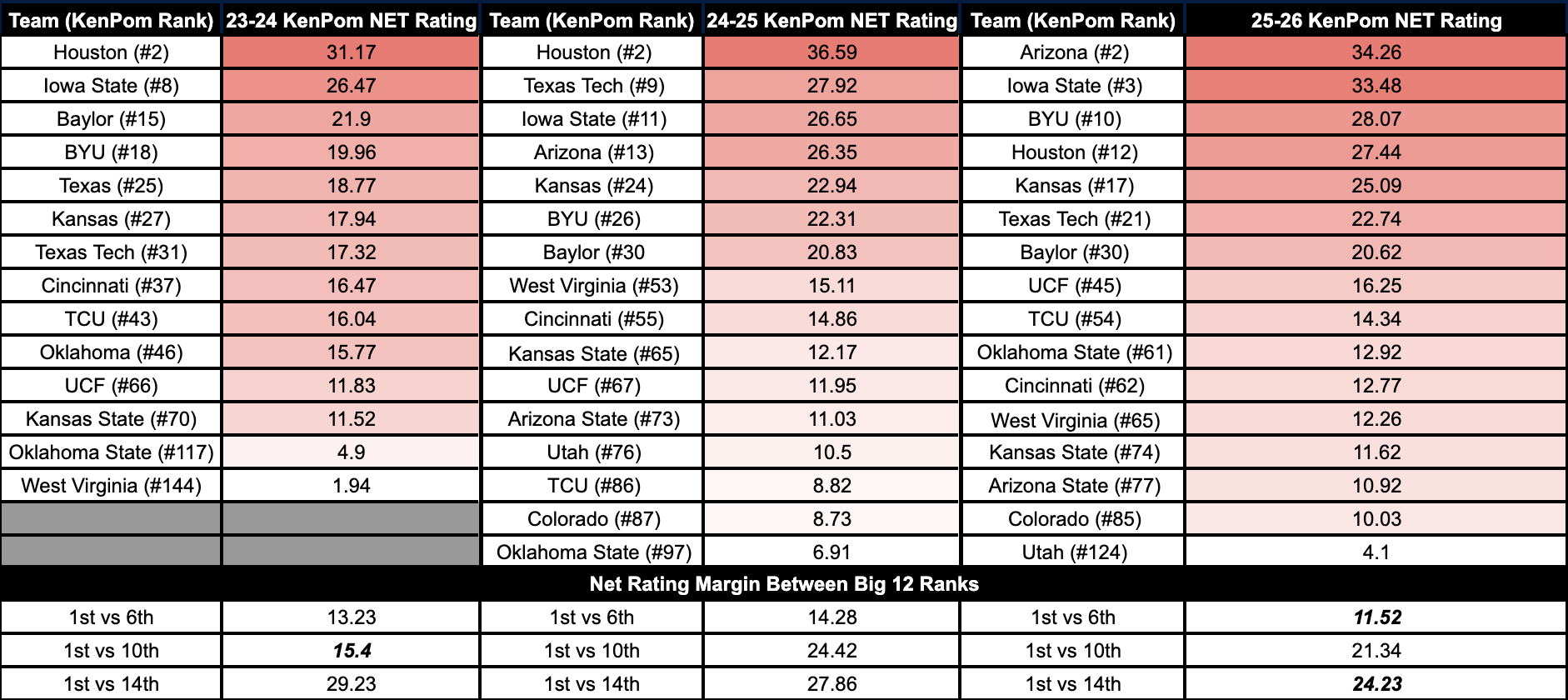
The top of the league is also broader and more dominant compared to the Division I standard, to the point that there could be a real argument for the league to have its first pair of 1-seeds in the tournament for the first time since 2022. Currently, in the NET Rankings, Iowa State and Arizona both sit in the top four nationally and have resumés worthy of consideration for top seed lines.
The question will be just how dangerous the middleground of UCF, TCU, Oklahoma State, Cincinnati and West Virginia will be for the top of the league and how much of a threat teams 8-15 in the standings will be for the pocket of five teams that have pathways for protected seed lines in March.
Who has the best and worst conference schedules?
Now that leagues hold too many conference foes to have everyone play twice, there are instances where a team has a built-in advantage over its competition, not just for conference supremacy, but also for NCAA tournament seeding. And who you play is not the only important factor for scheduling advantages; it’s also when you play certain teams and go on the road.
Favorable conference schedules
Arizona is an early favorite for preferred scheduling based on who they play and when they play tough competition. The Wildcats don’t play a team in that second tier of the conference (Baylor, BYU, Houston, Kansas, Texas Tech) until January 26th when they go on the road to Provo, Utah.
The Wildcats also get to work off any holiday rust by playing cellar-dweller Utah and a Kansas State team that has played Jekyll and Hyde basketball for the last two months, with a major size disadvantage against an Arizona frontcourt that is considered one of the best. The final month of the season won’t be a cakewalk for Tommy Lloyd’s team, as 7 of their last 8 games are against top-30 KenPom teams, but they do have the advantage of playing Houston and Iowa State once, with their game against the Cyclones coming at home.
BYU gains a regional advantage thanks to the school’s partnership with Utah as a travel partner, with the Utes facing BYU twice this season. However, they also avoided incredibly dicey road travel for a team with a case for a top-3 seed. The Cougars play Iowa State and Houston once and both games are at home in the Marriott Center.
In addition to the favorable pairings, BYU also avoids difficult road tandem games. In the two weeks they play on the road twice, the Cougars play just one of the top 7 teams in the conference. Should AJ Dybantsa continue developing into arguably the best offensive weapon in the country, look for BYU to be higher in the final standings than the analytics suggest.
Unfavorable conference schedules
Houston and Kelvin Sampson have likely the least enviable schedule when it comes to top-half teams in the conference. The Coogs start the season on the road against a Cincinnati team more than comfortable playing Houston’s style of game, with a head coach fighting for his job. After they get done with the Bearcats, Houston then faces Texas Tech at home and Baylor on the road.
Sampson’s team also faces Iowa State on the road and Arizona at home the same week in February. This is by no means a task too big for a team that just made it to the national championship less than a calendar year ago, but it’s a path that certainly isn’t without its share of bumps.
TCU looks every bit the part of a tournament team. They’re 10-3 on the season and after their disastrous buy game to start the season have only a two-possession loss to Michigan and an overtime heartbreaker against Notre Dame as their blemishes. They knocked off Florida in a neutral game in November and stapled a decisive win against Wisconsin to their resumé the day after. But otherwise, the Horned Frogs have beaten up on largely terrible teams.
That preamble is only to suggest that there is still some question marks on whether this Jamie Dixon team can score to the level necessary to take care of business against similarly talented teams and to possibly take down one of the upper echelon conference opponents when given the possibility. And the schedulers certainly gave them an immediate opportunity by scheduling four straight top-30 KenPom teams to start conference play, matching up against Baylor, Kansas, Arizona, and BYU to begin Big 12 play.
Just two of the Horned Frogs’ rotational players were on the team last season, so you could ask questions about how this team might do with their backs against the wall or starting out league play in the hole with a 0-4 or 1-3 record.
Games to Watch
- Baylor at TCU, Saturday at 2 pm ET on TNT and truTV
- Kansas at UCF, Saturday at 2 pm ET on Peacock and NBCSN
- Houston at Cincinnati, Saturday at 2 pm ET on Fox
