


Three freshmen are the focus of this week’s round-up as the storylines for league play begin to crystallize. The Big 12 tiers are beginning to take shape as data continues to trickle in, but each of the players discussed this week changes the trajectory for their teams and where they land, not just in conference standings but in national rankings.
Here are some developments – two good and one not so good – to keep an eye on over the next week and further.
Brayden Burries takes Arizona to another level
It was clear that Arizona was one of the best teams in the country based on their resumé alone in their first 10 games of the season. The Wildcats are the first team in AP poll history to defeat five ranked teams in their first 9 games of the season after taking down Alabama in a resounding win of 96-75.
I wrote just last week about the Wildcats’ frontcourt, a group that makes them a team with an incredibly high floor and a favorite for a top seed come Selection Sunday. Jaden Bradley is one of the steadier point guards in the country, but supplementary scoring from the backcourt was one of the only questions you could still have for this team.
Then Brayden Burries found his footing. The freshman guard is the ceiling raiser for a team that already has an already dominant scorer in fellow freshman Koa Peat, as well as a lead guard and frontcourt player, a weapon that could take them from great to elite. Burries in the preseason was seen as the most “ready” recruit in Arizona’s highest-rated class in program history. But it took a little while for the three-level scorer to find his shot and make an offensive impact.

The improved three-point shooting volume has an immediate and significant impact on Arizona’s offense, which ranks 362nd in the country for three-point attempts as a percentage of total field goal attempts and is in the bottom 4th percentile in three-point attempts per game. He took 10 of the team’s 26 perimeter shots against Alabama.
But Burries is more than a volume three-point shooter. Over 56% of his shots come off the dribble this season, and just as many of his attempts have come at the rim as behind the three-point line. Just as there has been an uptick in both his perimeter volume and scoring, he’s become more and more adept at getting to his spots in the half-court and getting out in transition.
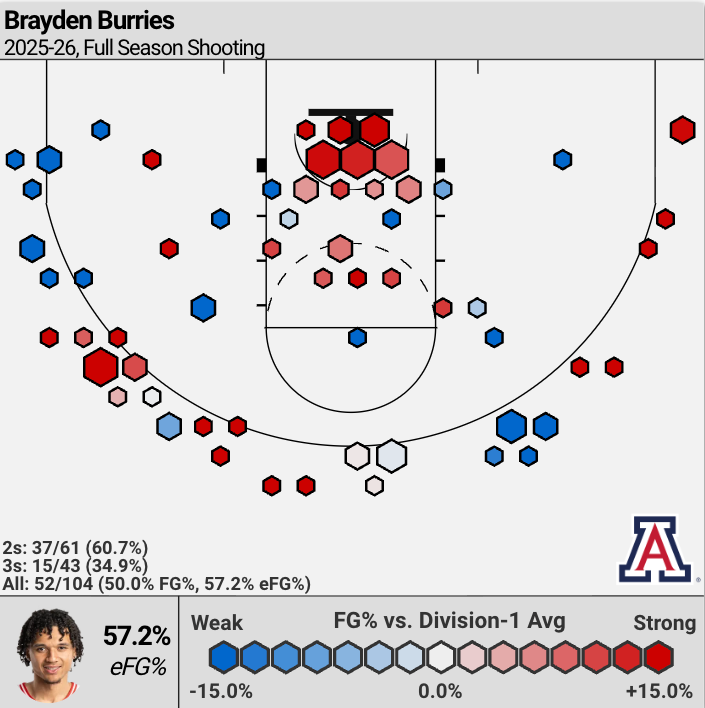
Burries has had nearly as many attempts coming from transition as when he’s the pick-and-roll ballhandler. Adding this multi-level scoring helps Bradley avoid having to create everything from scratch for this offense, allowing Anthony Dell’Orso to remain a highly efficient and dependable secondary piece. Considering how short a rotation Tommy Lloyd likes to run, developing a high-minutes player into a weapon diversifies the way that the Wildcats can win against great teams.
AJ Dybantsa is officially here
Perhaps the subject header is a bit misleading because AJ Dybantsa has been providing buckets and taking over throughout BYU’s nonconference schedule. But it’s been the last handful of games that we’ve started to see Dybantsa become the elite talent that can warp the game and get whatever he wants offensively.
The BYU Cougar is averaging 24.8 points per game in the month of December and shooting 68.6% from inside the arc over these last four games. Over this span, he’s held a median offensive player rating of 133.5 and a median possession percentage of 34.5%.
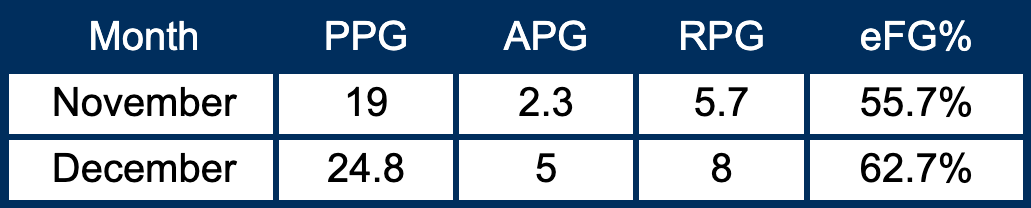
When it comes to beating his matchup, Dybantsa is shooting 57% from the field against man-to-man defensive coverage. He utilizes his handles and athleticism to his advantage, leveraging his 6-foot-9 frame. He’s shooting 55% on attempts where he’s the pick-and-roll ballhandler and 60.9% on post-up looks.
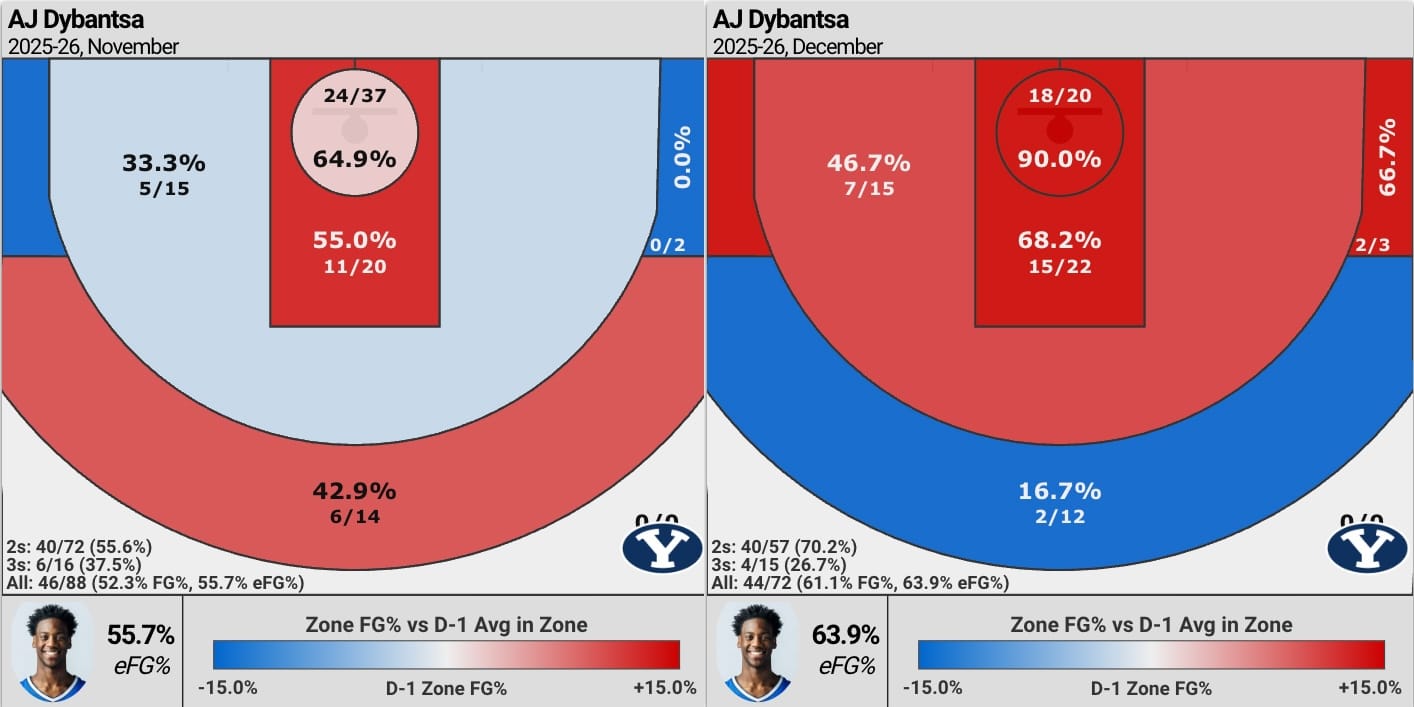
In an area of rim-and-three, Dybantsa is taking and making shots that only a real deal top 5 pick would be able to be efficient with as a forward. He’s shooting 40% in the midrange, 5% higher than the national average, and 61.9% in the paint, virtually 20% higher than the national average.
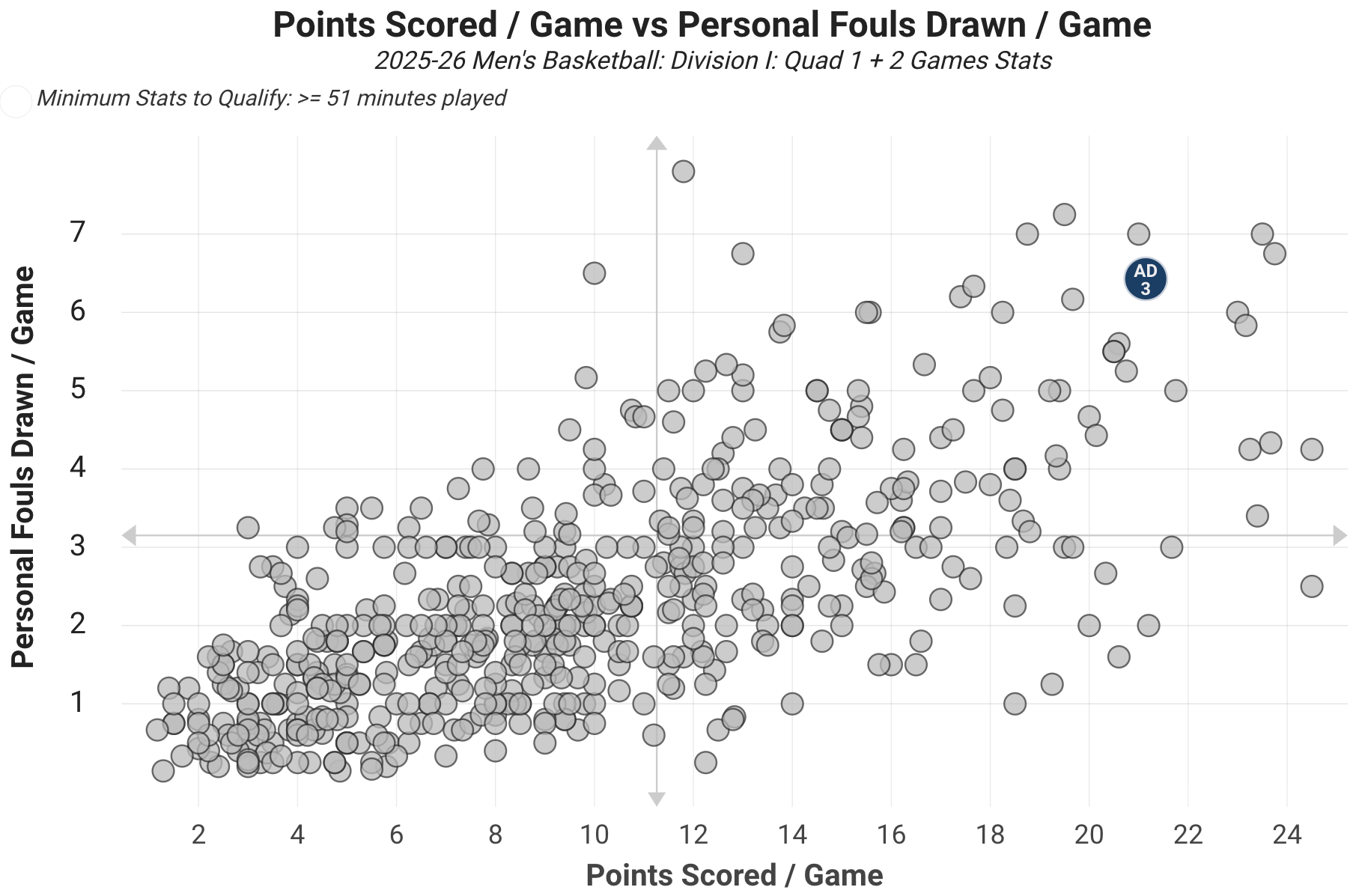
The future lottery pick consistently overpowers his defender and gets to the line. He’s averaging a free throw for every two shot attempts he puts up this season and is averaging 6.6 fouls drawn per 40 minutes.
Dybantsa has also continued to grow and showcase his ability to operate as a hub playmaker. He’s led the Cougars in assists in two of the last three games this season. How Dybantsa develops and responds to the elite Big 12 defenses this season will be one of the more fun storylines to follow over the next few months.
The Darryn Peterson season that could be
After coming back for two games following a seven-game absence, freshman guard Darryn Peterson is again out and day-to-day as he recovers from a hamstring strain. Interestingly, Bill Self said in his postgame press conference after beating Townson on Tuesday that Peterson’s unavailability is more health-related than necessarily the initial leg injury.
The winningest coach in Jayhawks history explained that Peterson is still limited in playing at the pace and with the mobility that the 19-year-old guard is accustomed to, although he still believes that both the guard and the team will overcome the setback.
“I’m concerned because this team needs to have an extended period of time together,” Self said. “Because it doesn’t work like, ‘Well, he practiced for two days so he’s ready to go.’ That’s not how it works. He wouldn’t be able to help us that way and we wouldn’t know how to help him.”
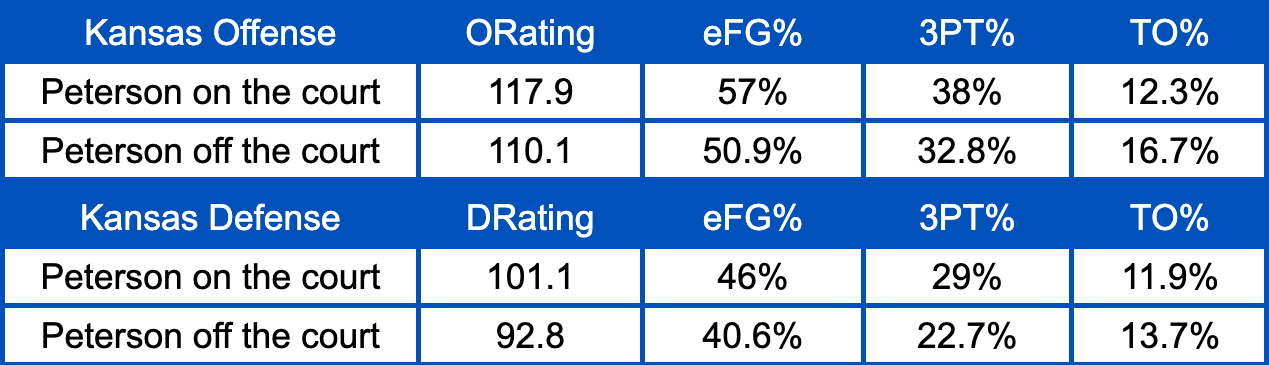
Kansas is simply a different team without the scoring guard, who is averaging 19.3 points, 2.8 assists, and 3.8 rebounds in the four games he has played this season. He accounts for 35% of the team’s shots when he’s on the floor, which is just a massive adaptation for the Jayhawks’ ensemble to adapt to on a night-by-night basis (for perspective, Duke’s Cameron Boozer accounts for 32% of the Blue Devils’ shot attempts when he’s on the floor).
The Jayhawks are built to be a stifling defense-first team that wins in the halfcourt and maximizes Peterson’s absurd shotmaking, where he’s averaging 1.26 points per possession in the halfcourt, putting him in the 97th-percentile. They’re holding opponents to 0.93 points per possession without Peterson on the floor and a decent 1.01 points per possession when he is playing. But the offensive ability of this team is wholly different when he’s playing.
Peterson is averaging 1.26 points per possession this season, per Synergy. He’s shooting 52.8% in catch-and-shoot opportunities for the season and an absurd 63.2% on catch-and-shoots where he’s being defended. He’s shooting 67% off of screens.
Without Peterson, Kansas is in a tier with Texas Tech and Baylor as good but not great and below a group consisting of Houston and BYU. With Peterson Self’s team is in conversation as one of the best four teams in the league. How Peterson and the staff proceed in managing this injury could help decide how this league finishes.
Games to watch this weekend
- Houston vs. Arkansas, Saturday, December 20th, 5:30 pm ET (CBS)
- Texas Tech vs. Duke, Saturday, December 20th, 8 pm ET (ESPN)
- Arizona vs. San Diego State Saturday, December 20th, 10 pm ET (ESPN2)
