


Things are already starting to get interesting in the Big 12 and we haven’t even had the giants of the league truly spar yet. The league as four teams in the top 12 of the NET Rankings headed into the weekend and we’re headed towards a collision course for conference games deciding who the one and two seeds in the NCAA Tournament will be. Arizona, Iowa State and BYU are all in the top 8 and a rising, dangerous Houston team is gaining ground at 12th.
Seven teams look to be tournament-caliber teams two weeks into league play, with teams like TCU and Baylor having a fighter’s chance to hear their names called should they pick up quality wins over the next eight weeks. Let’s take a look at some trends that will help decide where these programs end up by March.
Iowa State offense faltering
Perhaps the shooting was too good to be true, but Iowa State's offense has been an alarming drop-off since entering Big 12 play, with a regression in their first four games. Things are just not coming as easily for their primary scorers, with Joshua Jefferson going from a 60% effective field goal percentage in non-conference play to 37.3% in league play on almost 13 shots per game.
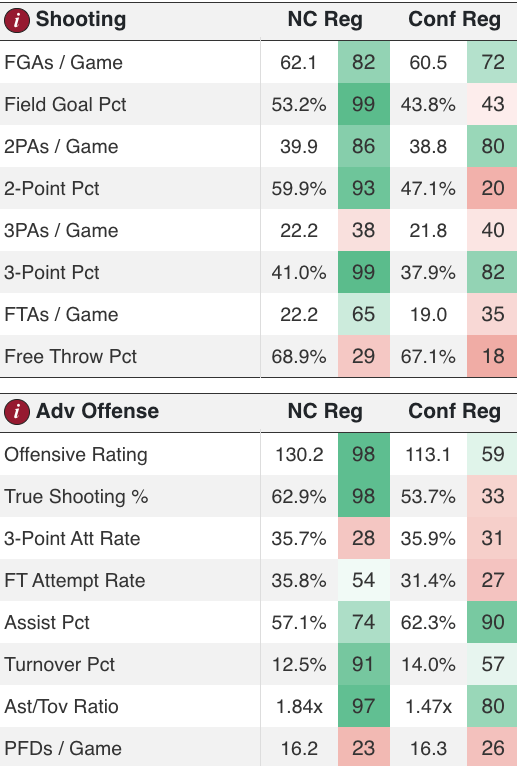
Iowa State’s points per possession have fallen from 1.3 points per possession in their first 13 games of the season to 1.13 in Big 12 play. Some may chalk this up to improved competition, but the Cyclones had a pretty stacked non-conference schedule and their first four games have come against teams ranked in the bottom 7 in defensive efficiency in league play.
The streakiness of Milan Momcilovic’s perimeter shooting also raises concerns about how dependable scoring from deep can be for a team ranked 260th in 3-point attempt rate to field goal attempt rate. The junior is 13 for 24 from three in league play, but 8 of those makes came against West Virginia to open league play. In the other three games, he has shot 5 for 14.
A lot of this concern comes from Kansas’ 21-point home win over Iowa State, which featured Jefferson and Tamin Lipsey combining for 5 for 19 from inside the arc and 3 for 10 from three-point. The offensive woes have also coincided with defensive lapses. The Jayhawks scored 1.29 points per possession and shot a blistering 12 for 24 from three.
The Cyclones will look to get their offense going against a reeling Cincinnati team whose students’ section is planning to don paper bags at home games, but one that plays a defensive approach that doesn’t make scoring easy at Fifth Third Arena.
Arizona’s depth shines
If you’re waiting for Arizona to come back to earth, as other top-ranked teams have throughout the college basketball season, you might be waiting awhile. The Wildcats are still undefeated 17 games into their season and they’ve proven the ability to have an answer for every obstacle opposing teams have thrown their way.
The Wildcats may not be a deep team in terms of rotational size, as they rank 233rd in the country for bench minutes this season. But the Wildcats, in terms of “dudes,” might be the deepest team in the country. In a classic trap game against an inconsistent but always pesky Arizona State team, Tommy Lloyd’s squad found its seventh different player to score 20 points in a game this season, with sixth-man Tobe Awaka dropping 25 points and being the unanswerable force to whether comically absurd tough shots made by the Sun Devils to stick within three or four possessions most of the game.
Koa Peat’s readiness as a freshman has made the process easy for the staff to build and empower guys up and down the roster to be contributors on any given night. Having a lottery pick talent lessens that burden for guys needing to score night in and night out. But the level of ownership in the offense throughout the Wildcats’ rotation makes them a dangerously adaptable team with the rare ability to push enough buttons until they find the guy who can take over and exploit his matchup.
Through 17 games, 5 different players hold a usage percentage of 20% or better, with center Montiejus Krivas just missing the mark at 19.5% usage. Not even Peat has a usage of 25% or greater, providing a balance and collective approach that makes scouting and prepping incredibly difficult for opposing teams. It’s in stark contrast to the offense run through Caleb Love the previous two seasons.
The Wildcats go on the road to UCF this weekend and will look to maintain their league-best two-point shooting against the third-worst two-point defense in the conference.
BYU’s top talent covers up concerns
The Cougars are 16-1 on the season, but does it feel like 16-1? Winning is all that ultimately matters, but the Cougars are now coming off back-to-back games against TCU and Utah that were decided by a combined 11 points.
BYU’s first four opponents in league play are a combined 2-10 in Big 12 games, which may help some of their weaknesses remain in the background. But whatever blemishes shown in these first 4 games, the specialness of AJ Dybantsa and Robert Wright alongside Richie Saunders covers them up and then some. The trio accounts for 70% of the team’s shots in league play and nearly 75% of the team’s points.
Unsurprisingly, the offense is in orbit of Dybantsa whenever he is on the floor. The future draft pick took 22 of the team’s 68 shots in their 76-70 win over TCU on Wednesday. His comfort level in isolation in the halfcourt is palpably game-changing. His efficiency has taken a downturn since getting into league play, but his 23.1 points per game sit atop the conference through these early weeks.
Dybantsa's physical talent jumps out in these games as well. It’s not just the tough shotmaking in isolation for the wing; it’s his ability to fight through contact and get to the line because of speed and size overwhelming his matchups. Dybantsa is averaging a league-best 10 free throws per game and is 10th in the country in foul-drawing rate.
Wright’s speed and handles only further leverage the physical disparity between these two stars and their counterparts on the court. Wright wasn’t ultimately hyper-efficient against a good TCU defense, but when it came to crunch time, the sophomore guard could get to another gear that his defender and the help defense couldn’t match in terms of downhill speed.
ROBERT WRIGHT III vs TCU
— BYU Men's Basketball (@BYUMBB) January 15, 2026
15 PTS | 6 REB | 6 AST pic.twitter.com/ajin4GDPFM
And the two have continued to grow together to become a lethal NBA-caliber tandem with Dybantsa holding gravity, initiating offense and bringing help defenders for the speedy Wright to cut and find space on the perimeter to knock down catch-and-shoot looks. Wright has gone from a 35% shooter his freshman season at Baylor to 46% at BYU in large part because of these actions.
The next couple of weeks will show how sustainable this top-heavy roster construction really is, as BYU facing Texas Tech, Arizona and Kansas to close out January. The role-player approach to the other four rotational players has worked against the bottom of the league, but does it work with a group of teams led by their frontcourt? The Cougars lead the conference in offensive rebounding rate at an eye-popping 41%. We’ll see where that number sits once they play teams of their caliber.
Games to watch
- Baylor at Kansas, Friday, 8 pm ET, FOX
- Iowa State at Cincinnati, Saturday, 2 pm ET, Peacock/NBCSN
- BYU at Texas Tech, Saturday, 8 pm ET, ESPN
