


The strength of the Big 12 as a whole is beginning to crystalize, having 7 teams in the top 25 in “wins above bubble” rankings, the most of any conference. Even as Iowa State stumbles in the NET, the Big 12 is neck-and-neck with the Big Ten for teams in the top 12 and in the lead for teams in the top 20.
While the Big 12 will look to bring seven-plus teams to the NCAA tournament, they’re also the league with most clearly tiered talent among the power conferences. They rank 4th out of all 31 Division I conferences for blowout games (matchups decided by 19 points or more).
The schedulers backloaded many of the top-tier matchups for later in the season, but we did get an early glimpse of where the top teams stand amongst each other when Texas Tech decisively took care of BYU last weekend.
Texas Tech back on track
The Red Raiders have turned a corner since their tight loss to Houston on the road a little over two weeks ago. Grant McCasland’s team has won four straight, including back-to-back wins against the aforementioned BYU and Baylor on Tuesday night.
Texas Tech has become one of the better two-way teams in the conference alongside Houston and Arizona. Their drop coverage defense provided fits for both BYU and Baylor, forcing both teams to settle for tough shots (17.8% of opponents’ shots came from the midrange, 7.3% above the Division I average). The defense was so good that “tough middie” hitter AJ Dybantsa went 6 for 17 from the field and 1 for 5 for non-paint midrange jumpers.
Texas Tech has done its best to circumnavigate the lack of frontcourt support around Preseason All-American JT Toppin. Wings Tyeree Bryan and LeJuan Watts have done their best to play expanded frontcourt minutes and provide offensive spacing for Toppin to maximize his elite efficiency scoring inside.
Toppin to get to his spots in the paint (over 76% of his attempts have come from this area of the court). He is averaging 22.8 points and 11.3 rebounds, along with a 99.3 defensive rating and 2 blocks in Big 12 league play.
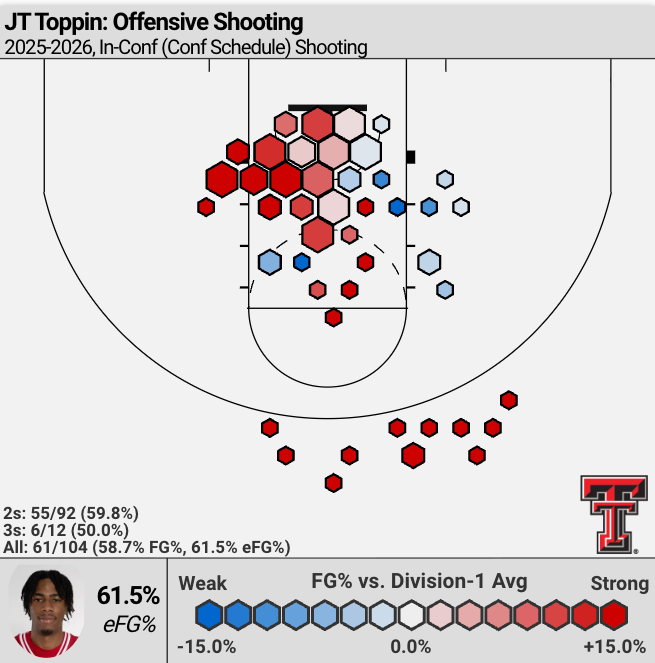
McCasland and Texas Tech have figured out how to minimize the strain of depending on two stars to carry their team offensively. Watts has been a reliable third scorer and Donovan Atwell joins Christian Anderson as two perimeter scorers shooting above 40% on over 150 attempts.
The Red Raiders’ starters all average over 30 minutes per game in conference play with Toppin and Anderson averaging 34.8 and 39.3 minutes. These minute and usage burdens will be something to monitor throughout conference season.
Baylor looks broken
Entering Big 12 play, the question for Baylor was whether their defense could improve enough to truly belong to that second tier of teams vying for protected seeds in the NCAA tournament but not quite #1 or #2 seeds.
But after 6 games, the Bears’ defense has remained inadequate and their offense has fallen off a cliff to the point that they rank 14th in effective field goal shooting offensively and 12th in opponent effective field goal shooting. The offense has gone from averaging 1.3 points per possession in nonconference games to 1.04 in league play.
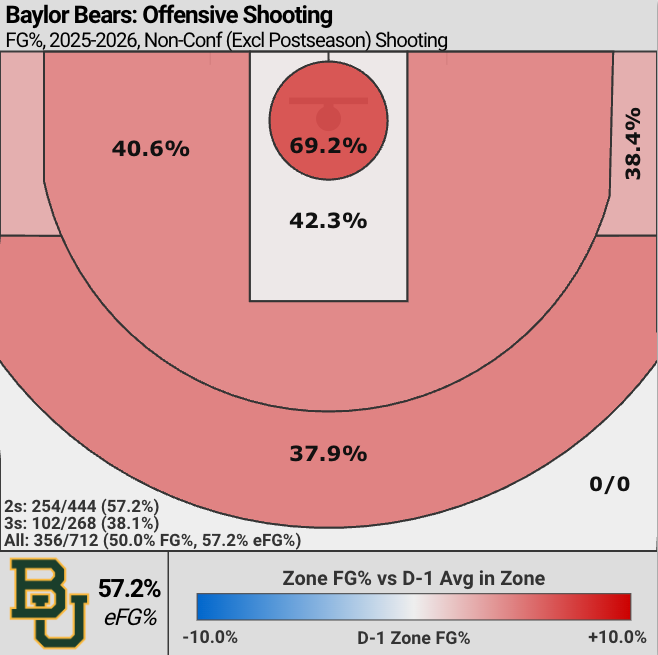
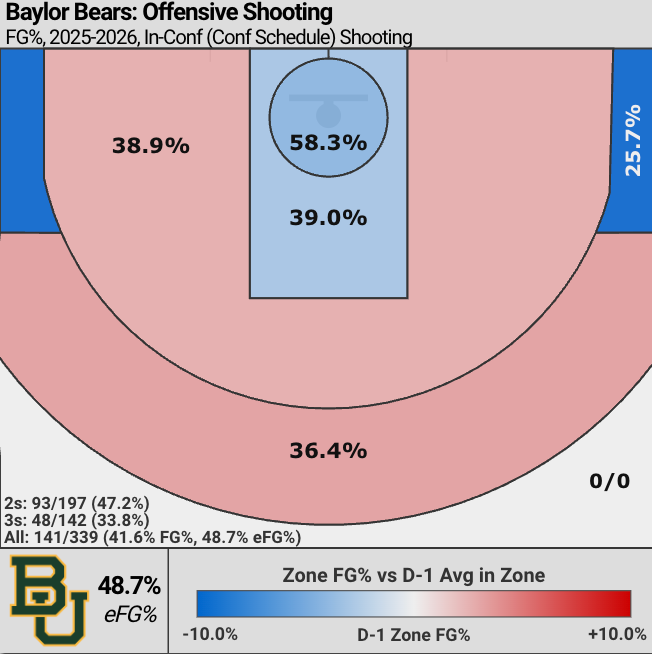
Baylor is roughly as effective shooting midrange shots as they are shooting in the paint, a damning proposition for Scott Drew’s offense that prides itself on getting scorers downhill and at the rim. The staff hitched their wagons to two portal players they locked up early in the process: seniors Michael Rataj and Obi Agbim, who came from mid-major ranks. The two are Baylor’s third and fourth-highest shot takers on the team and are shooting a combined 31% from the field.
Rataj was expected to be a primary scorer for Drew’s team and Agbim was the makeshift point guard and steady hand replacement for Robert Wright. But the two look out of their depth in a conference full of uber athletes and some of the most “ready” NBA-talent freshmen in the country.
Baylor is the worst team in college basketball at playing up to elite competition, a big reason why they might miss the NCAA tournament.
— Evan Miyakawa (@EvanMiya) January 22, 2026
The scary trend? It's been like this for Baylor for the last three years 👇 pic.twitter.com/CMuwSFu2iJ
The path to an NCAA tournament bid is beginning to get muddied for this Baylor team, which has a -60 point differential in league play, fresh off 18 and 19-point losses in its previous two games. The Bears will have to build back up their resumé playing three similarly ranked teams in TCU, Cincinnati and West Virginia to close out the month. One false move and they may be on the other side of the bubble for good.
Kansas has excelled at handling Peterson’s availability. Does the latest injury news change their ceiling?
It’s easy to shrug off a coach pulling the right levers when that coach is managing the talent pool of a Blue Blood like Kansas, but no staff has handled the ambiguity and ever-changing availability of their best player like Bill Self’s staff has this season.
Juggling between identities, between play styles, isn’t an easy adaptation should you lose someone for the season. But going back and forth every couple of games to fit what’s best for a top 25 team and a future top 5 NBA draft pick is maybe an even more unenviable task. But Kansas' staff have excelled at maintaining their defensive identity and winning in half court offense.
It was shared by Self on Tuesday night that Darryn Peterson had sprained his ankle in the second half of the Jayhawks’ win over Colorado, and was hesitant on setting expectations on the star freshman’s availability this weekend.
Peterson has played in 10 of Kansas’ 19 games this season, averaging 21.6 points, 4.6 rebounds and 1.9 assists in those appearances. When he’s on the court, Peterson has as high of usage as they come. His 38.9% shot percentage when he’s on the floor leads the conference, as does his 35.4% possession share.
Losing the star shooting guard is obviously a manageable proposition considering the games Peterson has already missed and the matchup of Kansas State doesn’t necessarily pose a greater threat than games Kansas has played without Peterson this season. But we’re reaching a point in the season where cohesion becomes essential, as other tournament teams spend the final month fine-tuning and discovering what their end-of-season identity should be.
After the rivalry game with the Wildcats, Kansas plays the two one-loss teams in the conference, BYU and Texas Tech, the following Saturday and Monday. The matchups are vital for a Kansas team that has an argument of being as good or better than either of these teams when they have Peterson.
When he’s felt fine or hasn’t been plagued with bouts of cramps, Peterson has largely played significant minutes, averaging 27.2 minutes over those 10 games he’s appeared in. For Kansas to be in the stratosphere of BYU and Texas Tech, and ultimately for Kansas to pose a real threat in March, can Peterson extend those minutes north of 30? Is that even in the realm of possibilities that this staff is considering?
Because if this season continues to be a game of red light-green light for this Jayhawk and the staff, it will feel like a game happening within the game for Kansas fans.
Games to watch
- Houston at Texas, Saturday, 2 pm ET, ESPN
- Iowa State at Oklahoma State, Saturday, 4 pm ET, Peacock and NBCSN
- Kansas at Kansas State, Saturday, 8 pm ET, FOX
- Arizona at BYU, Monday, 9 pm ET, ESPN
