

We have April basketball! The Crown kicks off in Vegas today and then Thursday the NIT resumes in Indianapolis. Let's take a brief look...
CROWN NOTES:
- Based on what I've gathered, Colorado is the only Crown participant facing heavy personnel losses, with Sebastian Rancik, Bangot Dak, and Isaiah Johnson all opting out after entering the portal. That's 3 of the Buffs' 4 best offensive players and their best defensive player/only rim protector. Colorado already struggled defending in ball screens and isolation as it was, and Oklahoma is a legitimately elite ball screen and isolation offense with Nijel Pack and Xzayvier Brown. Colorado is a more motion-centric offense, but with the personnel losses, I would expect to see some Barrington Hargress ball screen spamming- but without Isaiah Johnson, Porter Moser can sic Jadon Jones there defensively with impunity. Obviously all signs point to the Sooners, and it's not just the personnel losses by the Buffs. Since Feb 7, the Sooners have been a top 15 team per Torvik (Colorado 60th per Torvik filtering), and that's with NCAA Tournament play factored in. There's no question OU was playing their best basketball to end the season, and even had a legitimate at-large claim on Selection Sunday- but it's also impossible to gauge mindsets and the effects of not playing for nearly a month. Colorado is the clear "why did this team even accept the invitation" team in Vegas...so they'll probably win.
- Minnesota and Baylor both appear to have their usual rotations available in Vegas, which for the Gophers means just 6 players and no Jaylen Crocker-Johnson. Minnesota's offensive movement (91st percentile cut rate, 98th percentile off-ball screen rate) is an aspect that can make them arguably the toughest prep in the tournament. Baylor was very strong defending off the ball from an efficiency standpoint (.73 PPP, 96th percentile rating per Synergy data), but it's also not typically heavily deployed in the Big 12. In fact, Baylor themselves is the highest off-ball screening offense in the league (96th percentile). Minnesota of course has been zoning at one of the highest rates in the country due to a 6 man rotation, and Baylor hasn't seen much zone at all this season (19th percentile rate). The last extended zone the Bears saw was at Cincinnati back on Jan 28 where they scored .52 PPP in 29 zone offense possessions. It will keep Baylor off the rim (this is an offense that went tit for tat at the rim against Arizona just over a month ago) and free throw line, but the Bears are going to destroy on the offensive glass.
- Stanford will continue to be without Chisom Okpara while West Virginia is reportedly only down Amir Jenkins as they head to Vegas. Stanford's offense is of course heavily reliant on Ebuka Okorie's ball screen and isolation creation (90th+ percentile in both rate and efficiency in both regards), but WVU was excellent in ball screen defense (90th percentile efficiency rating and that efficiency only went from .70 PPP season long to .75 PPP in Big 12 play), holding elite ball screen operators like Kingston Flemings and Christian Anderson to 10 and 13 points in league games, respectively. Of course WVU lost both games because they can't score consistently, which has been the story of the Mountaineers' entire season- elite scheming defensively (top 50 defensive efficiency rating in 13 games vs the top 50) but no offense (143rd in offensive efficiency rating in those same games). Stanford however is a non-threatening defense. As noted with Baylor, there wasn't a ton of zone in the Big 12 outside of BYU and Baylor at times, but Kyle Smith relied heavily on his matchup zone down the stretch of the Cardinal's regular season. Stanford is 2-10 in game where Okorie has failed to hit 20 points, and have lost 9 straight games where that has occurred. I have a little more trust in Ross Hodge's scheming against high scoring lead guards with plenty of prep.
- Creighton sounds like they'll have everyone but potentially Austin Swartz, while Rutgers tweeted their whole roster traveled to Las Vegas. Rutgers secured just 3 wins in 20 tries against top 100 teams this season, but the Knights' one strength offensively this season was Tariq Francis creating on the ball, where he was a 95th percentile ball screen scorer and 70th percentile isolation scorer in terms of efficiency rating. Otherwise this offense had a 5th percentile rim rate and shot slightly below 33% from 3. Creighton's drop coverage is of course going to give up midrange pull ups, which is basically all Rutgers does on the offensive end. Rutgers was a brutal PNR defense this season, grading out in just the 7th percentile in overall PNR defensive efficiency rating. I would look for the Graves-Green PNR connection to exploit that in Vegas, and I doubt the Bluejays and Greg McDermott want his storied Creighton tenure to end in a defeat to Rutgers in front of a few hundred people.
NIT SEMIFINAL NOTES:
- New Mexico loves to play off non shooters and be aggressive in their help and rim denial (99th percentile jump shot rate allowed, 3rd percentile rim rate allowed), but Tulsa doesn't play a non shooter 1-4, so there's really no one to dork here. The Hurricane shot nearly 40% on a top 40 3PTA rate, with a 97th percentile jump shot efficiency rating and a 98th percentile catch and shoot efficiency rating. Basically any offense that allowed north of a 40% 3PTA rate was ran through the shredder by Tulsa's spread offense.
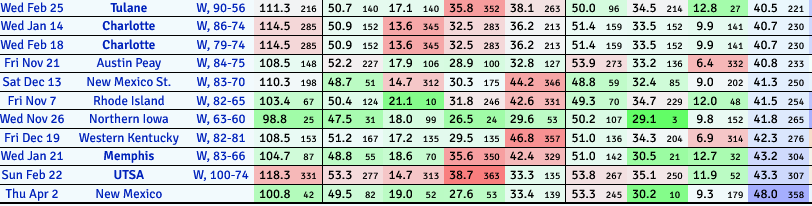
Tulsa meanwhile is more conservative defensively, typically sitting back in drop coverage, but they've had major issues defending high end PNR offenses (see Wichita State series, FAU, USF, and SFA in the first round of this tournament), and UNM is a high end PNR offense, especially with their 99th percentile use of roll/pop. Both offenses should be able to score here assuming they take to the Hinkle environs.
- Illinois State is the only NIT semifinalist to have won a game on the road in this tournament, and should have a strong crowd contingent in Indy. I noted ahead of this tournament that ISUred desperately needed Johnny Kinziger to rediscover his jump shot if they wanted to make a run to Indy, and he's had his best shooting stretch of the year (11-23 from 3) in what has been a trying year for him. Auburn has struggled to defend at the rim and in particular the post all season (4th percentile efficiency rating in post defense), which isn't ideal against Chase Walker and an ISU offense that filters offense through the post at an 85th percentile rate and now has the options around Walker's paint gravity to exploit Auburn's 64th percentile unguarded catch and shoot rate allowed (and opponents have rarely missed their catch and shoots against the Tigers all season). Elijah Price just had a career game in the post against Auburn, scoring 1.6 PPP on post possessions in Nevada's near comeback against the Tigers. Auburn meanwhile has seen Filip Jovic take full advantage of KeShawn Murphy's opt out, scoring 30 points the last two games, which is more than his previous 9 games combined. The problem is that he's allowed 1.5 PPP in the post- that's a 1st percentile grade out per Synergy data. That said, Pettiford's ball screen and dribble creation could have devastating effects against a pretty devout ISUred drop coverage with the paint bound Walker, and they have no one for Keyshawn Hall's isolations. ISUred has been an elite defensive rebounding team (best in the Valley, top 15 DREB% nationally, per KenPom), which is important against Auburn's athleticism and glass crashing. But in ISU's one top 50 game this season they allowed 19 offensive rebounds on a massive 63% rate to Utah State. Probably simply not enough horses from an athleticism standpoint for the Redbirds, and too many matchup advantages on the ball for the Tigers. We've also seen Auburn try to hand back the game after building big leads against Seattle and Nevada the past two rounds.
