


If there is a team in this year's Final Four that wasn't supposed to be here, it's UConn.
And yes, I understand that's an absurd thing to say about a program that has won two of the last three national championships, but it's true.
The Huskies were 7-4 in their last 11 games prior to the NCAA Tournament, a stretch that included humbling defeats to both Creighton and Marquette before losing by 20 to St. John's in the Big East Tournament title game. Then they were in a dogfight with 15-seed Furman, nearly blew a 19-point lead against Michigan State in the Sweet 16, and trailed Duke by 19 points in the Elite Eight.
But the Huskies survived all of that, the highlight being Braylon Mullins' epic game-winner.
"It takes a strong team, a tough team with tough men," UConn coach Dan Hurley said after beating the Blue Devils. "We run a very intense program. We're on these guys. We stress them in practice.
"We put a lot of pressure on them on a daily basis, to do the right things, to do everything at game speed, to do everything hard, to do everything tough and to be prepared, because that's what it takes to win games like this."
Now, UConn is two wins away from claiming its third national championship in four years.
- Tuck Clarry on UConn peaking at the right time
- Scout Team's preseason view on Silas Demary at UConn
- Sam Federman on UConn representing the spirit of the Big East
UConn's offense
BPR Report per EvanMiya:
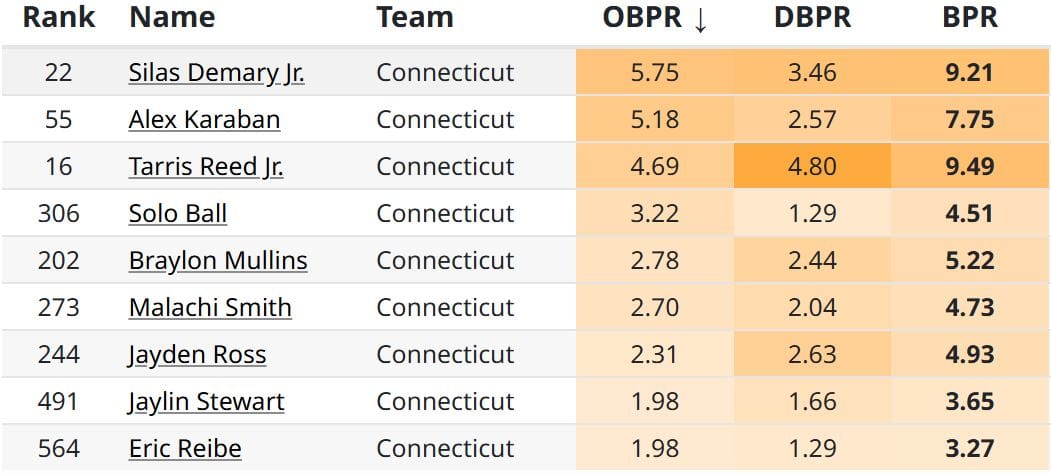
UConn’s offense is still one of the most structurally sophisticated systems in college basketball, which is part of what makes them so dangerous this late in the season.
It is not always overwhelming in the way their best teams have been over the last few years, but it is still incredibly difficult to guard because of how organized everything is. There is very little wasted movement. When UConn is at its best, every possession feels connected.
That is what has worked.
Yet in the NCAA Tournament, everything has centered around their center, Tarris Reed.
Already a high-usage player, Reed's post-ups have become a staple of every offensive possession in the Big Dance. Increased usage has correlated with increased production and increased efficiency — and he has also taken the uptick in opportunities to showcase more of his passing chops, too.

The Huskies still do an excellent job creating quality looks without needing Reed —or anyone else — to dominate the ball for 20 seconds. Reed gives them real interior gravity that forces help, opening up for the rest of the lineup.
Alex Karaban’s feel remains a huge part of the machine, and when the ball starts moving side to side, UConn can still create the kind of clean catch-and-shoot chances that break defenses over the course of 40 minutes. Karaban is a career 37.7 percent three-point shooter while Solo Ball, who has been inconsistent from long range this season, was a 41.4 percent sniper a season ago. Mullins is a lethal shooter, too, but his inconsistencies can be credited to his lack of experience.
They are also strong enough offensively to survive games that are played in the half court, which is because of the way Silas Demary and Malachi Smith can get into the paint off the bounce. Demary led the Big East in assist rate this year because of how effective he is at reading defenses. It just so happens that he also led the conference in three-point shooting, too, making 47.3 percent of his attempts in league play.
But this offense has not been quite as airtight as the championship versions because of the aforementioned inconsistencies, and that matters heading into the Final Four.
UConn can absolutely bury you when the ball is popping and the shooters are in rhythm, but there have also been stretches this season where the spacing has not felt nearly as threatening. And when that happens, the whole offense changes. Post entries get more crowded and there's a lot more overpassing.
That is probably the clearest way to describe where UConn is offensively right now: they are still precise, still disciplined, still capable of controlling a game with execution, but they are a little more vulnerable to stagnation than the very best Hurley teams have been.
UConn's defense
BPR Report per EvanMiya:
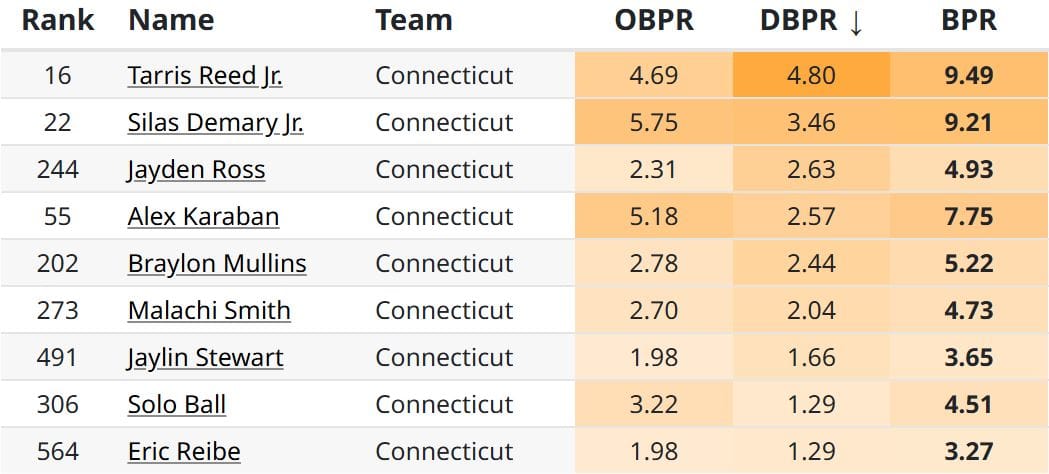
UConn's defense has been the constant with Dan Hurley’s program for several years now.
The Huskies don’t just defend hard — they defend with elite connectivity. Hurley’s teams play a version of man-to-man that looks almost like a shifting zone at times, with defenders constantly shrinking space around the ball. It forces offenses to operate in tight windows. Passes that feel open against most teams suddenly aren’t against UConn.
That connectivity shows up most clearly around the rim.
UConn’s defensive identity still starts with size and physicality in the paint. Reed is a deterrent and physical presence capable of walling off the likes of Cameron Boozer. He ranked 26th nationally in block rate on the season, and 7-foot-1 freshman Eric Reibe was only slightly behind him. That duo forms an elite unit that sits among the nation's best in every metric designed to measure interior defense.
And that is the real goal of the system. UConn doesn’t necessarily hunt blocks or steals (though the blocks come as a byproduct of rim protection) — they hunt bad shots.
Opponents often end up settling for contested jumpers late in the clock because they can't get to the rim effectively. Hurley’s teams are comfortable forcing possessions deep and trusting that the final shot will be lower quality than the offense wanted.
And, as good as UConn is at the rim, its perimeter defense is the special sauce.
UConn’s guards do a strong job of keeping the ball in front and funneling drivers toward help rather than giving up clean downhill lanes. They aren’t overly aggressive chasing steals — they choose to prioritize positioning and angles. That might not produce highlight plays, but it prevents the kind of breakdowns that lead to easy baskets.
It also keeps the entire defense intact.
You need size, versatility, and quickness to accomplish that, and this UConn roster has that in spades.
Demary ranks among the nation's best point-of-attack defenders, while Smith has a reputation as a defensive pest going back to his days at Dayton. Karaban's defense is underrated, too, and has shown the ability to adequately guard opponents both on the perimeter and on the block.
But the defensive end is where Jayden Ross and Jaylin Stewart become extra impactful. Both 6-foot-7 juniors have those size, length, and quickness attributes to be elite perimeter defenders capable of disrupting opposing wing players in a way no one else on the roster can.
There are also two principles UConn sticks to that increase the impact of its defense. For starters, they prioritize defensive rebounding and limiting second-chance points. Reed has been a beast in this area, particularly in the NCAA Tournament. The second is limiting transition baskets for opponents. The Huskies rank in the top-50 nationally in fast break defense, meaning they don't let their opponents get a lot of easy baskets in transition.
That combination is why their defensive numbers have remained among the better groups in the country. UConn consistently holds opponents in the mid-60s scoring range, and more importantly, many of those points come from difficult half-court possessions rather than easy offense.
Their defense doesn’t rely on one star stopper. It relies on five players moving in sync, shrinking the floor, and forcing opponents into decisions they don’t want to make.
Vulnerabilities
For all the things UConn does well, this team does have pressure points. The first vulnerability is offensive firepower.
UConn’s offense is efficient, but it isn’t overwhelming. The Huskies average 77.1 points per game, which ranks only around the middle of Division I nationally. That doesn’t mean the offense is bad — their 116.8 offensive rating still reflects a strong half-court system — but it does mean they rarely blow teams out purely with scoring.
That creates tighter margins in tournament games. If the opponent can keep the Huskies out of transition and out of rhythm, UConn sometimes has to grind through long scoring droughts (see what happened for most of that Elite Eight game against Duke).
Closely tied to that issue is the volatility of their perimeter shooting.
UConn’s spacing system relies heavily on wings like Ball and Mullins stretching the floor. But there have been stretches this season where those shots simply haven’t fallen.
When that's the case, the offense compresses and what normally looks like smooth ball movement can turn into a possession where UConn is forced into contested jumpers late in the clock.
Another vulnerability shows up in ball security.
Even in games they’ve controlled, players and coaches have acknowledged that turnovers can creep into their performances. UConn is just 179th in turnover rate on the season as both Demary and Smith have had times where they're too loose with the ball.
That’s not a constant problem, but it’s one that appears when UConn is out of its rhythm and the point guards are trying to force the issue.
Finally, there is the structural vulnerability that comes with UConn’s style — the Huskies don't get to the foul line a lot, and they do send their opponents there at a high clip.
When you have an offensive system that is as fluid and motion-heavy as UConn's, you're going to rely on precision over brute force. That kind of brute force may get you to the foul line, but the Huskies are more content to kick the ball back out and continue running their sets in hopes of getting a cleaner look. Again, that works well in theory, but it can leave points on the board.
Defensively, the Huskies simply foul a lot. Reibe, for all his shot-blocking prowess, can get into trouble chasing those blocks. The same is true for Reed. Mullins sometimes gets targeted for his lack of perimeter foot speed, and that has led to him committing 4.1 fouls per 40 minutes. Ross and Stewart are in a similar ballpark, but their fouls largely come from being too aggressive.
UConn is usually good enough to overcome that fouling, but giving opponents free opportunities for points is never a good thing.
None of this means the Huskies are flawed enough to be dismissed. Their statistical profile still shows a team with a top-tier defense (about 65 points allowed per game) and strong overall efficiency metrics.
But it does reveal the path against them.
If an opponent can stay attached to shooters, force turnovers, and get to the foul line, the Huskies suddenly look far less comfortable.
How they match up with Illinois
The UConn–Illinois semifinal is one of the most interesting clashes in the tournament.
Illinois arrives with the most explosive offense in the country, a group that spreads the floor and fires from deep at one of the highest rates in Division I. Nearly half of the Illini’s shots come from three, and when that rhythm takes hold, the game can flip quickly.
Illinois is also one of the best offensive rebounding teams in the country, and that matters against UConn because second chances are one of the few ways to break the Huskies’ defensive structure. Hurley’s defense is built on forcing teams into tough shots and then finishing possessions with rebounds. If Illinois starts extending possessions, the pressure on UConn’s defense multiplies quickly.
At the same time, the matchup also plays directly into some of UConn’s strengths.
The Huskies are extremely good at protecting the paint and forcing opponents into uncomfortable scoring areas. Illinois is efficient finishing inside, but UConn’s interior defense has consistently turned those attempts into contested looks. If the Huskies can hold their ground in the paint and keep Illinois from dominating the glass, they can force the game into a more perimeter-heavy attack.
When UConn has the ball, the dynamic shifts again.
Illinois doesn’t generate much disruption defensively. They rarely force turnovers, which means UConn should be able to run its offense the way it prefers — with patience, ball movement, and multiple actions within a possession. That’s exactly the environment where Hurley’s system tends to thrive.
The one area where Illinois does hold a structural advantage is fouling. UConn already struggles to get to the free-throw line, and Illinois is one of the best teams in the country at keeping opponents off it. That combination could make it harder for the Huskies to find easy points if the jump shots aren’t falling.
