

In a year where Division-I teams have absolutely crushed the offensive efficiency record dating back to 1996-97, it's the Illinois Fighting Illini that stand above the rest as the single-best offensive unit by adjusted efficiency not only this year, but of all-time.
But it certainly took a while to get there. To start the month of December, Illinois ranked 17th in KenPom with the country's 16th-best offense. Both its overall rating and offensive rank fell significant from the start of the season. It was fresh off its worst loss of the season, a 74-61 defeat to UConn. It's funny how these things work.
To explain how Illinois' season has changed since then can be as easy as just looking at the box score between that UConn game and its most recent contest against Iowa.
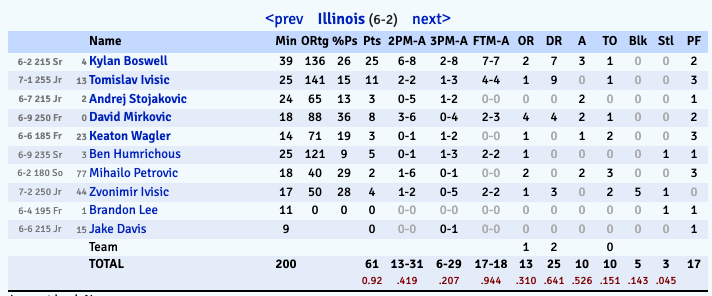
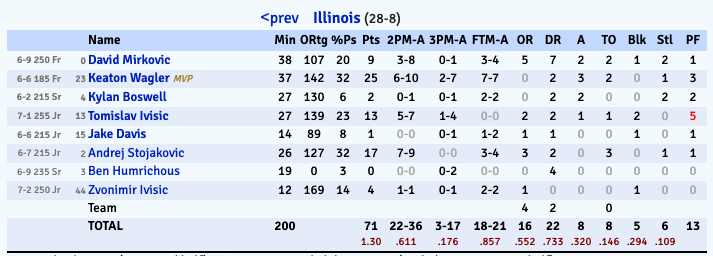
Today, Keaton Wagler is one of the best players in America. Back then, Wagler was struggling mightily as a freshman adjusting to major level hoops, scoring a combined 22 points on 6-of-21 shooting in his three power conference games. He was supplemented by Serbian guard Mihailo Petrovic, who has since fallen out of the rotation.
Sharpshooter Jake Davis saw fewer minutes and was splitting time with freshman Brandon Lee, who is also not currently in the rotation. Tomislav Ivisic was working his way back from injury. Kylan Boswell led the team in usage, before falling to fifth in Big Ten play.
Including the contest against the super slow Huskies, all of Illinois' games in November were at least 66 possessions. They have topped that number in just seven of their 28 games since.
In a portal era where rosters change every year, none of the four teams remaining in the NCAA Tournament have come close to morphing as much in-season as this Illinois squad.
To supplement this reading, take a look at what some of our experts at Basket Under Review have said about Illinois throughout the season:
Illinois on Offense
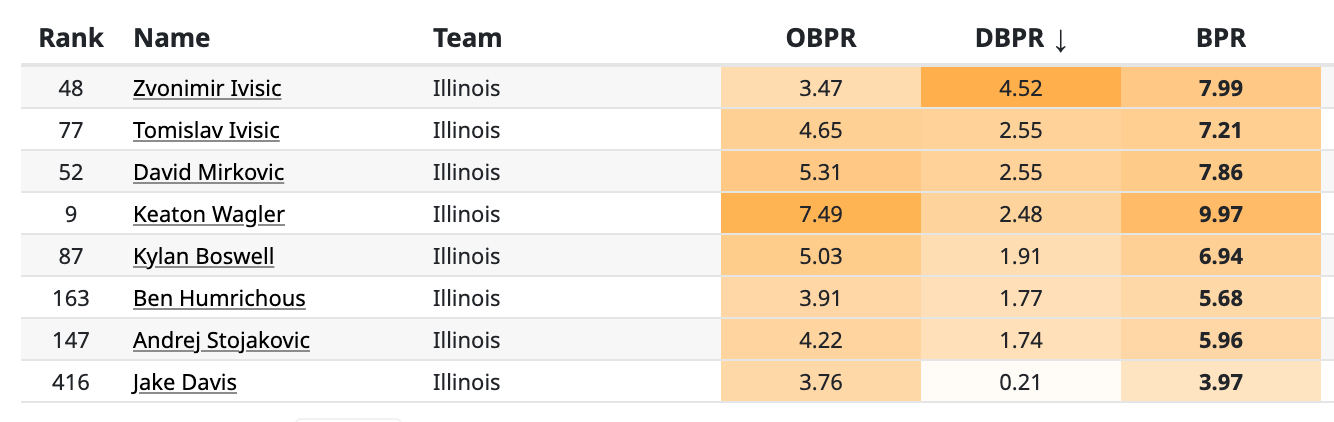
OBPR Report per EvanMiya
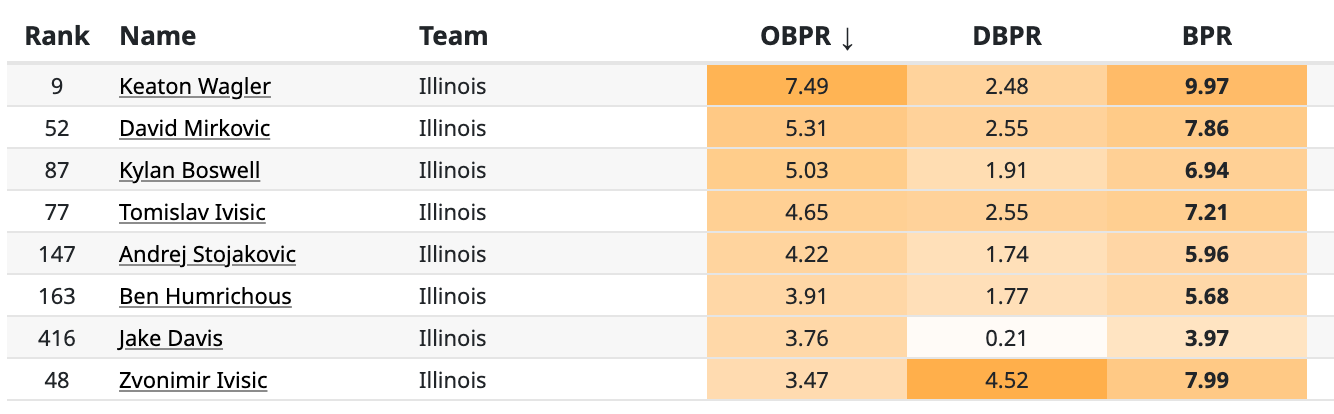
I have been fascinated all tournament long about the extremely interesting role allocation Illinois' offense has morphed into over the last couple of months. So rather just specifically highlighting players individually, I'm going to morph them into four groups.
Group One: Head of the Snake
Keaton Wagler
Boy has Wagler come a long way from that highly-touted freshman struggling in big games to where he is now. Wagler's possession usage was over 5% higher than any other Illini teammate in Big Ten play. He took 14 more twos, 27 more threes, and 58 more free throws than anyone else on the roster over that span. Outside of two stinkers against Maryland and Michigan State, he's had an offensive rating over 104 in every single game since the start of December.
Wagler is an exceptionally versatile jump shooter, who has split his catch-and-shoot threes and dribble jumper threes nearly 50/50, and shoots almost exactly 40% on both types of shot.
That major threat opens up his driving game, which is not elite, but certainly passable, especially with his ability to draw fouls.
Wagler is also the team's leader in assists in conference play with more than double the second-most on the roster. Illinois has morphed into an offense more focused on exploiting individual matchups than some of the more motion-based offenses Underwood has run in the past, but Wagler is still more than capable of making the right read, even if it's not a flashy one.
Wagler is undisputedly the offensive engine for Illinois, and his play style embodies this offense. Deliberate, solid, and selectively extravagant.
Group Two: Options 2A and 2B
David Mirkovic and Andrej Stojakovic
Outside of the fact that their last names end in the same five letters and they both have Balkan heritage, there really aren't many similarities between Mirkovic and Stojakovic. And that's probably what makes them equally as effective as second options next to Wagler.
There have been lazy comparisons for Mirkovic to players like Nikola Jokic and Luka Doncic in the NBA, but what I do think all three players share is their ability to make it feel like they can individually control the flow and pace of a game just by possessing the basketball.
In numbers, Illinois is a whole 3.4 possessions per 100 slower with Mirkovic on the floor versus off, in the 96th% of slowest on/offs nationally. In film, Mirkovic can seemingly get to his spot whenever he desires, and it often seems like he knows what he wants to do on a play just by reading the defense at halfcourt.
There is very possibly not a better processor in college basketball than Mirkovic.
On the other side of the spectrum, Illinois is nearly two possessions faster with Stojakovic on the floor. Despite being the team's fifth-biggest player, he leads the team in rim points by a fair margin. He's second-last on the team in assist-to-turnover ratio and assist-to-field goal ratio, yet still one of their most important players.
Every good offense needs to have rim pressure. With Wagler and Mirkovic more on-ball creators and multiple 3-point specialists on the roster, it can allow a defense to overhelp and blow up perimeter action. Stojakovic's straight-line driving ability completely changes that dynamic, and was seen multiple times in the Iowa game.
The play above perfectly embodies Stojakovic's value to Illinois. Iowa desperately needs a stop here, and do a great job of blowing up the Wagler/Mirkovic two-man game, before smartly switching Cam Manyawu onto Wagler on the subsequent pick-and-roll. Illinois has nothing going offensively and haven't gotten the ball closer than 30 feet from the hoop until Stojakovic catches the ball, makes a decisive downhill move, and essentially ices the game with an and-one.
Call it a pressure release, call it a fastball in a slow pitcher's arsenal, call it whatever you want. But whether it's cerebral Mirkovic or rocketship Stojakovic, those two vastly different offensive profiles are the perfect second options to have around Wagler.
Group Three: Connective Pieces
Kylan Boswell and Tomislav Ivisic
There have been two Kylan Boswells this season: pre and post-injury. The Boswell before he missed a month from mid-January to mid-February was very much in category one or two, but Wagler's breakout happening while Boswell was sidelined changed everything.
Before his injury, Boswell averaged 10 shots per game with a 44% 3-point rate and a 2.5:1 assist to turnover ratio. After the injury, he's averaged 8.2 shots per game with a 39% 3-point rate and a 3.2:1 assist to turnover ratio. Most notably, Boswell took 3.2 dribble threes per game before getting hurt, and 2.4 per game after the injury.
Boswell has missed eight straights shots in the NCAA Tournament and yet has been a critical piece to Illinois' success because he's retooled his game to be a connector. His assists this tournament have led to:
- 5 open Catch-and-Shoot Threes
- 1 paint touch layup
- 1 transition dunk (the nasty Big Z one)
Boswell is Illinois' best guard at getting two feet into the paint, and it opens up the rest of the offense. Once perceived as this team's go-to guy, he's now best as the third or fourth option on the floor.
Similar to Boswell, the returning Ivisic's usage has diminished from last year, where he burst onto the scene in his first year of college hoops. But more than that, his shot profile has also changed. His 3-point rate has soared from 49% last year to 59% this year, and despite the fact that his long range efficiency has fallen off dramatically, he is still has a higher offensive rating and effective field goal percentage from last year.
How is that possible? For one, he's leading the entire country in rim field goal percentage (min. 1 attempt per game) at an absurd 87.5%. 56 makes, eight misses. But when you watch those attempts, it makes sense. 48 of his 56 makes are either off offensive rebounds or off assists. Baskets that look like this.
Ivisic's rim profile is so clean largely because he doesn't even spend that much time there, hence the increased 3-point rate. And yet, Illinois doesn't want him out there because he's some sort of sniper (more of the opposite if anything), but because his passing as a hub big is fantastic.
I am pretty certain Ivisic has taken more dribbles with his back to his basket than him facing the basket this season. He's either getting rid of the ball immediately after he catches it via the shot or the pass, or bullying his way to the hoop where he either gets all the way to the rim, or finds the open player if a second defender comes or someone gets caught ball watching.
Ivisic and Boswell have spent the full year adjusting to their new roles after being featured more prominently earlier in the season and last year, but it's no surprise that once those two found their stride as connective pieces, Illinois' offense began to look unstoppable.
Group Four: Play Finishers
Jake Davis, Ben Humrichous, Zvonimir Ivisic
421 Catch-and-Shoot threes
19 Dribble threes
101 Rim attempts
8 Non-Rim 2-point attempts
65 assists
30 turnovers
Those are the combined stats of three of the most distinct offensive specialists in the country. Ivisic (the Kentucky/Arkansas transfer), Davis, and Humrichous are all in the Top 100 of individual offensive rating nationally by playing their roles to absolute perfection.
I've already had a lot to say on Humrichous and Davis' absurdly low turnover numbers this season, and for good reason. They have been historically mistake-free.
Ben Humrichous is having one of the truly wild statistical seasons in modern college basketball.
— Matthew Winick (@matthewwinick) March 29, 2026
He has six!!! turnovers in 808 minutes this year. That is the fewest number for any player with that many minutes in the 21st century. https://t.co/qZrABixVy6
By the way, if you drop the mins from 800+ to 700+, the only players to have 6 or fewer TOs in the 21st Century:
— Matthew Winick (@matthewwinick) March 30, 2026
Ben Humrichous, 2025-26 Illinois
Jake Davis, 2025-26 Illinois
Josh Kozinski, 20215-16 C. Michigan
Davis + Humrichous alone would be 6th in fewest TOs this season. https://t.co/joxgaUuzZ7
Most of that comes from the fact that neither Humrichous or Davis are basically ever tasked with dribbling the basketball. Their sole job is to space the floor for the uniquely talented and versatile Illinois players, keep their defender out of the paint, and make the opponent pay if they help off too far.
There are no ways to track dribbles for college basketball players as far as I'm concerned, but at minimum, I can tell you that on the 22 possessions that those two guys have taken up in the NCAA Tournament so far, they have combined for three total dribbles, and have had the ball in their hands for more than one total second one time.
Even in just the few clips I have already linked in this video, here are my three favorite stills of what just the threat of Davis + Humrichous do to a defense.
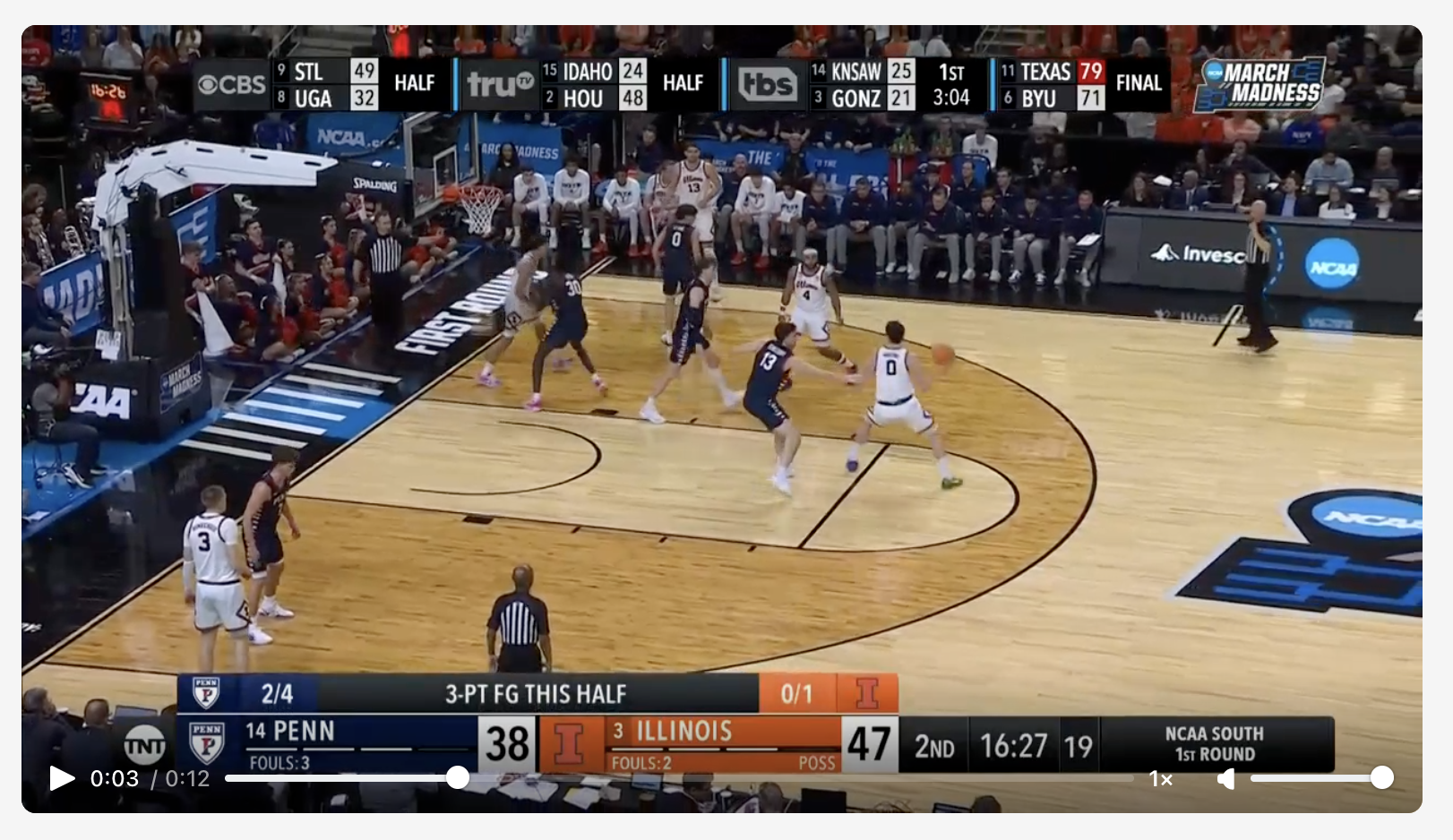
Penn gives Mirkovic an entire side of the floor to work with because they refuse to play off Humrichous whatsoever.
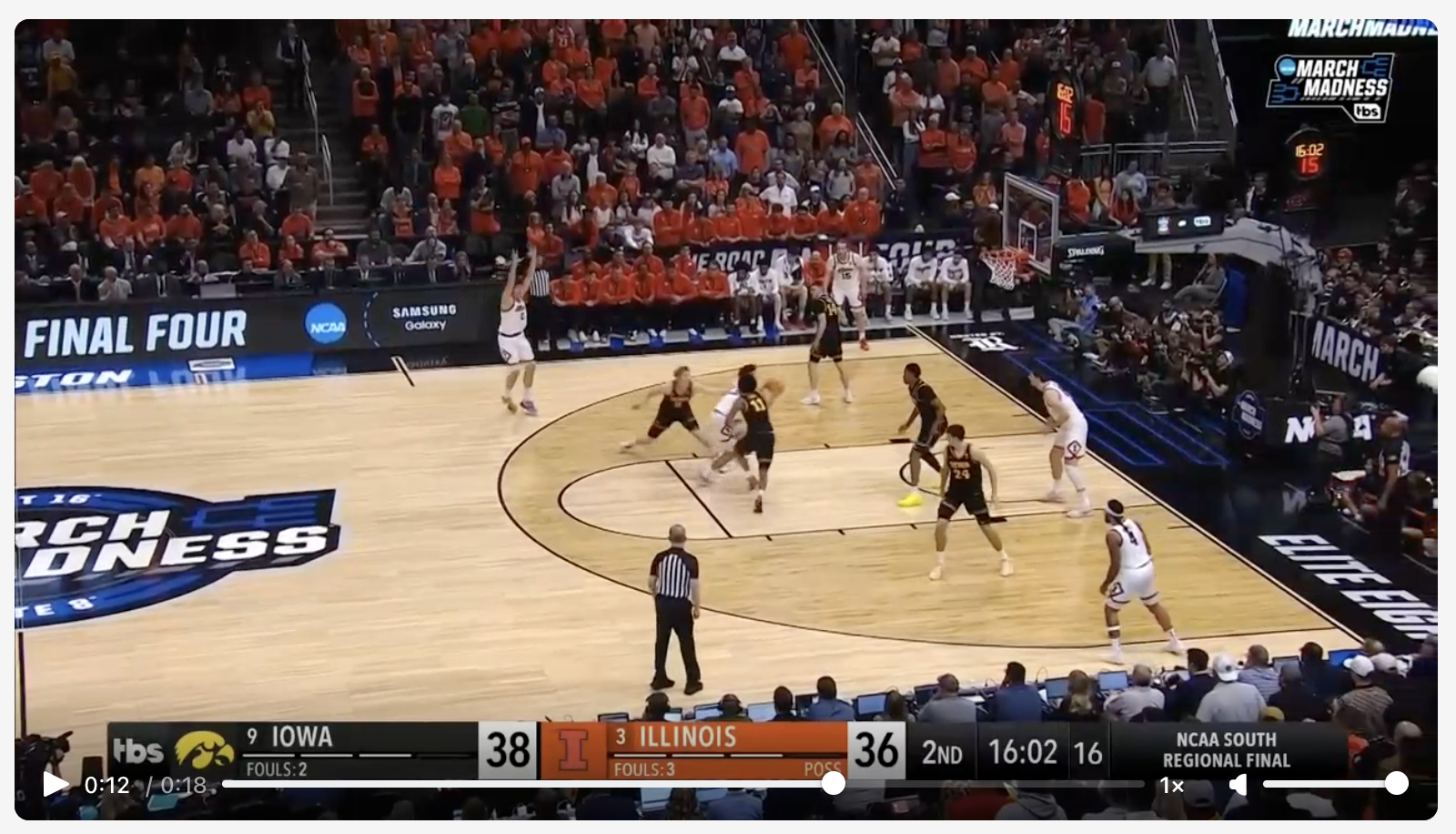
Bennett Stirtz doesn't notice Wagler's drive on his side quick enough because he's too busy keeping an eye on Davis in the corner.
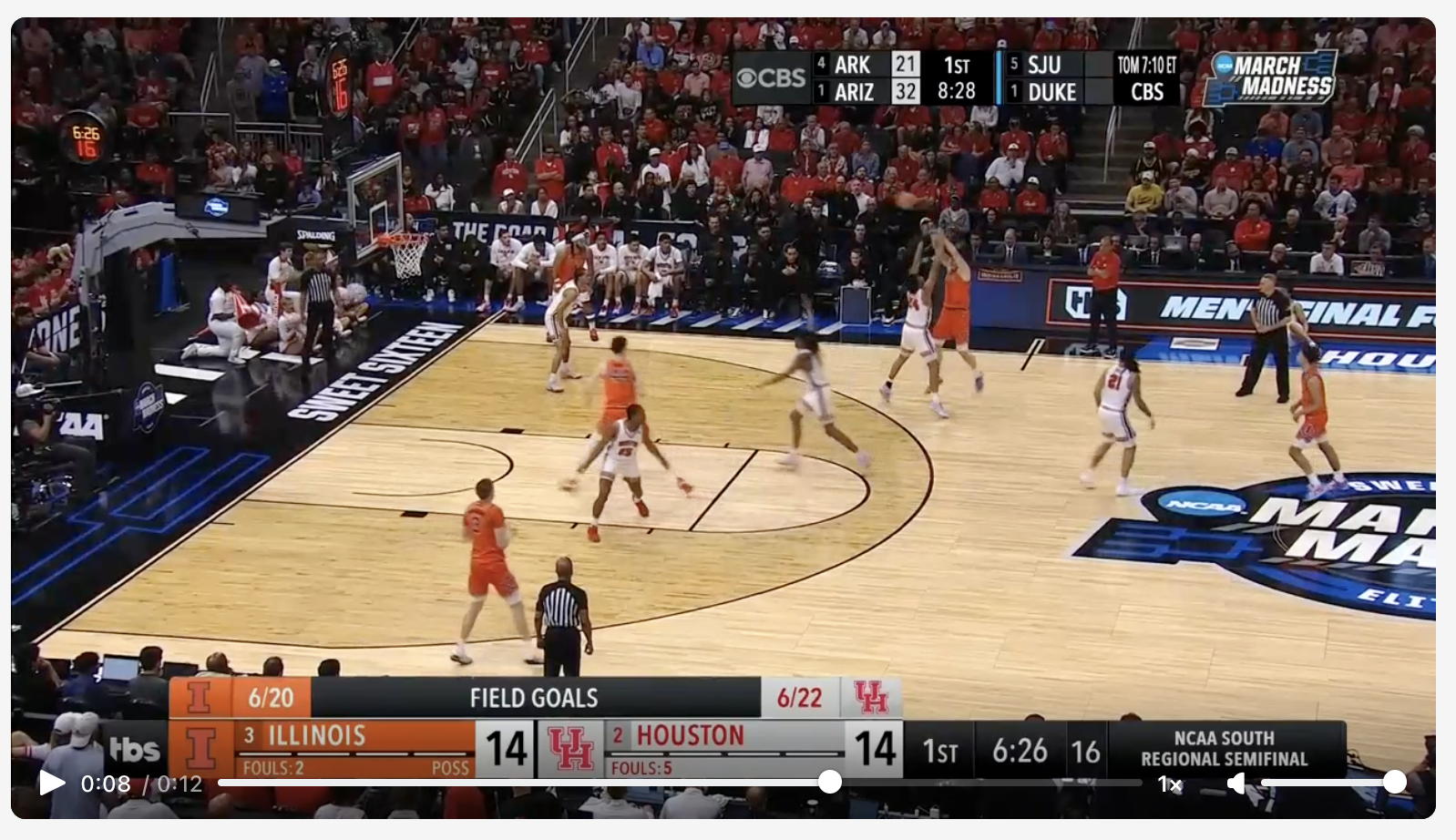
Houston's Mercy Miller is more concerned about closing out for a Humrichous cross-court three than tagging the wide-open 7-foot-2 dunking machine rolling to the hoop.
That brings us to Ivisic, one of the most unique and absurd players in the country. He leads the nation dunking 68% of his rim attempts (amongst qualified players). He's fourth in the country in block percentage. He's also one of only 16 players with an assist rate under 3%. In other words, he has 13 more dunks than assists and turnovers combined. He is on the floor to take an open three, dunk off an assist from his teammate, or get the ball out of his hands immediately.
Having the sport's premier dunker and two of its best low-usage spacers is truly the underrated part of Illinois' offense. Yes, Wagler's brilliance, Mirkovic's versatility, Stojakovic's downhill attack, and Boswell/Ivisic's connectivity is what is usually apparent, but that is all set up with the spacing, gravity, and rim pressure of Humrichous, Davis, and Ivisic.
Illinois Defense
DBPR Report per EvanMiya
While trying to be more brief defensively than my offensive deep dive, it's worth noting that Illinois' defensive unit is less dominant than the other end of the floor, but equally as unique. Whenever you rank first and last out of 365 teams in one of the defensive four factors, it is something extremely notable.
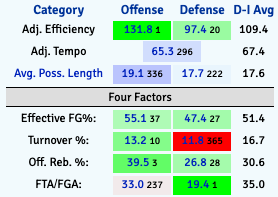
The two numbers are largely a byproduct of each other. Illinois is dead-last in turnover rate because it never pressures, and No. 1 in free throw attempt rate because it never pressures. On the flipside, Abilene Christian was second in turnover rate and last in free throw rate. It's quite correlated.
Underwood's defensive philosophy underwent one major shift this offseason. He had been in the Top 50 of lowest 3-point rate allowed in six straight seasons, sitting in the Top 10 in three of the last four years. But this year Illinois is 300th in 3-point rate allowed.
The Fighting Illini have sacrificed allowing more threes for the benefit of allowing fewer rim attempts. They allowed between 38% and 39% of opponents shots at the rim over the previous three years, but are all the way down to 31% this year, the fifth-lowest rate in the country.
Because Illinois is the single-tallest team in the nation across all five positions, but certainly not the most athletic, the concept is simple. Deny driving lanes, keep the ball in front, try not to help, and force shots to be taken over length.
When the team does allow open threes, its lack of pressure and focus on individual matchups allows it to dictate who they want taking those looks. Illinois allowed 16 open jumpers in its wins over Houston and Iowa last weekend. Let's see who took those attempts:
- Chase McCarty x4 (36%)
- Chris Cenac x4 (33%)
- Milos Uzan x2 (34%)
- Mercy Miller (34%)
- Isaia Howard x2 (28%)
- Alvaro Folgueiras (33%)
- Kael Combs (33%)
- Bennett Stirtz (36%)
Houston and Iowa's two best 3-point shooters combined to take just one open three in two games (Stirtz). The rest were basically all guys Illinois was willing to let fire away. In exchange, that Fighting Illini soft coverage allowed just 20 total rim attempts between those two contests.
Not to dive into massive Division I defensive trends, but I think Illinois is ahead of the curve here. Allowing more threes, but trying to force them to come unassisted off the dribble, while forcing the open ones to be taken by bad shooters, all culminating in fewer rim attempts allowed as a by-product, is the smartest way to play defense when you have the size to execute it.
Even Zvonimir Ivisic, one of the best shot blockers in the nation, picks up more of his blocks on-ball than as a weak side help defender. Because Illinois helps so rarely and keeps the ball in front with a less aggressive approach, he's rarely in weak side scenarios to begin with.
Above is one of my favorite defensive possessions from the Iowa game. Illinois never sends two to the ball, Iowa can never create a matchup advantage, Iowa has no interest in attacking to massive Ivisic, and then the Hawkeyes settle for a heavily contested deep 3-pointer. In a tie game with 10 minutes left in the Elite Eight, it doesn't get much better than this.
It's not all sunshine and rainbows defensively however, which is why Illinois ranks just 20th. Because the team relies so heavily on forcing difficult shots and never forcing turnovers, they will lose if a team has a monster shooting game. In the four contests where they allowed an effective field goal percentage over 58%, they allow a whopping 1.3, 1.27, 1.31, and 1.3 points per possession. Sometimes teams just get in a rhythm one night, and Illinois doesn't have the ability to do much when that happens.
How they match up against UConn
As I mentioned at the very top, I think we need to throw away these teams' first meeting back in November. Illinois' minutes, usage, and roles were entirely different back then.
Offensively, Illinois' matchup-based approach will have plenty of opportunities to find advantages. UConn's defense doesn't really trap or double, and try to force lots of isolation. Mirkovic being defended by Alex Karaban in particular stands out as a matchup Illinois will look to exploit. Karaban is a good defender, but is not as big or strong. Stojakovic matched up on Solo Ball or Braylon Mullins is another example.
This may not end up being the biggest Wagler game, as UConn will likely throw its best perimeter defenders on him, and aggressively take away his jump shot and force him to get downhill instead, where he's not as good. UConn will try to do much of what Iowa did - where the Illini had their second-lowest 3-point rate and assist rates of the season. Obviously Illinois had no issues with that scheme, but UConn is way bigger and more physical than the Hawkeyes.
On the other end, Illinois' drive denial doesn't really matter against a UConn team that drives the ball as little as anyone in the country. UConn's motion-based scheme is all perimeter screening action 1-through-4 with Tarris Reed as a heavy-usage post player down low.
The Fighting Illini never double the post, yet still rarely allow post ups because no one really wants to try backing it down on a 7-footer. But it's worth noting that the best post-up player Illinois has played all year, JT Toppin, scored 35 points on 25 shots on them. Granted there was no Tomislav Ivisic. But it would not surprise me if Reed gets up at least 20 shots with how Illinois will try and defend him. If the Fighting Illini have to send doubles, they're in big trouble. That's not how they play.
This game is also going to be exceptionally slow. No team wants to run in transition, and there will be very few run-out opportunities off live-ball turnovers. A halfcourt execution battle likely favors Illinois, especially with how much bigger and multi-faceted they are at basically every position. I can see a world where UConn's overplaying and physicality throws Illinois off its game, and if the Huskies hit their contest threes they've been missing for weeks now, it could change everything.
We'll have much more on the UConn/Illinois matchup throughout the week here at Basket Under Review, so stay tuned!
